European theatre of World War II
| European theatre of World War II | |||||||
|---|---|---|---|---|---|---|---|
| Part of World War II | |||||||
| |||||||
| |||||||
| Belligerents | |||||||
|
Allies: |
Axis: | ||||||
| Commanders and leaders | |||||||
| |||||||
| Strength | |||||||
| 44,150,000+ total[1][2][3] |
 18,000,000+ total[4][5][3]  2,560,000 total[6] | ||||||
| Casualties and losses | |||||||
|
Killed: 9,007,590–10,338,576 Captured: 5,778,680[nb 9][nb 10][11] |
Killed: 5,406,110–5,798,110[nb 11][12][13] Captured: 8,709,840[13][nb 12] | ||||||
| 19,650,000–25,650,000 civilians killed[nb 13][24] | |||||||
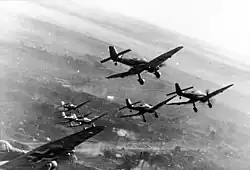
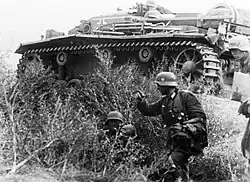
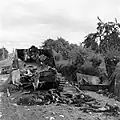
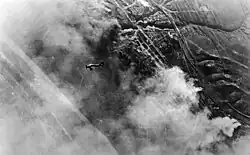

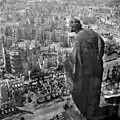
The European theatre of World War II, was a major theatre of operations during World War II
History
1939 – 1940
On 1 September 1939, Germany and Slovakia Invaded Poland. which is consider to be the start of the Second world war. two days later, the French colonial empire and the United Kingdom declared war on Germany after their ultimatums had expired. on the 17th, the USSR Invaded Poland from the east and managed to link up with the German units in a few days. on 6 October 1939, Poland was fully conquered and divided between Germany and the USSR.
After the Poland Campaign, the war between Germany and the the Western Allies would see no fighting for the rest of the year and what became known as the Phoney War. where both sides prepared for more fighting. in Eastern Europe, the USSR was allowed to build military bases the Baltic states after forcing them to allow them to do so. then the USSR tried to force Finland to allow them to have bases in their country. but Finland kept refusing every ultimatum. so on 30 November 1939, the USSR invaded Finland. for month leading into 1940, the Finnish were successful in preventing the country from falling to the Red Army but had to give the Soviets some land to end the war on 13 March 1940.
The Phoney War ended on 9 April 1940 when Germany started Operation Weserübung against Denmark and Norway. Denmark fell in 6 hours and the Norwegian capital Oslo became one of the first places in Norway to fall to the German Wehrmacht. on 10 May, due to the failure of stopping the invasions, British Prime Minister Neville Chamberlain resigned and Winston Churchill succeeded him in the position. but on the same day however, Germany launched invasions against France, Belgium, Luxembourg, and the Netherlands. Luxembourg fell first fully, then the Netherlands, then Belgium. from May to June, the Allies evacuated most of their forces in the North of France to Britain. on 10 June, Italy declared war on France and the UK and joined the Axis alliance. on the 22nd France surrendered to the Axis and became a puppet state called Vichy France. most of the South was governed by the Vichy government while the North was occupied by the German Army.
Meanwhile in the East, the USSR invaded and annexed the Baltics and Bessarabia from Romania.
With most Western European countries now under military occupation, Germany started building defences on the Coasts of the countries in what became known as the Atlantic Wall. the German Luftwaffe (air force) started bombing the UK in hopes of the country surrendering. but the UK never surrendered during the bombings and they eventually stopped.
On 28 October 1940, after building tensions with Greece, Italy invaded Greece from Italian-held Albania. however, Greece pushed back Italian forces back to Albania. in late November, the Axis grew more with Hungary and Romania joining.
1941 – 1942
For the first months of 1941, there was no major breakthrough from Greece or Italy on the Albanian Front. but the Axis would see more countries joining in March like Bulgaria and Yugoslavia. but the pro-Axis Yugoslav government was overthrown after two days of Yugoslavia being an Axis member. so on 6 April 1941, Germany, Italy, and Hungary Invaded Yugoslavia. fighting lasted for more than a week until Yugoslavia surrendered to the axis and was divided between Germany, Italy, Hungary, Bulgaria, and Italian Albania. the Axis also formed new puppet states including the Government of National Salvation in Serbia, Montenegro, the Independent State of Croatia. then the Axis conquered Greece at the end of the month, forming the puppet state called the Hellenic State, and ending the Balkans campaign.
On 22 June, after months of preparation, Germany invaded the USSR and the Molotov-Ribbentrop pact that was signed between the two countries ended then. the Soviets armies would see defeats at Smolensk, Kyiv, Odesa, and other major sites across the Western SSR's. the German army was also helped by the armies of Romania, Italy, Hungary, and Finland. Finland had allied with the Axis to retake land from 1940 and invaded the USSR from the North-West of the country, the Finnish part of the Eastern Front of World War II is known as the Continuation War. Finland was also involved in the Baltic Sea campaign of the war with the Finnish navy fighting with the German and Italian navies against the Soviet navy. the Siege of Leningrad began on September when the city was separated from the main front with German units in the South and Finnish forces in the North. but Leningrad would not fall to the axis. for the last months of the year, the Germans were pushing all the way to Moscow (Soviet capital) and in early December were only a few kilometres away from reaching the city, but the Red Army managed to push the German units more away from Moscow and the war in the Eastern part of the continent would continue even into 1942.
Also in December, with the Japanese Attack on Pearl Harbor, the Axis powers one by one declared war on the United States. which brought the US into the war in Europe.
In the First months of 1942, Soviet forces tried to breaktrough German defences in the North, Centre, and South of the Front but most units were encircled and defeated. on 17 July 1942, the Axis armies started an offensive to take the Caucasus region and its Oil fields. during this offensive, the Axis reach the Soviet city of Stalingrad. starting the Battle for the city itself. on 20 November, the Red Army began Operation Uranus to end the battle in a Soviet victory. in a few days the Soviets managed to trap most Axis forces on the Stalingrad front in an encirclement and pushed back the non-encircled forces more away from the trapped pocket while trying to destroy the pocket.
On 10 November, Vichy France was invaded and occupied by Germany and Italy due to its failures in stopping the Allies in Operation Torch. but the Vichy government was not dissolved.
1943 – 1944
On 2 February 1943, the Battle for Stalingrad ended with a Soviet victory. the Red Army managed to continue to destroy and push axis units out of Soviet territory. until the Soviets were stoped at Kursk. where the biggest Tank battle would begin on 5 July. the battle lasted more than a month before ending on 23 August. after Kursk, the Soviets pushed back the Axis armies even more and liberating Smolensk and Kyiv.
On 9 July 1943, after the successes in North Africa, the Western Allies invaded the Italian island of Sicily. starting the Italian campaign. Italian Prime Minister Benito Mussolini was deposed and was succeeded by Pietro Badoglio. the island was fully taken on 17 August and the Allies would invade Italy on 3 September. due how bad the war was going for them, the Kingdom of Italy surrendered to the Allies. upon hearing this. Adolf Hitler (German Führer) orderd German troops to occupy Italy and occupied parts of Europe. in a few days Mussolini was freed and was appointed as the new leader of the puppet state called the Italian Social Republic.
In the first months of 1944, the Red Army were now in the former Second Polish Republic, ended the siege of Leningrad from the south and pushed back German forces to the old border with Estonia, and entered Romania. Germany also invaded and occupied Hungary in order to prevent them from defecting like Italy did in 1943.
The Battle of Monte Cassino would begin on 17 January and would see much damage to the monastery from the fighting for months until 18 May when Allied forces finally entered the monastery and marched to Rome (Italian capital) and liberated the city on 4 June.
On 6 June, two days after the Rome liberation ended, the Western Allies started the Normandy landings. where mostly British, American, and Canadian forces landed in Northern France as a third front in the European war and was a huge success with the Western Front being re-opened. weeks later on 22 June, the Red Army launched Operation Bagration in the Eastern front to prevent more German forces from being moved to fight in France. fighting in Italy also continued with the allies advancing to the north until being stopped at the Gothic Line. a defence line made by the Axis to stop more advances by the Allies.
In August, the Allies in Normandy managed to break out of normandy and liberated more French territory in the West, on 15 August, mostly French and American forces landed in the South of France and advanced up North.
On 20 August, the Soviets started another offensive that this time, targeted the Axis armies in Romania and managed to get King Michael I to depose the government of Ion Antonescu and leave the Axis and join the Allies. around the same time, on 25 August, Allied forces and French Resistance groups liberated Paris from Axis control and began to advance from Paris to the Rhine. the Allies entered Belgium and liberated major cities like Brussels (Belgian capital), Ghent, and Antwerp.
In early September, the Red Army entered Bulgaria. seeing the opportunity, the Bulgarian resistance deposed the pro-Axis government and Bulgaria changed some from the Axis to the Allies. just like Romania did in August. the Bulgarian military presence in Yugoslav Macedonia and Greece was also withdrawn.
The Allies from Normandy and dragoon would eventually link up with each other in September and would form a line stretching from the Dutch coats to the French border with Switzerland. the Vichy government went into exile in Germany, and Luxembourg was liberated by the US forces. on 17 September, the Allies started Operation Market Garden in the Netherlands to create a path into Germany itself. but the operation would end on 25 September as a defeat of the Allied forces.
In Eastern Europe, the Soviets launched an offensive in to Estonia in September and managed to reach Tallinn (former Estonian capital) and take all Estonian land from the German Army. during the actions in Estonia, Finland signed a peace treaty with the USSR. but the German units in Lapland (North Finland) cooped the region and caused the Finnish and Soviets to forcefully expel the Germans from the region. as the Soviets reached the Norwegian border, the Soviets crossed the border to help the resistance against against Germany and the collaborationist government in Norway. in October, the Soviet managed to trap German forces in Courland in a Pocket. the trapped German forces would never break out and would remain there for the rest of the European theatre until May 1945.
September, October, and November would see lots of fighting in the Balkans. with the Soviet crossing the borders of occupied Yugoslavia to help with the Liberation of the country and Belgrade (Yugoslav capital). the German occupation forces in Greece was evacuated to Yugoslavia and Athens (Greek capital) was liberated by the Greek resistance and British Army while the Greek collaborationist government was dissolved. the German forces in Albania was also being evacuated and the Albanian resistance liberated the whole country. at this point, the Hungarian government was thinking of leaving the Axis at a time when the Eastern Allies were fighting against German and Hungarian forces for Debrecen. but the Germans launched Operation Panzerfaust to prevent this and were successful with Miklós Horthy being removed from power and the Government of National Unity being formed. after Debrecen had been taken, the Eastern Allies then began the offensive for Budapest (Hungarian capital) with the city being encircled by the end of the year.
From September to December, the Allies managed to take some German territory (but not a lot). with one major city Aachen being taken by US forces. on 16 December, Germany launched an offensive into Belgium and Luxembourg in what is called the Battle of the Bulge. the Germans managed to capture and destroy some American units as well as encircling some. but by the end of 1944, the battle was going in the Allied favour and Germany was running out of personnel.
1945
On 12 January 1945, the Red Army and Polish People's Army started the Vistula–Oder offensive against the German armies in the German Armies in occupied Poland.in a span of less than a month, Warsaw (Polish capital) was liberated and the Soviets entered East Prussia. during the offensive, the Red Army liberated Auschwitz concentration camp. which was on of the many Concentration/Extermination camps in Axis occupied Europe used for the killing of jews and other minorities as part of what is now called the The Holocaust. where six million jews were killed by the Nazi regime and other Axis members[25].
In January 1945, the Battle of the Bulge ended. but the fighting between the Allies and Axis forces continued.
in the first three months of 1945, the Western Allies started to enter the industrial area Rhineland more faster and had fully occupied the area by the end of March. and would invade the rest of Western Germany after the Rhine campaign.
In February, Budapest had fully fallen to the Red Army and most of Hungary was under Allied control. on 6 March, Germany started Operation Spring Awakening in Hungary. the last major German offensive of the war. but it operation failed and the Soviets reached Austria at the end of March and Soviet forced entered Vienna (former Austrian capital) on 13 April.
On the Yugoslav Front, forces from the Yugoslav People's Army entered Sarajevo on 6 April. the fourth anniversary of the Yugoslav invasion of 1941.
Also on 6 April, the Allied forces in Italy began the Spring 1945 offensive in Italy and break through German-Fascist Italian defences on the Gothic Line.
On 16 April, the Soviets start the Battle of Berlin as the last Soviet offensive targeted at taking Berlin (German capital). the city was fully surrounded by Soviet forces on 25 April. on the same day, American and Soviet troops Linked up at the Elbe river and cutting German-Axis forces in two (Northern forces and Southern forces).
On the Italian Front, Bologna was liberated on 21 April and the Allies started to advanced to the Italian Alps. on 28 April, Benito Mussolini was executed by the Italian resistance before he could reach Switzerland.
Two days after the death of Mussolini, Adolf Hitler killed himself on 30 April to prevent the Red Army from capturing him. Berlin surrendered to the Soviets two days later.
On the same day Berlin fell, the Axis forces in Italy surrendered to the Allies. this happened one day after forces from the Dominion of New Zealand and the Democratic Federal Yugoslavia linked up after the Yugoslavs liberated the port city Trieste from Germany and the Axis.
On 6 May, the Eastern Allies started the Prague offensive. the last major offensive of the European War. with the Soviets advancing from the North and South of Prague (former Czechoslovak capital). this was happening while the Czech resistance was fighting the German forces in the city itself. from 7-8 May, Germany Surrendered to the Allies. causing celebrations all over Europe. but not all German units surrendered. there was still fighting in Czechoslovakia (until 11 May with the liberation of Prague and the end of the offensive/uprising) and Yugoslavia. with the last two battles happening there. the Battle of Poljana ended on 15 May with German, Croatian, and other Axis forces surrendering to the Yugoslavs, and the Battle of Odžak ended on May 25 with the Odžak pocket being liberated.
Notes
- ↑ From 1941
- ↑ From 1941
- ↑
- FTR until 1940.
- Free France 1940-1944.
- PGFR from 1944.
- ↑ until 15 May 1945
- ↑ Until the Armistice of Cassibile, 8 September 1943
- ↑ Until 23 August 1944.
- ↑
- Kingdom of Hungary until 1944
- German occupation of Hungary in 1944
- GONU from 1944.
- ↑ Until 9 September 1944
- ↑ Ellis:
- Norwegian: 2,000 killed or missing with no information provided on those wounded or captured;
- Dutch: 2,890 killed or missing, 6,900 wounded, with no information provided on those captured;
- Belgian: 7,500 killed or missing, 15,850 wounded, and 200,000 captured;
- French: 120,000 killed or missing, 250,000 wounded, and 1,450,000 taken prisoner;
- British: 11,010 killed or missing, 14,070 wounded (only those who were evacuated have been counted), and 41,340 taken prisoner.[7][8]
- ↑ Ellis's numbers:
- American: 109,820 killed or missing, 356,660 wounded, and 56,630 captured;
- British: 30,280 killed or missing, 96,670 wounded, 14,700 captured;
- Canadian: 10,740 killed or missing, 30,910 wounded, 2,250 captured;
- French: 12,590 killed or missing, 49,510 wounded, 4,730 captured;
- Polish: 1,160 killed or missing, 3,840 wounded, 370 captured.[9] Thus according to Ellis' information, the Western Allies incurred 783,860 casualties.
- According to a post-war US Army study using war records, the army and army air forces of the United States suffered 586,628 casualties in western Europe, including 116,991 killed in action and 381,350 wounded, of whom 16,264 later died of their wounds.[10]
- ↑ 43,110 Germans killed or missing, 111,640 wounded, no information is provided on any who were captured. Italian losses amounted to 1,250 killed or missing, 4,780 wounded, and no information is provided on any who were captured.[7]
- ↑ Total German casualties between September 1939 to 31 December 1944, on the Western Front for both the army, Waffen SS, and foreign volunteers amounts to 128,030 killed, 399,860 wounded. 7,614,790 were held in POW camps by early June 1945 (including 3,404,950 who were disarmed following the surrender of Germany).[9] See also: Disarmed Enemy Forces
- ↑ All totals listed only include direct deaths due to military activity and crimes against humanity, including the Holocaust.[14]
Germany: 910,000. 410,000 in Allied strategic bombing, 300,000 in the Holocaust not including Austrian civilian deaths or deaths from the Nazi T4 program.[15] Counting the Aktion T4 program adds 200,000+ deaths to the total.[16]
France: 390,000. Includes 77,000 French Jews in the Holocaust.[17]
Netherlands: 187,300. Includes 100,000 Dutch Jews in the Holocaust.[18]
Belgium: 76,000. Includes 27,000 Belgian Jews in the Holocaust.[19]
United Kingdom: 67,200. Mostly died in German bombing.[20]
Norway: 8,200.[21] Includes 800 Norwegian Jews in the Holocaust.
Denmark: 6,000.[22]
Luxembourg: 5,000. Includes 2,000 Luxembourgish Jews.[23]
References
- ↑ Frieser, Karl-Heinz (2013)The Blitzkrieg Legend. Naval Institute Press
- ↑ MacDonald 2005, p. 478.
- 1 2 Glantz & House 2015, pp. 301–303.
- ↑ Overmans, Rüdiger (2004). Deutsche militärische Verluste im Zweiten Weltkrieg (in German). München: Oldenbourg. p. 215.
- ↑ Total German soldiers who surrendered in the West, including 3,404,950 who surrendered after the end of the war, is given as 7,614,790. To this must be added the 263,000–655,000 who died, giving a rough total of 8 million German soldiers having served on the Western Front in 1944–1945.Ellis 1993, p. 256
- ↑ Cloutier, Patrick. Regio Esercito: The Italian Royal Army in Mussolini's Wars, 1935–1943. p. 211.
- 1 2 Ellis 1993, p. 255.
- ↑ MacDonald 2005, p. 478: "Allied casualties from D-day to V–E totaled 766,294. American losses were 586,628, including 135,576 dead. The British, Canadians, French, and other allies in the west lost slightly over 60,000 dead".
- 1 2 Ellis 1993, p. 256.
- ↑ U.S. Army Casualties in World War II 1951.
- ↑ Erlikman, Vadim (2004). Poteri narodonaseleniia v XX veke: spravochnik (in Russian). Moscow. ISBN 5-93165-107-1.
{{cite book}}: CS1 maint: location missing publisher (link); Axworthy, Mark (1995). Third Axis, Fourth Ally. Arms and Armour. p. 216. ISBN 1-85409-267-7. - ↑ Marshall, George C. (1996). Biennial Reports of the Chief of Staff of the United States Army to the Secretary of War: 1 July 1939–30 June 1945. Washington, D.C.: Center of Military History, United States Army. p. 202. Archived from the original on 2012-01-18.
- 1 2
- Overmans, Rüdiger (2000). Deutsche militärische Verluste im Zweiten Weltkrieg. Oldenbourg. ISBN 3-486-56531-1.; "German military deaths to all causes EF". Archived from the original on 2013-05-02. Retrieved 2018-07-10.; Overy, Richard (2004). The Dictators: Hitler's Germany and Stalin's Russia. Allen Lane. ISBN 0-7139-9309-X.
- Italy:
- Ufficio Storico dello Stato Maggiore dell'Esercito. Commissariato generale C.G.V. . Ministero della Difesa – Edizioni 1986
- Romania: Krivosheev 2001.
- Hungary: Krivosheev 2001.
- Hungarian wounded: Clodfelter 2017, p. 527.
- Soviet volunteer deaths:
- Percy Schramm Kriegstagebuch des Oberkommandos der Wehrmacht: 1940–1945: 8 Bde. ISBN 9783881990738 pp. 1508–1511
- German prisoners: Krivosheev 2001.
- ↑ Niewyk, Donald L. The Columbia Guide to the Holocaust, Columbia University Press, 2000; ISBN 0-231-11200-9, p. 421.
- ↑ Statistisches Jahrbuch für die Bundesrepublik Deutschland 1960 Bonn 1961 p. 78
- ↑ Bundesarchiv Euthanasie" im Nationalsozialismus, bundesarchiv.de; accessed 5 March 2016.(German)
- ↑ Frumkin 1951, pp. 58–59.
- ↑ "Central Bureau of Statistics (CBS) Netherlands" (PDF). Retrieved 4 March 2016.
- ↑ Frumkin 1951, pp. 44–45.
- ↑ Commonwealth War Graves Commission Annual Report 2013–2014, page 44.
- ↑ Frumkin 1951, p. 144.
- ↑ "Hvor mange dræbte danskere?". Danish Ministry of Education. Retrieved 4 March 2016.
- ↑ Frumkin 1951, p. 59.
- ↑ Krivosheev 1997.
- ↑ "How Many People did the Nazis Murder?". Holocaust Encyclopedia. Retrieved 2026-06-26.