Soviet–Japanese War
| Soviet–Japanese War | |||||||
|---|---|---|---|---|---|---|---|
| Part of the Pacific War of World War II | |||||||
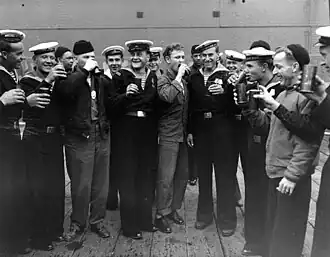 Soviet sailors celebrating V-J day. | |||||||
| |||||||
| Belligerents | |||||||
 CCP | |||||||
| Commanders and leaders | |||||||
 Joseph Stalin Aleksandr Vasilevsky Ivan Yumashev Rodion Malinovsky Kirill Meretskov Maksim Purkayev Alexander Novikov Nikolay Kuznetsov  Khorloogiin Choibalsan Lkhagvasuren Jamiyan |
 Hirohito   Otozō Yamada (POW) 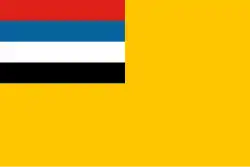 Puyi (POW) | ||||||
| Strength | |||||||
|
Soviet Union: 1.577.225 troops,[1] 26.137 artillery pieces 1.852 tanks and self-propelled guns, 5.368 aircrafts |
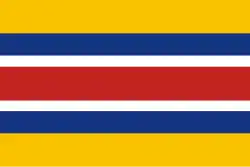
Empire of Japan: 983.000 troops,[a] 5.360 artillery pieces 1.155 tanks 1.800 aircrafts 1.215 vehicles Manchukuo: 170.000 men Mengjiang: 44,000 men[1] | ||||||
| Casualties and losses | |||||||
|
Soviet claims: 12.031 deaths 24.425 wounded[2][3] |
Japanese claims: Soviet claims:
| ||||||
The Soviet–Japanese War (Russian: Советско-японская война; Japanese: ソ連対日参戦) was a short-lived, limited armed conflict between the Soviet Union and the Japanese Empire during the last days of World War II. It began with the Soviet invasion of Manchuria on 9 August 1945 (the same day Nagasaki was nuked by the United States) and ended on 2 September 1945 with Japan surrendered unconditionally to the Allies. The Soviets' entry into the war against Japan was an important factor because it formally ended the Soviet role as a third-party country in negotiation of peace with conditions.[7][8][9][10][11][12][13][14][15]
Combined with the atomic bombings of Hiroshima & Nagasaki, this was among the reasons why Japan surrended.
Notes
- ↑ Glantz credits the Japanese with 713.000 soldiers in northern Korea and Manchuria, and 280.000 in southern Korea, South Sakhalin, and the Kuriles.
- ↑ 41,199 is the listed total of Japanese soldiers in Soviet custody on August 19, two days after the surrender of the Kwantung Army by order of Hirohito and four days after Hirohito announced the surrender of Japan. Post-war, 594,000 to 609,000 Japanese soldiers ended up in Soviet custody.
- ↑ Coox, Alvin D. Nomonhan; Japan Against Russia, 1939. 1985; 2 volumes. Stanford University Press. ISBN 0-8047-1160-7. Page 1176. 21,389 dead is from Japanese medical records; the Soviets claimed that the number of Japanese dead numbered 83,737. This number does not count POWs who died due to mistreatment in camps after the war.
- ↑ After the war, the number of Japanese soldiers and amounts of materiel in Soviet possession are as follows: 594,000–609,000 POWs, 861–925 aircraft, 369–600 tanks, 2,576–3,704 guns and mortars, and 2,129–2,300 other vehicles
References
- 1 2 Glantz, David M. & House, Jonathan (1995), When Titans Clashed: How the Red Army Stopped Hitler, Lawrence, Kansas: University Press of Kansas, ISBN 0-7006-0899-0, p. 378
- ↑ Glantz, David M. & House, Jonathan (1995), When Titans Clashed: How the Red Army Stopped Hitler, Lawrence, Kansas: University Press of Kansas, ISBN 0-7006-0899-0, p. 300
- ↑ G.F. Krivosheev, ed., "Russia and the USSR in twentieth century wars: A statistical survey". Moscow: 'Olma-press', 2001, page 309.
- ↑ Cherevko, Kirill Evgen'evich (2003). Serp i Molot protiv Samurayskogo Mecha. Moscow: Veche. ISBN 5-94538-328-7. Page 41.
- ↑ Coox, Alvin D. (1990) [1985]. Nomonhan: Japan Against Russia, 1939. Stanford, California: Stanford University Press. p. 1176. ISBN 9780804718356. Retrieved 9 February 2017.
- ↑ Australian War Memorial."Australia-Japan Research Project: Dispositions and deaths" Archived 2016-03-11 at the Wayback Machine. Citing figures of the Relief Bureau of the Ministry of Health and Welfare, March 1964. Total dead in Manchuria are given as 45,900 for the IJA, but this includes the earlier Soviet-Japanese border conflicts (~10,000 deaths), soldier killed by Chinese Northeast Anti-Japanese United Army and Chinese Anti-Japanese volunteer armies in Manchurian insurgency(~15,000 deaths), and POW deaths after the war.
- ↑ "A Soviet Push Helped Force Japan to Surrender". The Moscow Times. 8 August 2005. Archived from the original on 2013-12-12. Retrieved 2018-04-29.
- ↑ Lekic, Slobodan (22 August 2010). "How the Soviets helped Allies defeat Japan". San Francisco Chronicle.
- ↑ "Battlefield Manchuria – The Forgotten Victory", Battlefield (documentary series), 2001, 98 minutes.
- ↑ Hayashi, S. (1955). Study of Strategic and Tactical peculiarities of Far Eastern Russia and Soviet Far East Forces. Japanese Special Studies on Manchuria (Report). Vol. XIII. Tokyo: Military History Section, Headquarters, Army Forces Far East, US Army.
- ↑ Drea, E. J. (1984). "Missing Intentions: Japanese Intelligence and the Soviet Invasion of Manchuria, 1945". Military Affairs. 48 (2): 66–73. JSTOR 1987650.
- ↑ Butow, Robert Joseph Charles (1956). Japan's decision to surrender. Stanford University Press.
- ↑ Richard B. Frank, Downfall: The End of the Imperial Japanese Empire, Penguin, 2001 ISBN 978-0-14-100146-3. (Extracts on-line)
- ↑ Robert James Maddox, Hiroshima in History: The Myths of Revisionism, University of Missouri Press, 2007 ISBN 978-0-8262-1732-5.
- ↑ Racing the Enemy: Stalin, Truman, and the Surrender of Japan. Belknap Press. 2006. p. 298. ISBN 0-674-01693-9.