Soviet invasion of Manchuria
| Soviet invasion of Manchuria | |||||||
|---|---|---|---|---|---|---|---|
| Part of the Soviet–Japanese War and the Pacific War of World War II | |||||||
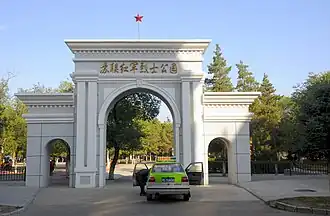 A memorial of the Soviet Red Army in Manchuria. | |||||||
| |||||||
| Belligerents | |||||||
 Japan •  Manchukuo •  Mengjiang |
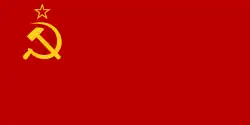 Soviet Union • 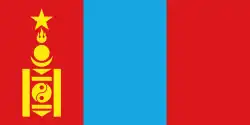 Mongolia | ||||||
| Commanders and leaders | |||||||
|
Japanese Empire: Yamada Otozō |
Soviet Union: | ||||||
| Strength | |||||||
|
Japan: 993.000 soldiers[4] (including 665.500 soldiers based in Manchukuo, others based in the Korean peninsula) 5.360 artillery pieces 1.155 tanks[Ct 1] 1.800 planes Manchukuo: 170.000 troops[6] Mengjiang: 44.000 troops[4] |
Soviet Union: 1.577.725 soldiers[Ct 2] 27.086 artillery pieces & mortars[8] 1.171 rocket launchers[8] 5.556 tanks & self-propelled guns[8] 5.171 planes[9] Mongolia: 18.000 cavalrymen | ||||||
| Casualties and losses | |||||||
|
Soviet claims:[1] 83.737 KIA or MIA 594.276 – 609.000 captured Others evaded or collapsed Japanese claims: 21.389 deaths (this does not include MIA, Manchukuo's or Mengjiang's armies)[10][Ct 3] |
Soviet claims:[10] 9.780 deaths 24.425 wounded Mongolia: 72 deaths, 125 wounded | ||||||
The Soviet Union invasion of Manchuria, also known as the Manchurian Operation (9 August – 2 September 1945) was a Soviet military operation against the Japanese forces in Manchuria, it was done because the Soviet Union promised to the Western Allies that they will soon attack Japan in Asia at the Yalta Conference in February 1945. Militarily, this was the largest land invasion in the entire Pacific front (more than any American or British offensives combined).
The Kwantung Army was, by far, the strongest elite ground army of the Empire of Japan. However, this group was still less advanced in terms of equipment and experience plus size when compared to the Soviet Red Army. Commanded by a high-profile experienced Soviet officer, the Soviet Army was much more effective in the invasion,[11] rapidly penetrating defensive areas in all levels to the point it made the Kwantung Army divided and paralyzed. The Soviets controlled Manchuria, northern Korean peninsula (now North Korea) and southern Sakhalin in just two weeks,[11] later it led to the successful occupation of the Kuril Islands.
Combined with the atomic bombs dropped on Hiroshima and Nagasaki by the United States, this invasion led to the unconditional surrender of Japan on 15 August 1945, ending the war.[12] This opportunity led to many nations to gain independence from colonisation worldwide (mostly in Asia, Africa and South America).[13]
Notes
- ↑ Number of tanks provided by the Soviet Union was considered too high compared to the number Japan provided. Japanese sources say some tanks were outdated so they didn't count. Another Soviet source says only 369 tanks were able to use after the war.[5]
- ↑ This does not include the Pacific Fleet soldiers.[7]
- ↑ This does not include the Japanese who were missing in action and those Manchukuo's deaths while Soviet sources included these.[10]
References
- 1 2 Stemenco 1984, p. 526
- ↑ LTC David M. Glantz, "August Storm: The Soviet 1945 Strategic Offensive in Manchuria". Leavenworth Papers No. 7, Combat Studies Institute, February 1983, Fort Leavenworth Kansas.
- ↑ "Battlefield Manchuria – The Forgotten Victory", Battlefield (documentary series), 2001, 98 minutes.
- 1 2 Glantz & Feb 1983, p. 28
- ↑ Glantz & Feb 1983, p. 209
- ↑ Jowett 2010, p. 36
- ↑ Glantz & Feb 1983, p. 210
- 1 2 3 Glantz & Feb 1983, p. 42
- ↑ Stemenko 1984, p. 514
- 1 2 3 Glantz & Feb 1983, p. 219
- 1 2 Glantz & Feb 1983, p. xviii
- ↑ Шишов 2001, p. 521-554
- ↑ Vasilevsky 1984, p. 528