Aleutian Islands campaign
| Aleutian Islands campaign | |||||||
|---|---|---|---|---|---|---|---|
| Part of the American Theater and Pacific War of World War II | |||||||
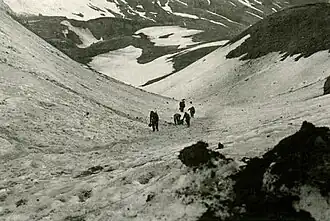 American troops hauling supplies through Jarmin Pass on Attu in May 1943. Their vehicles could not move across the island's rugged terrain. | |||||||
| |||||||
| Belligerents | |||||||
 United States •  Alaska Territorial Guard  Canada |
 Japan | ||||||
| Commanders and leaders | |||||||
|
| ||||||
| Strength | |||||||
| 144,000[1] | 8,500[1] | ||||||
| Casualties and losses | |||||||
U.S. Navy vessels lost:
|
4,350 killed
| ||||||
| 2 civilians killed, 46 captured (16 died in captivity) | |||||||


The Aleutian Islands campaign was a military operation between the United States and the Empire of Japan in the Aleutian Islands of Alaska, United States from 3 June 1942 to 15 August 1943 and was a part of the Pacific War during World War II.[3] A part of one of two attacks on the mainland United States, a small part of Japanese forces had occupied the islands of Attu and Kiska; where isolation, harsh weather and geographical complex delayed a greater Allied forces to drive out the Japanese in a year. The islands' strategic value was the ability to control shipping lanes in the Pacific.[4]
The Japanese thought that by occuping the islands, they would stop the Americans from the North Pacific. Similarly, the US feared that the islands would be used as bases for full-scale attacks on West Coast cities like Anchorage, Seattle, San Francisco or Los Angeles.
References
- 1 2 3 4 Cloe 1990, pp. 321–323
- ↑ MacGarrigle 2019, p. .
- ↑ "Battle of the Aleutian Islands". HISTORY. 2009-11-17. Retrieved 2026-04-25.
- ↑ Pike, Francis (2016-09-08). Hirohito's War: The Pacific War, 1941-1945. Bloomsbury Publishing. ISBN 978-1-350-02122-8.