Siege of Malta (World War II)
| Siege of Malta | |||||||
|---|---|---|---|---|---|---|---|
| Part of the Mediterranean and Middle East theatres of the Second World War | |||||||
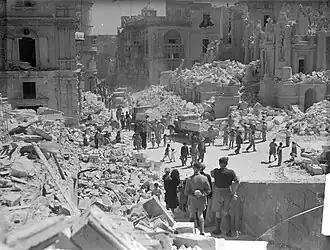 Service personnel and civilians clear up debris on a heavily bomb-damaged street in Valletta, Malta on 1 May 1942 | |||||||
| |||||||
| Belligerents | |||||||
|
Supported by:
|
 Italy  Germany | ||||||
| Commanders and leaders | |||||||
 Andrew Cunningham William Dobbie Keith Park Hugh Lloyd |
Hans Geisler Albert Kesselring Martin Harlinghausen Francesco Pricolo | ||||||
| Strength | |||||||
| 716 fighters over the course of the campaign[2] | c. 2,000 aircraft over the course of the campaign | ||||||
| Casualties and losses | |||||||
|
369 fighters (air) 64 fighters (ground)[2] 1 Battleship[3] 2 aircraft carriers[3] 4 cruisers[4] 19 destroyers[4] 38 submarines[3] 2,301 airmen killed or wounded[5] 30,000 buildings destroyed or damaged[6] 1,300 civilians killed[6] |
357 German aircrafts 175 Italian aircrafts[2] 72 percent of the Italian Navy transport fleet lost 23 percent of the Axis merchant fleet lost[7] 2,304 merchant ships sunk[8] 17,240 killed at sea[9] ~50 German U-Boats (in entire MTO)[3] Italian ships lost around 16[3] | ||||||





The Siege of Malta, also known as the Battle of Malta, was a military operation in the Mediterranean and Middle East theatres of the Second World War. In around 1940–42, the fight to gain control of the island of Malta was the front between the Italian and German naval and air forces against the United Kingdom's naval and air force armies.
In mid-1940, when a new front opened in North Africa increased the significant value of Malta. Because its location is in the middle of the Mediterranean Sea, from this island the British Naval and Air Force armies can easily attack supply line ships and reinforcements of the Axis powers which will be starting from Europe to North Africa. For Germany, the Nazi commander-in-chief in North Africa Field Marshal Erwin Rommel immediately saw the importance of the island for his armies. In May 1941, he warned that if Malta is not under Axis control then sooner or later the Axis will lose North Africa.[1]
The Axis were determined to bombard or exhaust Malta to the point that they need to leave the island, by attacking harbours, towns and Allied ships to supply. Malta became the most bombarded place in the entire war. The German Air Force Luftwaffe and Italian Air Force Regia Aeronautica had conducted 3,000 airstrikes in around two years to destroy the British Royal Air Force's defences and harbours.[10] The success of the bombardments will create an opportunity for a German–Italian landing (Operation Herkules) supported by paratroopers (Fallschirmjäger). In reality, the landing was never conducted. While being surrounded, Allied ships can still be continuing to supply and aid Malta, the British Royal Air Force can ensure its defences while taking heavy casualties.
In November 1942, the Axis lost the Second Battle of El Alamein and the Allies had landed in Morocco (under the Vichy France) and Algeria in Operation Torch. The Axis were forced to exchange their troops to the Battle of Tunisia, resulting in the decreasing attacks on Malta. The siege formally ended in November 1942.[1]
In December 1942, the British Naval and Air Force armies in Malta changed into defensive positions. In May 1943, they sunk 230 Axis ships in 164 days, this was the highest sinking rate for the Allies in the war. The Allied victory in Malta contributed an important part for their victory in North Africa.[11]
References
- 1 2 3 4 Taylor 1974, p. 182.
- 1 2 3 4 Bungay 2002, p. 64.
- 1 2 3 4 5 Spooner 1996, p. 5.
- 1 2 Spooner 1996, p. 3.
- ↑ Spooner 1996, p. 8.
- 1 2 Spooner 1996, p. 11.
- ↑ Bungay 2002, p. 66.
- ↑ Spooner 1996, p. 343.
- ↑ Spooner 1996, p. 326.
- ↑ Holland 2003, p. 417.
- ↑ Spooner 1996, p. 337.