South-East Asian theatre of World War II
| South-East Asian theatre of World War II | |||||
|---|---|---|---|---|---|
| Part of the Pacific War in the Second World War | |||||
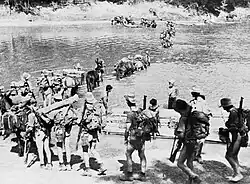 Indian soldiers marching in Burma,1943 | |||||
| |||||
| Belligerents | |||||
 Việt Minh |
 Thailand  France (until 1944) | ||||
| Commanders and leaders | |||||
 Louis Mountbatten William Slim Arthur Percival Archibald Wawell  Joseph Stilwell Douglas MacArthur  Chiang Kai-shek Wei Lihuang Ho Chi Minh |
 Terauchi Hisaichi Yamashita Tomoyuki Kimura Heitarō Kawabe Masakazu Ida Shojiro Plaek Phibunsongkhram  Trần Trọng Kim  Norodom Sihanouk  Phetsarath Rattanavongsa  Ba Maw  José P. Laurel  Subhas Chandra Bose | ||||
| Strength | |||||
|
341.400 soldiers 33 warships 41 submarines 492 aircrafts 20 tanks |
582.700 soldiers 70 warships 18 submarines 708 aircrafts 134 tanks | ||||
| Casualties and losses | |||||
|
82.200 died or wounded 202.700 captured | 222.000 died, wounded or missing in action | ||||






The South-East Asian theatre of World War II was a military operation theatre during World War II from 1941 to 1945 in Southeast Asia. It began with the Japanese invasions of Thailand and Myanmar from military bases in Indochina on 8 December 1941. All military fightings officially ended on 9 September 1945. This theatre was important to imperial Japan because if they won then the whole Southeast Asia would have been under their control which would eliminate France (under German influence after May 1940) and the British Empire, should they lose (which they did in reality) then they would lose the Southern Army.
Japanese initial victories
The Allies had suffered severe damages in the first six months of the military campaign. Two British battleships (HMS Repulse & HMS Prince of Wales) were sunked by Japanese navy and air force on 10 December 1941. After that, Japan invaded Thailand, later Thailand aligned with Japan and joined the Axis powers. Japan continued its expansion to Hong Kong on 8 December 1941, then invaded British Burma and the Dutch East Indies.
Malaya and Singapore
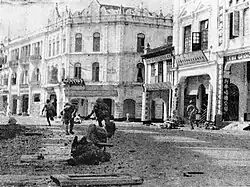
Japan faced resistance forces from the Indian Army's III Corps, Australians of the 8th Division, and British units in the Battle of Malaya. After Japan conquered Malaya and kicked Allied troops out, Allied forces in Singapore, under the command of Lieutenant General Arthur Percival, surrendered to Japan on 15 February 1942, around 130.000 Allied soldiers became prisoners of war. It became the largest surrender event in the history of British army.
Indian Ocean region
Japan attacked the Indian Ocean from 31 March to 12 April 1942, forcing Allied troops to retreat continuously. After the destructive actions of ABDACOM during the battles of Java in February and March, the Japanese attacked in the Indian Ocean to eliminate the British troops in there and support the invasion of Burma. That was partially succeeded. It was not succeeded in destroying the Allied navies' strengths in the Indian Ocean, but it made the British fleet to relocate British Ceylon to Kilindini near Mombasa in Kenyvee. Right now, the British Navy was unable to counter the Japanese Navy. British troops gradually decreased. From May 1942, it was also used in the invasion of Madagascar – a military action aimed to prevent any Japanese attempts to set up military bases in Vicy territory.
In 1942, the city of Madras was struck by Japan, there were limited damages,[1] but public reactions were strong and the city had to evacuate in fear of a Japanese invasion & bombing. Many rich families from Madras moved permanently to hill stations in fear.[2]
Takeover of the Andaman and Nicobar Islands
The Andaman and Nicobar Islands have over 130 islands in the Bay of Bengal. Formerly, the British Empire used this place to imprison political prisoners, Indian and African slaves. The main military target was the city of Port Blair. Before the attack, the British had improved their strength with one division and one regiment that marched rapidly to the area. However, the British saw that defending the islands was impossible so they withdrew.
Burma campaign
The Burma campaign occured mostly between the British Commonwealth, Republic of China and the United States against Japan and its puppet states (including Thailand, Burma and Indian collaborators). The region's climate was hot, humid and monsoon primarily. This kind of weather was not suitable for both the British and the Japanese. Because of that, most soldiers during the campaign were from occupied/colonized nations. Two sides fought very hard, Allied casualties from 1942 to 1943 were 71.244 died and wounded and mostly failed.[3] However, the Allies turned the table and began defeating the Axis troops in 1944 and overall the entire conflict. The Burma campaign ended with an Allied victory. This was a big victory, boosting Allied morale and reversing the situation.
Air strikes
The years 1944 and 1945 saw Allied success in South-East Asia. The Japanese forces kept taking defeats. To shorten the war, the Anglo–American coalition had started a series of bombing campaigns. The British no longer faced German threats in Europe after its struggling and eventual surrender, so they sent large troops to the Far East. This was an important step for the British to regain their influence in Southeast Asia. However, to achieve such success, they had to collaborate with the US. To make those plans become reality, the British troops caused destructive damages to the Japanese via bombing raids on oil and military bases of Japan in Indonesia plus with American ships.
The British forces continuously air struck the Japanese forces. The United States primarily focused on Operation Matterhorn (which was another air strike on Japanese forces in India and China). These bombing raids caused massive damages to Japan.