Volcano and Ryukyu Islands campaign
| Volcano and Ryukyu Islands campaign | |||||||
|---|---|---|---|---|---|---|---|
| Part of the Pacific War of the Second World War | |||||||
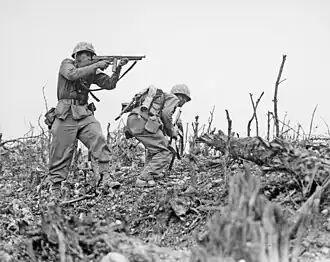 Two American soldiers fighting in the Battle of Okinawa. | |||||||
| |||||||
| Belligerents | |||||||
 United States  British Empire  Canada  Australia  New Zealand |
 Japan | ||||||
| Commanders and leaders | |||||||
|
Chester W. Nimitz Holland Smith Simon B. Buckner † Joseph W. Stilwell Ray Spruance Marc A. Mitscher Bruce Fraser |
Tadamichi Kuribayashi † Mitsuru Ushijima † Isamu Cho † Hiromichi Yahara (POW) Seiichi Itō † Minoru Ota †Kosaku Aruga † Keizō Komura | ||||||
| Casualties and losses | |||||||
|
19.840 died or missing in action 58.105 wounded 33.096 non-combat casualties 79 ships sunk and damaged 773 aircrafts destroyed |
90.400 died or missing in action 17.000 wounded 7.671 captured 21 ships sunk and damaged 3.130 aircrafts destroyed 75.000–140.000 civilians died or missing in action | ||||||
The Volcano and Ryukyu Islands campaign (January – June 1945) was a series of battles and engagements between the Allies and the Empire of Japan in the Pacific War during the Second World War.
The campaign happened in the Volcano and Ryukyu Islands. There were two major battles: Iwo Jima and Okinawa. One of the largest naval battles were Operation Ten-Go. This campaign was one of the first steps of the Allies to invade mainland Japan (codenamed Operation Downfall), with Iwo Jima and Okinawa in American hands they were able to blockade and bomb major Japanese bases and cities and eventually an Allied invasion of Japan. However, this was unnecessary after the atomic bombings of Hiroshima and Nagasaki plus the Soviet invasion of Manchuria which ultimately forced Japan to surrender unconditionally without the Allies sending massivs troops to Japanese mainland.
Related pages