Air raids on Japan
| Air raids on Japan | |||||||
|---|---|---|---|---|---|---|---|
| Part of the Japan campaign during the Pacific War | |||||||
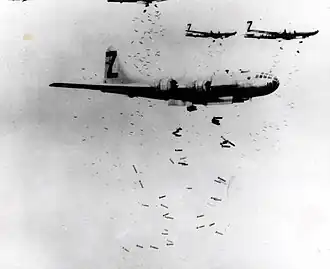 B-29 Superfortress bombers dropping incendiary bombs on Yokohama in May 1945[1] | |||||||
| |||||||
| Belligerents | |||||||
 United States  United Kingdom  China |
 Japan | ||||||
| Units involved | |||||||
|
Fifth Air Force Seventh Air Force Eleventh Air Force Twentieth Air Force 3rd Fleet 5th Fleet British Pacific Fleet Republic of China Air Force |
 Northern District Eastern District Central District Western District General Defense Command Air General Army | ||||||
| Strength | |||||||
| 27,261 B-29 sorties, exclusive of mining operations[2] |
2,833 heavy AA guns 5,916 automatic cannons 168,900 personnel[3] | ||||||
| Casualties and losses | |||||||
|
5th Air Force: 31 aircraft 7th Air Force: 12 aircraft VII Fighter Command: 157 aircraft 91 killed 20th Air Force: 414 aircraft 2,600+ killed[4] ~545 Allied airmen captured |
241,000–900,000 killed 213,000–1,300,000 wounded 8,500,000 rendered homeless[5] Very heavy damage to industry Extensive damage to urban areas 4,200 aircraft[6] | ||||||
The most notable air raids on Japan occurred in the closing stages of the war, where two nuclear bombs were dropped which caused the end of World War 2. The first air raid on Japan was the Doolittle Raid by the United States Air Force. The bombing operations against Japan continued until Japan's surrender.
References
- ↑ Wolk (2004), p. 72
- ↑ Survey of Japanese antiaircraft artillery Archived 26 May 2023 at the Wayback Machine, p. 230. Retrieved 5/26/23
- ↑ Survey of Japanese antiaircraft artillery Archived 26 May 2023 at the Wayback Machine, Figures 12 and 25 for weapons and army personnel strength (127,285), p. 255 for navy personnel strength (41,615). Retrieved 5/26/23
- ↑ Kerr (1991), p. 276
- ↑ Kerr (1991), pp. 280–281
- ↑ Coox (1994), p. 417