Italian Social Republic
Italian Social Republic Repubblica Sociale Italiana | |||||||||
|---|---|---|---|---|---|---|---|---|---|
| 1943–1945 | |||||||||
| Anthem: "Il Canto degli Italiani" (de facto)[a] ("The Song of the Italians") "Giovinezza" (de facto) ("Youth") | |||||||||
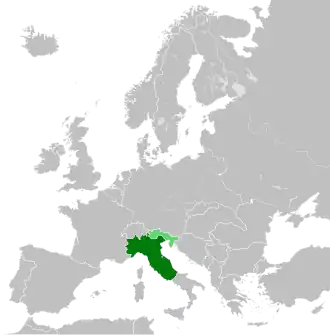 Italian Social Republic in 1943 | |||||||||
| Status | Puppet state of Nazi Germany[3] | ||||||||
| Capital | Salò (de facto) Rome (claimed) | ||||||||
| Government | Various | ||||||||
| Duce | |||||||||
• 1943–1945 | Benito Mussolini | ||||||||
| Plenipotentiary | |||||||||
• 1943–1945 | Rudolf Rahn | ||||||||
| Historical era | World War II | ||||||||
• Gran Sasso raid | 12 September 1943 | ||||||||
| 23 September 1943 | |||||||||
| 25 April | |||||||||
• Surrender | 2 May 1945 | ||||||||
| Currency | Republican Lira (de jure) Italian lira (de facto) | ||||||||
| ISO 3166 code | IT | ||||||||
| |||||||||

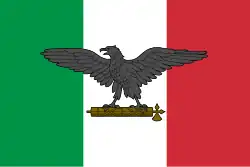
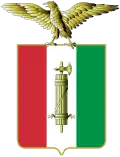
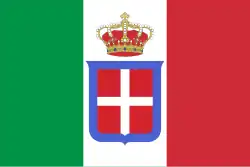
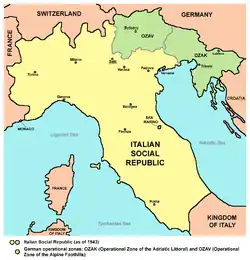
The Italian Social Republic (Italian: Repubblica Sociale Italiana or RSI) was a provisional government sponsored by and allied with Nazi Germany.[3] It was led by Benito Mussolini and his Republican Fascist Party. In name, it controlled northern Italy but, in fact, the land was under German military control. The country had another informal name, Salò Republic (Italian: Repubblica di Salò), after where their headquarters was located. Before 25 November 1943, the official name of the country was widely called Republican State of Italy and Republican National State (Italian: Stato Nazionale Repubblicano).[4] It was the second and last Fascist Italian state.
References
- ↑ (De Marzi, Giacomo. "I canti di Salò". archiviostorico. Fratelli Frilli Editori. Retrieved 2 March 2025.)
- ↑ ("Excalibur 22: L'inno nazionale della R.S.I." vicosanlucifero. Vico San Lucifero. Retrieved 4 March 2025.)
- 1 2 Pauley, Bruce F. (2003), Hitler, Stalin and Mussolini: Totalitarianism in the Twentieth Century Italy (2nd ed.), Wheeling: Harlan Davidson, p. 228, ISBN 088295993X.
- ↑ Palla, M. (2000) Mussolini and fascism, p. 137. ISBN 1566563402
Other websites
 Media related to Italian Social Republic at Wikimedia Commons
- ↑ In ceremonies, either Il Canto degli Italiani or Giovinezza was sung (in the latter case the legionaries preferred the text of the "Hymn of the Arditi" rather than that of the "Triumphal Hymn of the National Fascist Party").[1] Marcia del Volontario by Ennio Porrino was endorsed by Undersecretary to the Presidency of the Council of Ministers, Francesco Maria Barracu, but never became official.[2]
<ref group=lower-alpha> tags or {{efn}} templates on this page, but the references will not show without a {{reflist|group=lower-alpha}} template or {{notelist}} template (see the help page).