Pseudopaludicola
| Pseudopaludicola | |
|---|---|
 | |
| Pseudopaludicola falcipes | |
Scientific classification  | |
| Kingdom: | Animalia |
| Phylum: | Chordata |
| Class: | Amphibia |
| Order: | Anura |
| Family: | Leptodactylidae |
| Genus: | Pseudopaludicola Miranda-Ribeiro, 1926 |
| Type species | |
| Liuperus falcipes Hensel, 1867 | |
| Species | |
|
About 25, see text | |
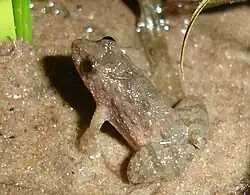
Pseudopaludicola is a group of frogs in the family Leptodactylidae. They live in northern and central South America.[1][2] In English, people call them dwarf swamp frogs or swamp frogs.[1]
Systematics
Pseudopaludicola are small frogs. They are not bigger than 22 mm (0.87 in) from nose to rear end. The part of their bodies that shows they are Pseudopaludicola is a very big bump on the outer edge of the front foot. This is called a hypertrophied antebrachial tubercle.[3] Scientists looked at the frogs' genes to make sure they were related to each other, and they saw that they are. Genetic data show that there are four groups of speciess in the genus.[2]
Species
There are currently 25 species in this group:[1]
- Pseudopaludicola ameghini (Cope, 1887)
- Pseudopaludicola atragula Pansonato, Mudrek, Veiga-Menoncello, Rossa-Feres, Martins, and Strüssmann, 2014
- Pseudopaludicola boliviana Parker, 1927
- Pseudopaludicola canga Giaretta and Kokubum, 2003
- Pseudopaludicola ceratophyes Rivero and Serna, 1985
- Pseudopaludicola facureae Andrade and Carvalho, 2013
- Pseudopaludicola falcipes (Hensel, 1867)
- Pseudopaludicola florencei Andrade, Haga, Lyra, Leite, Kwet, Haddad, Toledo, and Giaretta, 2018
- Pseudopaludicola giarettai Carvalho, 2012
- Pseudopaludicola hyleaustralis Pansonato, Morais, Ávila, Kawashita-Ribeiro, Strussmann, and Martins, 2012
- Pseudopaludicola ibisoroca Pansonato, Veiga-Menoncello, Mudrek, Jansen, Recco-Pimentel, Martins, and Strüssmann, 2016
- Pseudopaludicola jaredi Andrade, Magalhães, Nunes-de-Almeida, Veiga-Menoncello, Santana, Garda, Loebmann, Recco-Pimentel, Giaretta, and Toledo, 2016
- Pseudopaludicola jazmynmcdonaldae Andrade, Silva, Koroiva, Fadel, and Santana, 2019
- Pseudopaludicola llanera Lynch, 1989
- Pseudopaludicola matuta Andrade, Haga, Lyra, Carvalho, Haddad, Giaretta, and Toledo, 2018
- Pseudopaludicola mineira Lobo, 1994
- Pseudopaludicola motorzinho Pansonato, Veiga-Menoncello, Mudrek, Jansen, Recco-Pimentel, Martins, and Strüssmann, 2016
- Pseudopaludicola murundu Toledo, Siqueira, Duarte, Veiga-Menoncello, Recco-Pimentel, and Haddad, 2010
- Pseudopaludicola mystacalis (Cope, 1887)
- Pseudopaludicola parnaiba Robert, Cardozo, and Ávila, 2013
- Pseudopaludicola pocoto Magalhães, Loebmann, Kokubum, Haddad, and Garda, 2014
- Pseudopaludicola pusilla (Ruthven, 1916)
- Pseudopaludicola restinga Cardozo, Baldo, Pupin, Gasparini, and Haddad, 2018
- Pseudopaludicola saltica (Cope, 1887)
- Pseudopaludicola ternetzi Miranda-Ribeiro, 1937
AmphibiaWeb also says Pseudopaludicola serrana is in this group,[4] but Amphibian Species of the World says this is only another name for of Pseudopaludicola murundu.[1]
References
- 1 2 3 4 Frost, Darrel R. (2016). "Pseudopaludicola Miranda-Ribeiro, 1926". Amphibian Species of the World: an Online Reference. Version 6.0. American Museum of Natural History. Retrieved 23 February 2016.
- 1 2 Veiga-Menoncello, Ana C. P.; Lourenço, Luciana B.; Strüssmann, Christine; Rossa-Feres, Denise C.; Andrade, Gilda V.; Giaretta, Ariovaldo A.; Recco-Pimentel, Shirlei M. (2014). "A phylogenetic analysis of Pseudopaludicola (Anura) providing evidence of progressive chromosome reduction". Zoologica Scripta. 43 (3): 261–272. doi:10.1111/zsc.12048. S2CID 85241492.
- ↑ Lynch, John D. (1989). "A Review of the leptodactylid frogs of the genus Pseudopaludicola in northern South America". Copeia. 1989 (3): 577–588. doi:10.2307/1445483. JSTOR 1445483.
- ↑ "Leptodactylidae". AmphibiaWeb: Information on amphibian biology and conservation. [web application]. Berkeley, California: AmphibiaWeb. 2016. Retrieved 23 February 2016.