Pseudopaludicola florencei
| Pseudopaludicola florencei | |
|---|---|
Scientific classification  | |
| Kingdom: | Animalia |
| Phylum: | Chordata |
| Class: | Amphibia |
| Order: | Anura |
| Family: | Leptodactylidae |
| Genus: | Pseudopaludicola |
| Species: | P. florencei |
| Binomial name | |
| Pseudopaludicola florencei Andrade, Haga, Lyra, Leite, Kwet, Haddad, Toledo, and Giaretta, 2018 | |
Pseudopaludicola florencei is a frog. It lives in Brazil in Minas Gerais.[2][3][1]
Home
This frog lives in dead leaves on the ground in Caatinga and Atlantic forest placess. It can live in grassy places, places with small, woody plants, and forests. It is good at living in places that have been changed. For example, people see it in forests where some trees are missing and in places where animals eat grass. Scientists have seen it between 0 and 10 m (0 and 33 ft) above sea level.[1]
There are protected places where the frog lives, for example Área de Preservação Ambiental Marimbus-Iraquara.[1]
Young
The young hatch out of their eggs as tadpoles, not small froglets.[1]
Danger
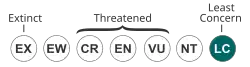
Scientists from the IUCN say this frog is in some danger of dying out.[1]
First paper
- Andrade FS; Haga IA; Lyra ML; Leite FSF; Kwet A; Haddad CFB; Toledo LF; Giaretta AA (2018). "A new species of Pseudopaludicola Miranda-Ribeiro (Anura: Leptodactylidae: Leiuperinae) from eastern Brazil, with novel data on the advertisement call of Pseudopaludicola falcipes (Hensel)". Zootaxa. 4433: 71–100. doi:10.11646/zootaxa.4433.1.4. PMID 30313239. Retrieved March 22, 2026.
References
- 1 2 3 4 5 6 IUCN SSC Amphibian Specialist Group; Instituto Boitatá de Etnobiologia e Conservação da Fauna (2023). "Pseudopaludicola florencei". IUCN Red List of Threatened Species. 2023: e.T154107472A154107477. doi:10.2305/IUCN.UK.2023-1.RLTS.T154107472A154107477.en. Retrieved March 22, 2026.
- ↑ Frost, Darrel R. "Pseudopaludicola florencei Andrade, Haga, Lyra, Leite, Kwet, Haddad, Toledo, and Giaretta, 2018". Amphibian Species of the World, an Online Reference. Version 6.0. American Museum of Natural History, New York. Retrieved March 22, 2026.
- ↑ "Pseudopaludicola florencei Andrade, Haga, Lyra, Leite, Kwet, Haddad, Toledo, & Giaretta, 2018". AmphibiaWeb. University of California, Berkeley. Retrieved March 22, 2026.