Pseudopaludicola giarettai
| Pseudopaludicola giarettai | |
|---|---|
Scientific classification  | |
| Kingdom: | Animalia |
| Phylum: | Chordata |
| Class: | Amphibia |
| Order: | Anura |
| Family: | Leptodactylidae |
| Genus: | Pseudopaludicola |
| Species: | P. giarettai |
| Binomial name | |
| Pseudopaludicola giarettai Carvalho, 2012 | |
Pseudopaludicola giarettai is a frog. It lives in Brazil.[1][2][3]
Home
This frog lives in Cerrado places. Scientists have seen the frogs between 525 and 905 m (1,722 and 2,969 ft) above sea level.[1]
Scientists have seen these frogs in a protected place: Parque Nacional Grande Sertão Veredas.[1]
Young
The male frog sits next to human-made ponds or slow, small streams and calls to the female frogs. He calls during the day. The male frog almost always calls from near marshes with buriti palm plants (Mauritia flexuosa). The tadpoles swim in water.[1]
Danger
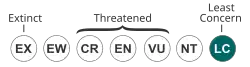
Scientists from the IUCN say this frog is not in danger of dying out. It is in some danger because people change the places where the frogs live to make farms, make places for animals to eat grass, and make towns. Also, the way people grow plants on farms causes soil in the ground to wash away into streams, which makes the water harder to live in.[1]
First paper
- de Carvalho TR (2012). "A new species of Pseudopaludicola Miranda-Ribeiro (Leiuperinae: Leptodactylidae: Anura) from the Cerrado of southeastern Brazil with a distinctive advertisement call pattern". Zootaxa. 3328: 47–54.
References
- 1 2 3 4 5 6 IUCN SSC Amphibian Specialist Group; Instituto Boitatá de Etnobiologia e Conservação da Fauna (2023). "Pseudopaludicola giarettai". IUCN Red List of Threatened Species. 2023: e.T45508064A45509184. doi:10.2305/IUCN.UK.2023-1.RLTS.T45508064A45509184.en. Retrieved March 14, 2026.
- ↑ Frost, Darrel R. "Pseudopaludicola giarettai Carvalho, 2012". Amphibian Species of the World, an Online Reference. Version 6.0. American Museum of Natural History, New York. Retrieved March 14, 2026.
- ↑ "Pseudopaludicola giarettai Carvalho, 2012". AmphibiaWeb. University of California, Berkeley. Retrieved March 14, 2026.