|
|---|
|
| 1940s | |
|---|
| 1950s | |
|---|
| 1960s | |
|---|
| 1970s | |
|---|
| 1980s | |
|---|
| 1990s | |
|---|
| Frozen conflicts | |
|---|
| Foreign policy | |
|---|
| Ideologies | |
|---|
| Organizations | |
|---|
| Propaganda | | Pro-communist |
- Active measures
- Izvestia
- Neues Deutschland
- Pravda
- Rudé právo
- Trybuna Ludu
- TASS
- Soviet Life
|
|---|
| Pro-Western | |
|---|
|
|---|
Technological
competition | |
|---|
| Historians |
- Gar Alperovitz
- Thomas A. Bailey
- Michael Beschloss
- Archie Brown
- Warren H. Carroll
- Adrian Cioroianu
- John Costello
- Michael Cox
- Nicholas J. Cull
- Norman Davies
- Willem Drees
- Robert D. English
- Herbert Feis
- Robert Hugh Ferrell
- André Fontaine
- Anneli Ute Gabanyi
- John Lewis Gaddis
- Lloyd Gardner
- Timothy Garton Ash
- Gabriel Gorodetsky
- Fred Halliday
- Jussi Hanhimäki
- John Earl Haynes
- Patrick J. Hearden
- Tvrtko Jakovina
- Tony Judt
- Harvey Klehr
- Gabriel Kolko
- Walter LaFeber
- Walter Laqueur
- Melvyn P. Leffler
- Geir Lundestad
- Vojtech Mastny
- Jack F. Matlock Jr.
- Thomas J. McCormick
- Timothy Naftali
- Marius Oprea
- David S. Painter
- William B. Pickett
- Ronald E. Powaski
- Yakov M. Rabkin
- Mary Elise Sarotte
- Arthur M. Schlesinger Jr.
- Ellen Schrecker
- Giles Scott-Smith
- Shen Zhihua
- Timothy Snyder
- Athan Theoharis
- Andrew Thorpe
- Vladimir Tismăneanu
- Patrick Vaughan
- Alex von Tunzelmann
- Odd Arne Westad
- William Appleman Williams
- Jonathan Reed Winkler
- Rudolph Winnacker
- Ken Young
|
|---|
Espionage and
intelligence |
- List of Eastern Bloc agents in the United States
- Soviet espionage in the United States
- Russian espionage in the United States
- American espionage in the Soviet Union and Russian Federation
- CIA and the Cultural Cold War
- CIA
- MI5
- MI6
- United States involvement in regime change
- Soviet involvement in regime change
- MVD
- KGB
- Stasi
|
|---|
| See also | |
|---|
- Category
- List of conflicts
- Timeline
|
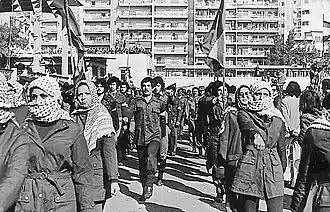
 Saudi Arabia
 Jordan
 Morocco
 Egypt (since 1973)
 Syria (until 1963)
 Libya (until 1951)
 Iraq (until 1958)
 Yemen (until 1970)
 North Yemen (since 1967)
 Oman
 Bahrain
 Kuwait
 Syria (since 1963)
 Algeria (since 1962)
 Libya (since 1977)
 Iraq (since 1963)
 South Yemen (since 1967)
 Tunisia (1957 – 1987)
 Mauritania (until 1984)
 Somalia (since 1969)
 Palestine Liberation Organization
 Frente Polisario
 United States
 United Kingdom
 Israel (secret)
 Iran (until 1979)
 France
 Afghan mujahideen
 Pakistan
 Turkey
 Afghanistan (since 1978)
 Soviet Union
 China
 Cuba
 North Korea
 Ethiopia
 Hafez al-Assad
