1952 Egyptian revolution
| 1952 Egyptian Revolution | |||||||
|---|---|---|---|---|---|---|---|
| Part of Cold War | |||||||
 | |||||||
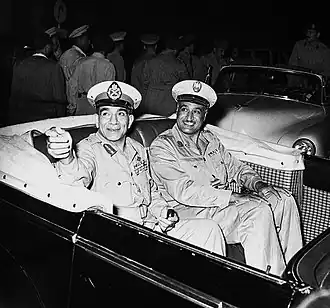
The Egyptian revolution of 1952 (Arabic: ثورة 23 يوليو),[1] also known as the 1952 coup d'état (Arabic: انقلاب 1952)[2][3][4]and 23 July Revolution,[5] was a period of time when Egypt experienced changes in politics, economy and society. On 23 July 1952 the revolution began with King Farouk losing power in a coup d'état by the Free Officers Movement. This group of army officers was ruled by Mohamed Naguib and Gamal Abdel Nasser.[6] After the revolution, Egypt became a republic and introduced new political and social reforms.
Before the Revolution
Before the 1952 Egyptian Revolution, Egypt faced political and social problems under King Farouk, the last ruling monarch of Egypt. Although Egypt became formally independent in 1922, Britain still controlled defence, foreign policy, and the Suez Canal.[7] The 1936 Anglo-Egyptian Treaty gave Britain even more military rights, especially in the Canal Zone.[8] During World War II, Britain forced King Farouk to appoint a pro-British prime minister from the Wafd Party in 1942, showing many Egyptians that their independence was limited.[7][8] Inflation had risen, and basic food items were so inadequate that in 1942, bread revolts began in Cairo.[7] In politics, the changes caused by the war became more important than the political system that had ruled Egypt since 1923, including the monarchy, parliament, and the Wafd Party. This led to a period of political weakness and loss of public support, which continued until the Egyptian Revolution of 1952.[9] People became angered and desired change.
One of these people was a highly respected military officer Gamal Abdel Nasser. The experience Nasser gained on the battlefield during the Arab-Israeli War made him question monarchical intentions of the Egyptians’ national interest.[8] The Egyptian defeat in the war made him further weaken his trust, which led to him founding the Free Officers Movement which was led by the army officer Mohamed Naguib. Mohamed Naguib also led the RCC (Revolutionary Command Council) which meant that he held the position of prime minister, minister of war and navy and later became the first Egyptian president in 1953.
1952: Coup d'état
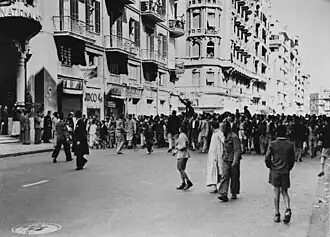
The Egyptian Revolution of 1952 began after violence increased between British forces and Egyptian nationalists in the Suez Canal Zone. In January 1952, British troops killed about 50 Egyptian policemen, leading to riots in Cairo known as “Black Saturday”.[8] These events pushed the Free Officers and the Muslim Brotherhood to overthrow the monarchy.[9] On the night of 22–23 July 1952, around 3,000 soldiers and tanks seized important military buildings in Cairo.[10] On July 23rd, the Free Officers asked the King to appoint a Prime Minister chosen by them and remove senior army officials, following the rules of the 1923 Constitution.[7] The same morning, Anwar Sadat, speaker of the Free Officers Movement, announced that the army had taken power. The King was in Alexandria during the summer and could not gain enough support. King Farouk was forced to abdicate in favour of his son and leave Egypt forever on July 26, 1952.[7][8]
The new regime was led by Naguib, the popular army general, but its ruling body was the Revolutionary Command Council (RCC), which was dominated by the younger, more radical, Free Officers.[8] The Revolutionary Command Council abolished political parties and declared Egypt a republic in 1953. This was followed by the implementation of Martial Law for the next three years. The new government promised land reform, social justice, welfare expansion, and an end to British influence.[7][8] After a general strike in April 1954, Naguib was forced to appoint Nasser as Prime Minister again. Plans to return to democracy were delayed for an unknown amount of time, and Naguib lost his power permanently.[8]
After the Revolution
One of the first laws that passed in the weeks after the revolution was the Property Law on September 9, 1952. This law fundamentally changed the agricultural sector in Egypt, it abolished feudalism and set aside agricultural landlords.[11] The Egyptian revolution in 1952-1953 did not only have a national impact on the British rule within Egypt but also a mondial impact that inspired anti-colonial movements in Africa and the Middle-East.[12] Under the rule of Jamal Abdel Nasser, Egypt grew to be one of the most important participants in the Non-Aligned Movement (Nam). This was a movement of states that put themselves outside the conflict of the Cold War. [13]
Trivia
- July 23rd is currently a national holiday in Egypt.
References
- ↑ Stenner, David (2019-05-14), "Globalizing Morocco: Transnational Activism and the Postcolonial State", Globalizing Morocco, Stanford University Press, doi:10.1515/9781503609006, ISBN 978-1-5036-0900-6, retrieved 2024-09-25
- ↑ L., T. R. (1954). "Egypt since the Coup d'Etat of 1952". The World Today. 10 (4): 140–149. ISSN 0043-9134.
- ↑ "Egypt - Revolution, Republic, Nile | Britannica". www.britannica.com. 2024-09-21. Retrieved 2024-09-25.
- ↑ "Military seizes power in Egypt | July 23, 1952". HISTORY. Retrieved 2024-09-25.
- ↑ Holland, Matthew F. (1996-07-11). America and Egypt: From Roosevelt to Eisenhower. Bloomsbury Academic. ISBN 978-0-275-95474-1.
- ↑ Gordon 1992
- 1 2 3 4 5 6 Budak, Muhammet Musa (2022). A Comparison of the Egyptian Revolutions of 1952 and 2011. Newcastle-upon-Tyne (GB): Cambridge Scholars Publishing. ISBN 978-1-5275-7724-4.
- 1 2 3 4 5 6 7 8 McNamara, Robert (2004-08-02). Britain, Nasser and the Balance of Power in the Middle East, 1952-1977 (0 ed.). Routledge. doi:10.4324/9780203495308. ISBN 978-1-135-77303-8.
- 1 2 Alexander, Anne (2011-12). "Brothers-in-arms? The Egyptian military, the Ikhwan and the revolutions of 1952 and 2011". The Journal of North African Studies. 16 (4): 533–554. doi:10.1080/13629387.2011.630876. ISSN 1362-9387.
{{cite journal}}: Check date values in:|date=(help) - ↑ McNamara, Robert (2004-08-02). Britain, Nasser and the Balance of Power in the Middle East, 1952-1977 (0 ed.). Routledge. doi:10.4324/9780203495308. ISBN 978-1-135-77303-8.
- ↑ "Erasing the effects of agrarian reform and social contempt for agricul... | Reports". mksegypt.org. Retrieved 2026-05-23.
- ↑ "The July 23rd Revolution".
- ↑ Payind, Alam; McClimans, Melinda (2016). "Gamal Abdul Nasser and Non-Alignment".
{{cite journal}}: Cite journal requires|journal=(help)