1948 Arab–Israeli War
| 1948 Arab–Israeli War | |||||||||
|---|---|---|---|---|---|---|---|---|---|
| Part of the 1947–1949 Palestine war and the Arab–Israeli conflict | |||||||||
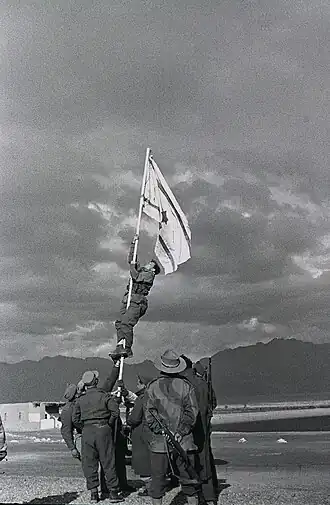 Captain Avraham Adan raising the Israeli flag in Umm Rashrash (now Eilat), marking the war's end. | |||||||||
| |||||||||
| Belligerents | |||||||||
|
Before 26 May 1948: Paramilitary groups:
After 26 May 1948:
Foreign volunteers: Mahal |
Irregulars: Foreign volunteers:  Muslim Brotherhood  Pakistan  Sudan[5] | ||||||||
| Commanders and leaders | |||||||||
 David Ben-Gurion Yisrael Galili Yaakov Dori Yigael Yadin Mickey Marcus † Yigal Allon Yitzhak Rabin David Shaltiel Moshe Dayan Shimon Avidan Moshe Carmel Yitzhak Sadeh |
  Azzam Pasha King Farouk I  King Abdallah I  Muzahim al-Pachachi  Husni al-Za'im  Haj Amin al-Husseini Ahmed Ali al-Mwawi Muhammad Naguib John Bagot Glubb Habis al-Majali Hasan Salama †  Fawzi al-Qawuqji | ||||||||
| Strength | |||||||||
|
Israel: Initially 29,677 people, in March 1949 increased to 115,000 people |
Egypt: Initially 10,000, then increased to 20,000 Iraq: Initially 5,000, then increased to 15–18,000 Syria: 2,500–5,000 Jordan: 6,000–12,000 Lebanon: Initially 1,000, then increased to 2,000[6]  Saudi Arabia: 800–1,200  Yemen: Unknown Arab Liberation Army: 3,500-6,000 | ||||||||
| Casualties and losses | |||||||||
| 6,373 deaths (4,000 soldiers and around 2,400 civilians) | Around 10,000 to 15,000 people | ||||||||



The Arab–Israeli War of 1948, also known as the War of Independence by the Jewish people and the Liberation War/War of Liberation and al Nakba (Arabic: النكبة, "the Castatrophe") by the Palestinian people, was the first war of various conflicts between Israel and the Arab nations. It was also the second and last phrase of the 1947–49 Palestine war.
The war broke out immediately after British-rule Mandatory Palestine ended on 15 May 1948 and the declaration of Israel's independence on 14 May 1948 due to the Arab nations' opposition and continued through the 1947–1948 civil war period, when the Arabs rejected the United Nations' Resolution 181 which established an Arab and a Jewish nation in this territory. A coalition consisted of Egypt, Jordan and Syria with paramilitary troops from Iraq entered Palestine.[7] The invasion forces immediately gained many Arab territories and began attacking Jewish settlements and Israeli forces.[8][9][10] The conflict mainly fought in Mandatory Palestine ruled by Britain and a short time in the Sinai Peninsula. Lebanon, Anglo–Egyptian Sudan, Saudi Arabia, Pakistan, Yemen and Morocco also intervened. The war lasted 10 months and was officially over in Palestine, the Sinai Peninsula and southern Lebanon with the armistice agreements in 1949; however, the Arab–Israeli conflict remains to be continued to this day.[11]
Due to the war's aftermath, Israel fully took the Jewish Quarter and 60% of the Arab Quarter.[12] The remaining territories were annexed by Jordan in the West Bank and the Gaza Strip was conquered by Egypt. At the Jericho Conference on 1 December 1948, 2,000 Palestinians had required Palestine and Jordan to be unified.[13] Palestinian Arabs were not able to create a state.
Origins
After the Ottoman Empire lost World War I, the Allies met in San Remo, Italy from 18 to 26 April to discuss treaty terms with Turkey.[14] The discussion's conclusion mainly confirmed the first London talks and the Sykes–Picot Agreement on 16 May 1916 and the Balfour Declaration on 12 November 1917.[15][16] According to the agreement, France will control Syria and Britain will control Mesopotamia and Palestine, the borders will be confirmed by the great powers in the talks.[14]
In a meeting in Cairo and Jerusalem between Winston Churchill and Prince Abdullah (later the King Abdullah I of Jordan) in March 1921, they agreed that Abdullah will control Transjordan (in around 6 months) to represent the Palestinian side. Until the summer of 1921, Transjordan was still under the Mandate Territory, but was not in one of the terms about the Homeland of the Jewish people.[17] On 24 July 1922, the League of Nations accepted the terms regarding the British control over Palestine and Transjordan. On 16 September, the League of Nations officially ratified the memorandum of Arthur Balfour, confirming the terms about the establishment of the Jewish state except Transjordan.[18]
Until 1920, the Palestinian citizens consisted of around 589,200 Muslims, 83,800 Jews, 71,500 Christians and 7,600 other more (1922 estimates[19]). However, this region had a mass Jewish exodus event (mostly fleeing from persecutions in Europe). The exodus and the call for a Jewish nation faced massive backlashes from native Arabs due to the Arabs rumoured that the Jews would enslave the Arabs and deport natives that were not Jewish.
Under Amin al-Husayni's leadership, the Grand Ayatollah in Jerusalem, the Arabs rose against the British and constantly attacking the Jewish communities. Those sporadic attacks began from the Arabs' 1920 revolt and the 1921 revolt in Jaffa. In the uprising of 1929, 67 Jews were killed in Hebron, the remaining survivors were evacuated by British authorities.
The Arab Uprisings (1936–1939) and aftermath
In the late 1920s and early 1930s, some Palestinian factions were impatient with the disunity in the communities plus the Palestinian leaderships' incompetence so they began a series of anti-British, antisemite movements of the common people led by many parties. They organized boycotts and non-cooperation events similar to that of India. Most of these new uprisings were surpressed by local figures working for the British government.
References
- 1 2 3 4 Oren 2003, p. 5.
- ↑ Morris (2008), p. 260.
- ↑ Gelber, pp. 55, 200, 239
- ↑ Morris, Benny (2008), 1948: The First Arab-Israeli War, Yale University Press, p.205, New Haven, ISBN 978-0-300-12696-9.
- ↑ Morris, 2008, p. 332.
- ↑ Pollack, 2004; Sadeh, 1997
- ↑ David Tal, War in Palestine, 1948: Israeli and Arab Strategy and Diplomacy, p. 153.
- ↑ Benny Morris (2008), p. 401.
- ↑ Morris, 2008, p. 236, 237, 247, 253, 254
- ↑ Zeev Maoz, Defending the Holy Land, University of Michigan Press, 2009 p. 4: 'A combined invasion of a Jordanian and Egyptian army started . . . The Syrian and the Lebanese armies engaged in a token effort but did not stage a major attack on the Jewish state.'
- ↑ Rogan and Shlaim 2007 p. 99.
- ↑ Cragg 1997 pp. 57, 116.
- ↑ Benvenisti, Meron (1996), City of Stone: The Hidden History of Jerusalem, University of California Press, ISBN 0-520-20521-9. p. 27
- 1 2 Geddes, 1991, pp. 79-81
- ↑ According to the Balfour Declaration, the British government sided with the re-establisment of the Jewish nation.
- ↑ Karsh & Karsh, 1999, pp. 254-258
- ↑ Gelber, 1997, pp. 6-15
- ↑ Sicker, 1999, p. 164
- ↑ Bickerton and Hill, 2003, p. 43. Cited from census figures quoted in Janowsky, 1975.
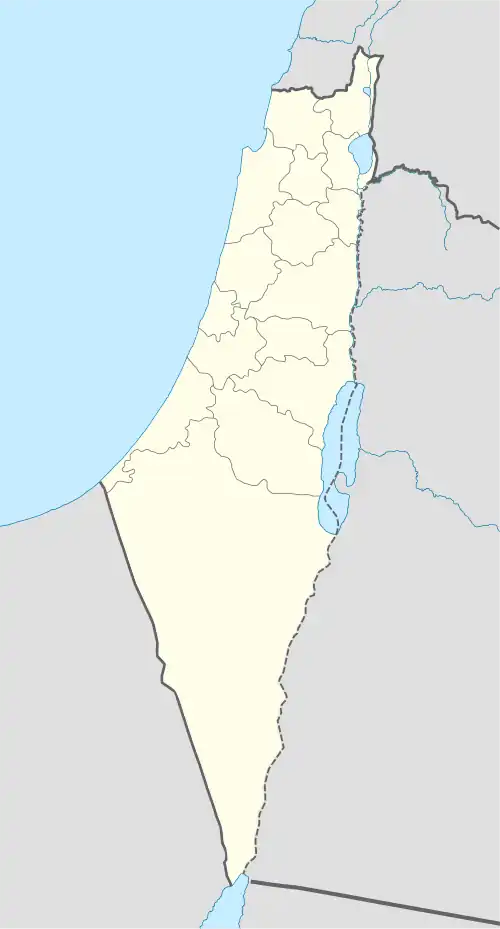
Palestinian Arab towns and villages depopulated during the 1948 Palestinian exodus by subdistrict | ||
|---|---|---|
| Acre |
|   |
| Beisan |
| |
| Beersheba |
| |
| Gaza |
| |
| Haifa |
| |
| Hebron |
| |
| Jaffa |
| |
| Jenin |
| |
| Jerusalem |
| |
| Nazareth |
| |
| Ramle |
| |
| Safad |
| |
| Tiberias |
| |
| Tulkarm |
| |
 villages depopulated during the 1948 Arab–Israeli War | ||
 Egypt–Israel relations | |
|---|---|
| Diplomatic posts |
|
| Diplomacy |
|
| Conflicts |
|
| Incidents |
|
| Related |
|
| Category:Egypt–Israel relations | |