United Nations Partition Plan for Palestine
| UN General Assembly Resolution 181 (II) | |
|---|---|
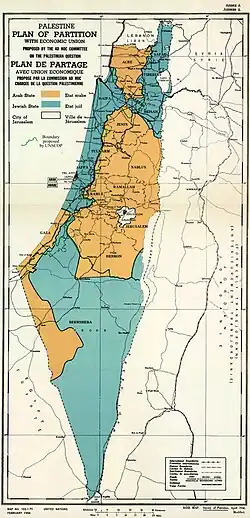 UNSCOP (3 September 1947; see green line) and UN Ad Hoc Committee (25 November 1947) partition plans. The UN Ad Hoc Committee proposal was voted on in the resolution. | |
| Date | 29 November 1947 |
| Meeting no. | 128 |
| Code | A/RES/181(II) (Document) |
Voting summary |
|
| Result | Adopted |
 |
| Part of a series on the |
| Nakba |
|---|
The United Nations Partition Plan for Palestine was a plan approved by the United Nations on 29 November 1947.[1] It proposed dividing Mandatory Palestine, then under British rule, into two countries: one Jewish and one Arab.[2] Jerusalem would not belong to either state but would be controlled internationally. Jewish leaders accepted the plan because it supported the creation of a Jewish state, later established as the State of Israel in 1948.[3] Arab leaders rejected the plan because they opposed dividing the land.[4] This disagreement was one of the reasons for the outbreak of the war in 1948 and became a key-point in the Israeli-Palestinian conflict.[5]
Historical Background
Ottoman Rule: 1517 - 1917
From 1517 to 1917, Palestine was part of the Ottoman Empire. Most people living there were Arab Muslims and Christians, with a small Jewish minority in cities like Jerusalem, Hebron, Safed, and Tiberias.[6] People usually identified with their religion, their town, or the Ottoman state, not with a separate Palestinian nation.[7] In the late 1800s, the Zionist movement in Europe began supporting Jewish immigration to Palestine.[8] Some Arab leaders opposed this immigration and asked the Ottoman government to stop land sales to Jewish settlers.[9] The Ottoman authorities tried to control immigration, but they did not fully prevent it.[10] By the early 1900s, tensions between Arab residents and Jewish immigrants were increasing.[11]
British Mandate: 1917 - 1947
During World War I, Britain and France secretly signed the Sykes-Picot Agreement, which planned how to divide parts of the Middle East after the defeat of the Ottoman Empire.[12] After the war, Britain took control of Palestine. In 1917, Britain also issued the Balfoure Declaration, supporting the creation of a Jewish “national home” in Palestine.[13] In 1922, the League of Nations officially gave Britain the Mandate for Palestine.[14] During this time, Jewish immigration increased, especially in the 1930s when many Jews fled persecution in Europe to Israel because of the rise of antisemitism.[15] By the 1930s and 1940s, violence in Palestine increased. [16] Arab groups opposed Jewish immigration, and Jewish armed groups also carried out attacks.[17] Britain tried to control the situation, but fighting and unrest continued.[18] After World War II, Britain found it too difficult and costly to keep control.[19]
Involvement of the United Nations
In 1947, Britain decided it could no longer control the situation in Palestine because of increasing violence and asked the United Nations (UN) to decide what should happen next.[20] The UN created a special group called the United Nations Special Committee on Palestine (UNSCOP).[21] This group studied the situation and suggested dividing Palestine into two states, one Jewish and one Arab, and suggested that Jerusalem should be controlled internationally.[22]
Voting
On 29 November 1947, the UN General Assembly voted in favor of this plan.The plan was approved with 33 countries voting in favor, 13 against, and 10 abstaining.[23] Countries such as the United States and the Soviet Union supported the plan. Many Western countries also voted in favor.[24] Most Arab and Muslim countries voted against the plan because they believed it was unfair to the Arab population in Palestine.[25]
Role of major powers
Major world powers played an important role in the vote on the Partition Plan.[26] The United States strongly supported the plan and encouraged other countries to vote in favor.[27]The Soviet Union also supported the plan, which was unusual because the two countries often disagreed during this period.[28] Britain, which controlled Palestine at the time, did not support the plan. Instead, it chose to abstain from the vote and focused on ending its rule in the region.[29] The support of both the United States and the Soviet Union helped the plan gain enough votes to pass in the United Nations.[30] However, the lack of British support made it harder to implement the plan on the ground.[31]
Comparison with earlier partition proposals
The United Nations Partition Plan of 1947 was not the first plan to divide Palestine. In 1937, a British group called the Peel Commission suggested dividing the land into a Jewish state and an Arab state, giving less land to the Jewish state and more to the Arab population.[32] However, both Jewish and Arab leaders rejected this earlier plan, although some Jewish leaders were willing to discuss it.[33] By 1947, the situation had changed. There were more Jewish immigrants, and tensions had increased.[34] The UN plan gave more land to the Jewish state and included international control of Jerusalem.[35] Unlike the earlier plan, the UN proposal was accepted by Jewish leaders but rejected by Arab leaders.[36]
The Partition Plan
Features and controversies of the Plan
The UN Partition Plan suggested splitting Palestine into two states, one for Jews and one for Arabs, while Jerusalem would be controlled by the United Nations.[37] Both states would share trade and resources in an economic union, and each state would handle its own security and police.[38] The plan aimed to give both groups their own country while keeping Jerusalem neutral. [39]
Geography and Demographics
At the time of the UN Partition Plan, Palestine had a mixed population of Jews and Arabs.[40] Most Arabs lived in rural areas, villages, and small towns, while many Jews lived in cities and along the coastal areas.[41] Important cities like Jerusalem and Haifa had both Jewish and Arab populations.[42] The population was not clearly separated. In many parts of the country, Jews and Arabs lived close to each other, making it difficult to draw clear borders between the two proposed states.[43]
The United Nations tried to divide the land based on where each group lived, but the result was complex. The Jewish state would include areas with large Arab populations, and the Arab state would include some Jewish communities.[44] This created concerns about minorities living in both states. The plan gave about 55% of the land to the Jewish state and about 45% to the Arab state although Jews were a smaller part of the total population.[45] The Jewish state included much of the coastal region and some desert areas, while the Arab state included hill regions and parts of the countryside.[46]
Economic Aspects
The UN Partition Plan included an economic union between the Jewish and Arab states. This meant that the two states would be separate, but still work together in some economic areas.[47] They would share resources like water, roads, and railways.[48] Trade between the two states would be open, so goods could move easily across borders.[49]
The Jewish state included much of the coast and important ports, which helped with trade, while the Arab state had more farmland, which was important for agriculture.[50] The plan was meant to help both states grow and stay stable, but the conflict and lack of trust made it difficult for for this cooperation to work in reality.[51]
Legal Status of the Plan
The United Nations Partition Plan was adopted as a resolution by the UN General Assembly in 1947, making it an official decision of the United Nations, known as Resolution 181.[52] However, UN resolutions are not legally binding, meaning they are recommendations but not laws that countries or groups are required to follow. [53] Therefore, while The United Nations adopted the Partition Plan as a resolution, it did not have the power to enforce it.
Goals and intentions
The UN Partition Plan was made to try to stop the fighting between Jews and Arabs in Palestine and aimed to give both groups their own independent states.[54] Jerusalem was to be managed by the United Nations so that all religious groups could access its holy sites safely.[55] The plan also hoped the two states would work together economically, sharing trade, resources, and transport.[56] Another goal was to help each state create local governments and security forces to keep order.[57] Overall, the plan’s intention was to offer a peaceful solution to a long-standing conflict, even though the UN knew this would be difficult to achieve.[58]
Reactions to the Passing of the Resolution
Reactions of populations in Palestine
The reactions to the Partition Plan were very different among Jews and Arabs in Palestine. Most Jewish communities accepted the plan, even though some disagreed with the borders.[59] They saw it as an important step toward creating their own state. In contrast, most Arab communities strongly rejected the plan.[60] They believed it was unfair, especially because the Jewish state was given more land while Arabs made up a larger part of the population.[61]
After the UN vote, there were celebrations in many Jewish areas, while protests and strikes took place in Arab communities.[62] Tensions quickly increased, and violence between the two groups began soon after the announcement of the plan.[63] These different reactions made cooperation between the two sides almost impossible and contributed to the outbreak of conflict.
Reactions in Arab Nations
The plan was met with disapproval in Arab nations. Mass demonstrations against the plan erupted in cities, buildings belonging to Europeans were vandalised and damaged, and some called for Jihad.[64] In some Arab states, Jews became targets of violence and were injured or killed. Jewish homes, schools and businesses were also targeted and destroyed.[65] The Arab League met to discuss their response to the partition. Member states agreed to provide weapons, training and funding to Palestinian Arabs. However, they were unwilling to send their own armies to intervene in Palestine as they wanted to avoid a conflict with the British.[66]
Implementing the Plan
The United Nations Palestine Commission
The United Nations Palestine Commission (UNPC) was created to help carry out the Partition Plan. Its task was to gradually take control of Palestine from the British support the creation of the two new states.[67] The commission comprised of five members from different countries: Chairman Karel Lisicky (Czechoslovakia), co-chair Raul Diaz de Medina (Bolivia), Morgan Per Federspiel (Denmark), Eduardo Morgan (Panama) and Vicente J. Francisco (Philippines). [68]
Challenges in Implementing the Plan
Political situation
Britain refused to fully cooperate and did not allow the Commission to take real authority on the ground before their withdrawal.[69] At the same time, the Commission needed cooperation from both Jewish and Palestinian leaders. However, the Palestinian Arab leadership boycotted the process, while Jewish representatives attempted to gain the favour of the UNPC.[70]
Minorities and population issues
The UN Partition Plan created two states, but the populations were mixed. This meant that both states would include large minority groups. This raised concerns about how these minorities would be treated. [71] The plan included ideas to protect minority rights, such as equal rights and protection of property and religion.[72] However, because of the high level of tension and lack of trust, many people doubted that these protections would work in practice.[73] The presence of large minority groups made the division more complicated and increased fears on both sides.[74]
Security and Military Situation
At the time of the Partition Plan, the security situation in Palestine was unstable. There was already violence between Jewish and Arab groups, and both sides had armed organizations.[75] Jewish groups had more organized militias, such as the Haganah, which were prepared to defend Jewish areas.[76] Arab groups also had fighters, but they were less organized at the local level.[77] The United Nations did not have its own army to enforce the plan or keep peace between the two sides.[78] Britain was also preparing to leave and did not want to stay involved in the conflict.[79] Because there was no strong authority to maintain order, violence increased quickly after the plan was announced.[80] This made it very difficult to carry out the plan peacefully.
Aftermath and Consequences
Civil war
After the UN voted in favor of the Partition Plan in 1947, violence between Jewish and Arab groups quickly increased. This period is often called the civil war in Mandatory Palestine.[81]
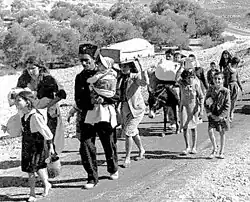
Fighting broke out in cities, towns, and along roads. Both sides attacked each other’s communities and transport routes.[82] Many people were forced to leave their homes because of the violence.[83] The situation became more serious as both sides tried to gain control over important areas before the end of British rule.[84] This conflict continued until 1948, when a larger war began after the creation of Israel.[85]
The UN Partition Plan was never fully carried out.[86] In May 1948, Jewish leaders declared the creation of the State of Israel, based partly on the ideas of the plan.[87] Soon after, several neighboring Arab countries, including Egypt, Jordan, Syria, and Iraq, attacked Israel. This led to the Arab-Israeli War of 1948.[88] The war ended with the signing of the Rhodes Armistice in 1949.[89] During the war, Israel gained control of 78% of Palestinian mandate, more land than it had been given in the UN plan.[90] The Arab state that was proposed in the plan was never created. Instead, Jordan took control of the West Bank, and Egypt took control of the Gaza Strip.[91]
The war also caused a large refugee crisis.[92] Hundreds of thousands of Palestinians fled or were forced to leave their homes.[93] Many of them moved to nearby countries or to other parts of Palestine. At the same time, many Jewish people moved to the new state of Israel, including refugees from Europe and the Middle East.[94] These events had long-lasting effects. The failure of the Partition Plan and the war that followed would shape the future political situation in the region.[95]
Jersulem: Special status and importance
Jerusalem was given a special international status in the UN Partition Plan.[96] It was not meant to be part of either the Jewish or Arab state.[97] Instead, the United Nations planned to control the city directly.[98] This was because Jerusalem is important to three major Abrahamic religions; Judaism, Christianity, and Islam. The goal was to protect the holy sites and allow free access for all religious groups.[99] The city and its surrounding area were meant to become an international zone, separate from both states.[100]
However, this plan was never fully implemented. During the war in 1948, Jerusalem was divided into two parts. West Jerusalem came under Israeli control, while East Jerusalem was controlled by Jordan.[101] Jerusalem has remained a central issue in the conflict ever since. Both Israelis and Palestinians claim the city as their capital, and its final status is still disputed today.[102]
Israel-Arab relations
The Palestine issue shaped the relationship between Israel and its neighbours for many years. Relations were poor in the years following the war and multiple military conflicts occurred.[103] On June 5, 1967, following increasing tensions in the region, Israel attacked Egypt, leading to what is known today as the Six Day War. By the end of the conflict, Israeli forces occupied Egyptian, Syrian and Palestinian territories.[104] On 6 October 1973, Egypt and Syria attacked Israel leading to the October War. Israel, with the help of the United States, was able to repel the attack, and a ceasefire was signed on October 24. [105]
Egypt was the first Arab state to normalise relations with Israel following the 1978 Camp David accords, a move that angered the other Arab nations and led to Egypt's expulsion from the Arab league.[106] Since then, some Arab nations have gradually normalised relations with Israel. Today, Egypt, Jordan, the United Arab Emirates, Morocco, Bahrain and Sudan recognise Israel. Nonetheless, the Palestine issue continues to be a point of disagreement.[107]
Long-term impact on the conflict
The UN Partition Plan had a strong and lasting impact on the Israeli-Palestinian conflict.[108] It introduced the idea of dividing the land into two separate states, which later became known as the “two-state solution.” Even though the plan was never fully carried out, it influenced many later peace efforts.[109] International organizations and governments have often returned to the idea of two states living side by side. Many of the problems that existed in 1947 are still important today.[110] These include disagreements over borders, the status of Jerusalem, and the rights of Palestinian refugees. Because of this, the Partition Plan is still discussed in politics and diplomacy. It is often seen as an early attempt to solve a complex conflict that remains unresolved.[111] The most recent attempt at a two state solution was the 2025 United Nations resolution 80/72 on the Settlement of the Question of Palestine, a proposed framework for resolving the Gaza War which included a two state solution.[112]
Historical Significance
The UN Partition Plan is considered a key moment in modern history. It was one of the first major actions taken by the United Nations to try to solve an international conflict. [113] The plan played an important role in the creation of the State of Israel in 1948. At the same time, it marked the beginning of a long and difficult conflict between Israelis and Palestinians.[114] It also showed both the possibilities and the limits of international organizations. While the UN was able to create a plan, it was not able to enforce it or prevent violence.
Historiography and interpretations
Historians have different opinions about the UN Partition Plan. Some believe it was a fair and necessary solution at the time, given the growing conflict and the need to find a political answer.[115] Other historians argue that the plan was unfair, especially to the Arab population, because it gave more land to the Jewish state even though Jews were a smaller part of the population. They also say the plan did not fully take into account the realities on the ground.[116] Historians also focused on different aspects of the plan. Some historians focus on the role of the United Nations and major powers, such as the United States and the Soviet Union, in supporting the plan. Others focus more on the experiences of local people and how the plan affected their lives.[117]
Because the conflict is still ongoing, different perspectives continue to influence how the plan is understood. This makes it an important and debated topic in both history and politics.[118]
References
- ↑ Ben-Dror, Elad (2007). "How the United Nations Intended to Implement the Partition Plan: The Handbook Drawn up by the Secretariat for the Members of the United Nations Palestine Commission". Middle Eastern Studies. 43 (6): 997. ISSN 0026-3206.
- ↑ Ben-Dror (2007). "How the United Nations Intended to Implement the Partition Plan". pp. 997.
- ↑ Gavison, Ruth, ed. (2013). The two-state solution: the UN partition resolution of mandatory Palestine ; analysis and sources. New York, NY: Bloomsbury [u.a.] p. 11. ISBN 978-1-62356-079-9.
- ↑ Gavison, Ruth (ed.). The Two-State Solution: The UN Partition Resolution of Mandatory Palestine - Analysis and Sources. p. 37.
- ↑ Biger, Gideon (2021). "The Partition Plans for Palestine—1930–1947". Israel Studies. 26 (3): 5. doi:10.2979/israelstudies.26.3.03. ISSN 1084-9513.
- ↑ United Nations: Palestinian Rights Committee (1980). "The Palestine Question: A Brief History". Question of Palestine. Retrieved 12 May 2026.
- ↑ United Nations (1947). "The Origins and Evolution of the Palestine Problem, part I: 1917-1947". Question of Palestine. p. 3. Retrieved 12 May 2026.
- ↑ United Nations (1947). "The Origins and Evolution of the Palestine Problem, part I: 1917-1947". p. 4.
- ↑ Barın, Büşra (2014). The Ottoman Policy towards Jewish Immigration and Settlement in Palestine: 1882–1920. Master’s thesis, METU. p.100 - 102.
- ↑ Büşra (2014). The Ottoman Policy towards Jewish Immigration and Settlement in Palestine: 1882–1920. p. 71.
- ↑ Reinkowski, Maurus (1999). "Late Ottoman Rule over Palestine: Its Evaluation in Arab, Turkish and Israeli Histories, 1970-90". Middle Eastern Studies. 35 (1): 66–97. ISSN 0026-3206.
- ↑ Sykes-Picot Agreement, 1916.
- ↑ Gelvin, James L. (2014). The Israel-Palestine Conflict: One Hundred Years of War (3 ed.). Cambridge: Cambridge University Press. doi:10.1017/CBO9781139583824.
- ↑ League of Nations (1922). "Mandate for Palestine - League of Nations". Question of Palestine. Retrieved 12 May 2026.
- ↑ Mendilow, Jonathan (2023). "Israel Is Created as a Homeland for Jews". EBSCO. Retrieved 21 May 2026.
- ↑ Reinkowski, Maurus (1999). "Late Ottoman Rule over Palestine". pp. 67.
- ↑ Izak, Krzysztof (9 October 2024). "The Jewish-Palestinian conflict. History and the Present". Terroryzm (6 (6)): 299–307. doi:10.4467/27204383TER.24.027.20247.
- ↑ Izak, Krzysztof (2024). "The Jewish-Palestinian conflict. History and the Present". Terrorism – Studies, Analyses, Prevention 2024: 304.
- ↑ United Nations (1980). "The Palestine Question: A Brief History". Question of Palestine. Retrieved 21 May 2026.
- ↑ Tessler, Mark (2009). A History of the Israeli-Palestinian Conflict, Second Edition (NED - New edition, 2 ed.). Indiana University Press. p. 90. doi:10.2307/j.ctt1d10hf6. ISBN 978-0-253-22070-7.
- ↑ Tessler, Mark (2009). A History of the Israeli-Palestine Conflict. p. 90.
- ↑ Pappé, Ilan (2006). The ethnic cleansing of Palestine. Oxford: Oneworld Publ. ISBN 978-1-85168-555-4.
- ↑ Tesslar, Mark (2009). A History of the Israeli-Palestinian Conflict. pp. 257–258.
- ↑ Tesslar, Mark (2009). A History of the Israeli-Palestinian Conflict. pp. 257–258.
- ↑ Khalidi, Rashid (2006). The Iron Cage: The Story of the Palestinian Struggle for Statehood. Boston: Beacon Press. pp. 32-35. ISBN 978-0-8070-0309-1.
- ↑ Cohen, Michael J. (1982). Palestine and the Great Powers, 1945-1948. Princeton University Press. p. 260.
- ↑ Morris, Benny (2008). 1948: A History of the First Arab-Israeli War. Yale University Press. pp. 56–57. doi:10.2307/j.ctt1np9bm. ISBN 978-0-300-14524-3.
- ↑ Franco, Jonathan (2023). "The Palestine Commission: the forgotten chapter in United Nations peacemaking and peacekeeping in the Arab-Israeli conflict". Middle Eastern Studies. 60 (5): 764. doi:10.1080/00263206.2023.2280232. ISSN 0026-3206.
- ↑ Morris, Benny (2008). 1948: A History of the First Arab-Israeli War. pp. 56–57.
- ↑ Morris, Benny (2008). 1948: A History of the First Arab-Israeli War. pp. 56–57.
- ↑ Franco, Jonathan (2023). "The Palestine Commission". pp. 766.
- ↑ Cohen, Micheal J (1982). Palestine and the Great Powers, 1945 - 1948. pp. 12-15.
- ↑ Gelber, Yoav (2012). Palestine 1948: War, Escape and the Emergence of the Palestinian Refugee Problem. Liverpool University Press. pp. 1–3. doi:10.2307/jj.18654759. ISBN 978-1-902210-67-4.
- ↑ Gelber, Yoav (2006). Palestine 1948. pp. 16.
- ↑ Gelber, Yoav (2006). Palestine1948. p. 16.
- ↑ Morris, Benny (2008). 1948: A History of the First Arab-Israeli War. p. 66.
- ↑ Ben-Dror, Elad (2007). "How the United Nations Intended to Implement the Partition Plan". pp. 997
- ↑ United Nations General Assembly. (1947). Resolution 181 (III). Future Government of Palestine. p.3-9.
- ↑ United Nations General Assembly. (1947). Resolution 181 (III). Future Government of Palestine. p.13
- ↑ Cohen, Michael J. (1982). Palestine and the Great Powers. pp. 5–10.
- ↑ Gelber, Yoav (1982). Palestine 1948. pp. Introduction.
- ↑ Morris, Benny (2008). 1948: A History of the First Arab-Israeli War. pp. 90–95.
- ↑ Rogan, Eugene L.; Shlaim, Avi, eds. (2007). The War for Palestine: Rewriting the History of 1948. Cambridge Middle East Studies (2 ed.). Cambridge: Cambridge University Press. p. 2. doi:10.1017/CBO9781139167413. ISBN 978-0-521-87598-1.
- ↑ Cohen, Michael J (1982). Palestine and the Great Powers. pp. 260–262.
- ↑ Cohen, Michael J (1982). Palestine and the Great Powers. pp. 5–10.
- ↑ Morris, Benny (2008). 1948: A History of the First Arab-Israeli War. pp. 100–105.
- ↑ Morris, Benny (2008). 1948: A History of the First Arab-Israeli War. p. 100.
- ↑ Morris, Benny (2008). 1948: A History of the First Arab-Israeli War. p. 100.
- ↑ Gelber, Yoav (2006). Palestine 1948. pp. Introduction.
- ↑ Morris, Benny (2008). 1948: A History of the First Arab-Israeli War. p. 100.
- ↑ Rogan, Eugene; Shlaim, Avi, eds. (2007). The War for Palestine (2nd ed.). p. 2.
- ↑ United Nations (1947). The Origins and Evolution of the Palestine Problem, part I: 1917-1947
- ↑ United Nations. "How Decisions are Made at the UN". United Nations. Retrieved 23 May 2026.
- ↑ United Nations General Assembly. (1947). Resolution 181 (III). Future Government of Palestine. p.1-2
- ↑ United Nations General Assembly. (1947). Resolution 181 (III). Future Government of Palestine. p.13, 15, 16
- ↑ United Nations General Assembly. (1947). Resolution 181 (III). Future Government of Palestine. p.7-9
- ↑ United Nations General Assembly. (1947). Resolution 181 (III). Future Government of Palestine. p.3,7
- ↑ United Nations General Assembly. (1947). Resolution 181 (III). Future Government of Palestine. p.1
- ↑ Morris, Benny (2008). 1948: A History of the First Arab-Israeli War. p. 45.
- ↑ Morris, Benny (2008). 1948: A History of the First Arab-Israeli War. p. 45.
- ↑ Ben-Dror, Elad (2007). "The Arab Struggle against Partition: The International Arena of Summer 1947". Middle Eastern Studies. 43 (2): 259–260. ISSN 0026-3206.
- ↑ Franco, Jonathan. "The Palestine Commission". Middle Eastern Studies: 763.
- ↑ Morris, Benny (2008). 1948: A History of the First Arab-Israeli War. p. 76.
- ↑ Morris, Benny (2008). 1948: A History of the First Arab-Israeli War. p. 70.
- ↑ Morris, Benny. 1948: A History of the First Arab-Israeli War. p. 71.
- ↑ Morris, Benny (2008). 1948: A History of the First Arab-Israeli War. p. 72.
- ↑ Franco, Jonathan (2023). "The Palestine Commission". pp. 763.
- ↑ Franco, Jonathan (2023). "The Palestine Commission". pp. 765.
- ↑ Franco, Jonathan (2023). "The Palestine Commission". pp. 766.
- ↑ Franco, Jonathan (2023). "The Palestine Commission". pp. 766.
- ↑ Gelber, Yoav (2006). Palestine 1948. pp. Introduction.
- ↑ Cohen, Michael J (1982). Palestine and the Great Powers. pp. 260–262.
- ↑ Gelber, Yoav (2006). Palestine 1948. pp. Introduction.
- ↑ Cohen, Micheal J (1982). Palestine and the Great Powers. pp. 260–262.
- ↑ Gelber, Yoav (2006). Palestine 1948. pp. 16-20.
- ↑ Gelber, Yoav (2006). Palestine 1948. pp. 31.
- ↑ Gelber, Yoav (2006). Palestine 1948. pp. 59.
- ↑ Cohen, Michael J. Palestine and the great Powers. pp. 260–262.
- ↑ Cohen, Michael J (1982). Palestine and the Great Powers. p. 203.
- ↑ Gelber, Yoav (1982). Palestine 1948. pp. 16–20.
- ↑ Morris, Benny (2008). 1948: A History of the First Arab-Israeli War. p. 101.
- ↑ Morris, Benny (2008). 1948: A History of the First Arab-Israeli War. p. 93.
- ↑ Morris, Benny (2008). 1948: A History of the First Arab-Israeli War. p. 94.
- ↑ Morris, Benny (2008). 1948: A History of the First Arab-Israeli War. p. 93.
- ↑ Gelber, Yoav (2006). Palestine 1948. pp. 19.
- ↑ Pappé, Ilan (1 October 2006). "The 1948 Ethnic Cleansing of Palestine". Journal of Palestine Studies. 36 (1): 6–20. doi:10.1525/jps.2006.36.1.6. ISSN 0377-919X.
- ↑ Pappé, Ilan (2006). The 1948 Ethnic Cleansing of Palestine. pp.14
- ↑ Gelber, Yoav (2006). Palestine 1948. pp. 19.
- ↑ Gelber, Yoav (2006). Palestine 1948. pp. 20.
- ↑ Gelber, Yoav (2006). Palestine 1948. pp. 20.
- ↑ Morris, Benny (2008). 1948: A History of the First Arab-Israeli War. p. 195.
- ↑ Morris, Benny (2008). 1948: A History of the First Arab-Israeli War. p. 195.
- ↑ Morris, Benny (2008). 1948: A History of the First Arab-Israeli War.
- ↑ Anderson, Betty S. (2016). A History of the Modern Middle East. Stanford University Press. p. 333. doi:10.1515/9780804798754. ISBN 978-0-8047-9875-4.
- ↑ Morris, Benny (2008). 1948: A History of the First Arab-Isreali War. p. 93.
- ↑ "U.N. Security Council: Resolution 181, The Partition of Palestine (November 29, 1947)", The Arab-Israeli Conflict, Routledge, pp. 109–115, 10 September 2009, ISBN 978-0-203-87159-1, retrieved 22 May 2026
- ↑ "U.N. Security Council: Resolution 181, The Partition of Palestine (November 29, 1947)", The Arab-Israeli Conflict, Routledge, pp. 109–115, 10 September 2009, ISBN 978-0-203-87159-1, retrieved 22 May 2026
- ↑ "U.N. Security Council: Resolution 181, The Partition of Palestine (November 29, 1947)", The Arab-Israeli Conflict, Routledge, pp. 109–115, 10 September 2009, ISBN 978-0-203-87159-1, retrieved 22 May 2026
- ↑ Anderson, Betty S. (2016). A History of the Modern Middle East. pp. 335.
- ↑ Anderson, Betty S. (2016). A History of the Modern Middle East. pp. 335.
- ↑ Anderson, Betty S. (2016). A History of the Modern Middle East. pp. 333.
- ↑ Anderson, Betty S. (2016). A History of the Modern Middle East. pp. 335.
- ↑ Anderson, Betty S. (2016). A History of the Modern Middle East. pp. 335.
- ↑ Anderson, Betty S. (2016). A History of the Modern Middle East. pp. 337.
- ↑ Bakare, Najimdeen (2024), "Introduction: Continuity in Tradition and Reconstruction of the Past: An Analysis of Contemporary Middle East", Arab-Israel Normalisation of Ties, Singapore: Springer Nature Singapore, pp. 3–21, ISBN 978-981-99-7764-2, retrieved 22 May 2026
- ↑ Anderson, Betty S. (2020). A History of the Modern Middle East. pp. 337.
- ↑ Bakare, Najimdeen (2024). Arab-Israel Normalisation of Ties. pp. 2
- ↑ Rogan, Eugene L.; Shlaim, Avi, eds. (2007). The War for Palestine. p. 1.
- ↑ Franco, Jonathan (2023). "The Palestine Commission". pp. 763-776
- ↑ Rogan, Eugene L.; Shlaim, Avi, eds. (2007). The War for Palestine. p. 2.
- ↑ Rogan, Eugene; Shlaim, Avi (2002). 1948 : la guerre de Palestine. Autrement. p. 2.
- ↑ United Nations. "General Assembly Resolution: Peaceful settlement of the question of Palestine (A/RES/80/72)". Question of Palestine. Retrieved 28 May 2026.
- ↑ Pappé, Ilan (2006). The 1948 Ethnic Cleansing of Palestine. pp. 6–20.
- ↑ Tessler, Mark (2009). A History of the Israeli-Palestinian Conflict, Second Edition. p. 91.
- ↑ Tessler, Mark (2009). A History of the Israeli-Palestinian Conflict, Second Edition. p. 91.
- ↑ Pappé, Ilan (2006). The 1948 Ethnic Cleansing of Palestine. pp.60.
- ↑ Pappé, Ilan (2006). The 1948 Ethnic Cleansing of Palestine. pp.60.
- ↑ Pappé, Ilan (2006). The 1948 Ethnic Cleansing of Palestine. pp.57