The Cambodian–Vietnamese War was a war fought between Kampuchea (present-day Cambodia) and Vietnam.[1] The war had started because of repeated attacks by the Khmer Rouge guerillas into Vietnamese territory, which often caused the massacre of entire villages. On 21 December 1978, after the Khmer Rouge had raided a village on the border, perpetrating the Ba Chúc massacre, murdering almost all 3,000 Vietnamese civilians, Vietnam decided to launch a full-scale invasion of Kampuchea, which the aim of overthrowing the Khmer Rouge forces of Pol Pot. Less than 2 weeks later, the Vietnamese army entered Phnom Penh, establishing a new government made up of Khmer Rouge defectors. In response to the overthrow of the Khmer Rouge, China invaded Vietnam. As a response to the overthrow of the Khmer Rouge, Vietnam managed to stop the Cambodian genocide, which caused the deaths of between 1.5 million and 3 million people, approximately 25 percent of the country's population.
| Cambodian - Vietnamese War |
|---|
| Part of the Third Indochina War, Cold War and the Sino-Soviet split |
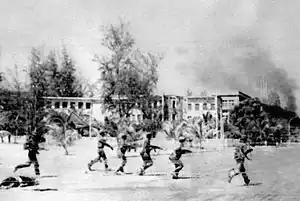
Vietnamese soldiers entering Phnom Penh in January 1979 |
| Date | 21 December 1978 - 23 October 1991
(14 years, 5 months, 3 weeks and 2 days) |
|---|
| Location | |
|---|
| Result |
Vietnamese/PRK victory
- Removal of the Khmer Rouge from power
- End of the Cambodian genocide
- Disestablishment of Democratic Kampuchea
- Creation, then disestablishment of the People's Republic of Kampuchea
- Creation of the State of Cambodia and a UN-led transitional government
- Chinese invasion of Vietnam and border clashes
- Signing of Paris Peace Agreements in 1991, restoring the House of Norodom.
- Start of CGDK insurgency in Thailand and Vietnamese border raids in Thailand
- Re-establishment of the Kingdom of Cambodia
|
|---|
|
| Belligerents |
|---|
|
 Democratic Kampuchea
(1978 - 82)
Coalition Government of Democratic Kampuchea (1982 - 91)
 Thailand
 China
 United States |
 Vietnam
 People's Republic of Kampuchea (1979 - 89)
 State of Cambodia (1989 - 91) |
| Commanders and leaders |
|---|
Pol Pot
Khieu Samphan
Ieng Sary
Nuon Chea
Ta Mok
Son Sen
 Norodom Sihanouk
Norodom Ranariddh
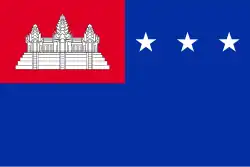 Son Sann
Dien Del
Ronald Reagan
Bhumibol Adulyadej
Prem Tinsulanonda
Chavalit Yongchaiyudh
Deng Xiaoping |
Lê Duẩn
Trường Chinh
Nguyễn Văn Linh
Võ Nguyên Giáp
Heng Samrin
Hun Sen
Pen Sovan
Chan Sy
Chea Sim |
| Strength |
|---|
1979: 73,000
1989: 30,000 |
150,000 - 200,000 Vietnamese soldiers |
| Casualties and losses |
|---|
- 1975–1979:
c. 15,000 killed[2] - 1979–1989: more than 100,000 killed
|
- 1975–1979:
- 10,000 killed[2]
- 1979–1989:
- Vietnam:
- People's Republic of Kampuchea:
- Total: 25,000–52,000 killed[5]
|
|
200,000+ Cambodian civilians killed |
References
- ↑ "Vietnam's Invasion of Cambodia, Revisited". thediplomat.com. Retrieved 2022-12-11.
- 1 2 Khoo, p. 127
- 1 2 Vietnamese sources generally offer contradictory figures, but Vietnamese General Tran Cong Man stated that at "least 15,000 soldiers died and another 30,000 were wounded in the ten-year long Cambodian campaign"—so the figures do not include the casualties from the period between 1975 and 1979. Thayer, 10
- ↑ SIPRI Yearbook: Stockholm International Peace Research Institute
- ↑ Clodfelter, p. 627.
|
|---|
|
| 1940s | |
|---|
| 1950s | |
|---|
| 1960s | |
|---|
| 1970s | |
|---|
| 1980s | |
|---|
| 1990s | |
|---|
| Frozen conflicts | |
|---|
| Foreign policy | |
|---|
| Ideologies | |
|---|
| Organizations | |
|---|
| Propaganda | | Pro-communist |
- Active measures
- Izvestia
- Neues Deutschland
- Pravda
- Rudé právo
- Trybuna Ludu
- TASS
- Soviet Life
|
|---|
| Pro-Western | |
|---|
|
|---|
Technological
competition | |
|---|
| Historians |
- Gar Alperovitz
- Thomas A. Bailey
- Michael Beschloss
- Archie Brown
- Warren H. Carroll
- Adrian Cioroianu
- John Costello
- Michael Cox
- Nicholas J. Cull
- Norman Davies
- Willem Drees
- Robert D. English
- Herbert Feis
- Robert Hugh Ferrell
- André Fontaine
- Anneli Ute Gabanyi
- John Lewis Gaddis
- Lloyd Gardner
- Timothy Garton Ash
- Gabriel Gorodetsky
- Fred Halliday
- Jussi Hanhimäki
- John Earl Haynes
- Patrick J. Hearden
- Tvrtko Jakovina
- Tony Judt
- Harvey Klehr
- Gabriel Kolko
- Walter LaFeber
- Walter Laqueur
- Melvyn P. Leffler
- Geir Lundestad
- Vojtech Mastny
- Jack F. Matlock Jr.
- Thomas J. McCormick
- Timothy Naftali
- Marius Oprea
- David S. Painter
- William B. Pickett
- Ronald E. Powaski
- Yakov M. Rabkin
- Mary Elise Sarotte
- Arthur M. Schlesinger Jr.
- Ellen Schrecker
- Giles Scott-Smith
- Shen Zhihua
- Timothy Snyder
- Athan Theoharis
- Andrew Thorpe
- Vladimir Tismăneanu
- Patrick Vaughan
- Alex von Tunzelmann
- Odd Arne Westad
- William Appleman Williams
- Jonathan Reed Winkler
- Rudolph Winnacker
- Ken Young
|
|---|
Espionage and
intelligence |
- List of Eastern Bloc agents in the United States
- Soviet espionage in the United States
- Russian espionage in the United States
- American espionage in the Soviet Union and Russian Federation
- CIA and the Cultural Cold War
- CIA
- MI5
- MI6
- United States involvement in regime change
- Soviet involvement in regime change
- MVD
- KGB
- Stasi
|
|---|
| See also | |
|---|
- Category
- List of conflicts
- Timeline
|