List of presidents of the United States
This is a list of people who have served as President of the United States. As of 2025, there have been 45 men sworn into office and 47 presidencies; there have been more presidencies than people sworn into office because Grover Cleveland and Donald Trump won two nonconsecutive (not back-to-back) terms. Donald Trump is the 47th and current president; he also served as the 45th president.
George Washington, the first president, is the only president who was not a member of a political party. William Henry Harrison spent the shortest time in office, at 31 days; Franklin D. Roosevelt spent the longest at over twelve years. Franklin D. Roosevelt is the only president to serve more than two terms; he died early in his fourth. The youngest person to serve as president is Theodore Roosevelt, at 42 years old; the oldest is Joe Biden, at 82 years old. The youngest person elected President is John F. Kennedy at 43 years old; the oldest is Donald Trump at 78 years old. John F. Kennedy had the shortest lifespan of any president, at 46 years; Jimmy Carter had the longest, at 100 years. Eight presidents have died in office (William Henry Harrison, Zachary Taylor, Abraham Lincoln, James A. Garfield, William McKinley, Warren G. Harding, Franklin D. Roosevelt, and John F. Kennedy). Richard Nixon is the only president to resign from office. Five people (John Quincy Adams, Rutherford B. Hayes, Benjamin Harrison, George W. Bush, and Donald Trump) won the presidency without winning the most votes in their election. Three presidents have been impeached (Andrew Johnson, Bill Clinton, and Donald Trump twice). Barack Obama was the first president of color.
Presidents
| No.[a] | Portrait | Name (birth–death) |
Term[1] | Party[b][2] | Election | Vice President[3] | |
|---|---|---|---|---|---|---|---|
| 1 |  |
George Washington (1732–1799) [4] |
April 30, 1789 – March 4, 1797 |
Unaffiliated | 1788–89 | John Adams[c] | |
| 1792 | |||||||
| 2 | 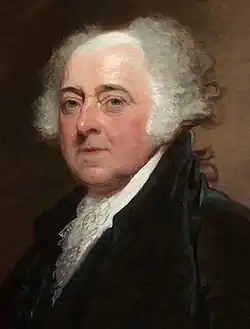 |
John Adams (1735–1826) [6] |
March 4, 1797 – March 4, 1801 |
Federalist | 1796 | Thomas Jefferson[d] | |
| 3 | 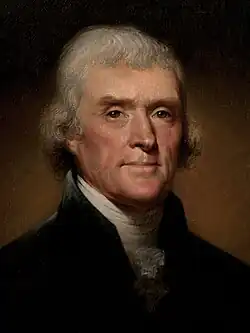 |
Thomas Jefferson (1743–1826) [8] |
March 4, 1801 – March 4, 1809 |
Democratic- Republican |
1800 | Aaron Burr | |
| 1804 | George Clinton | ||||||
| 4 | 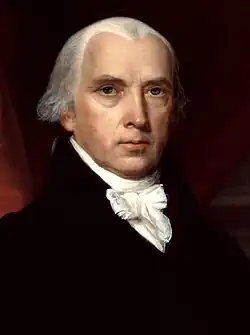 |
James Madison (1751–1836) [9] |
March 4, 1809 – March 4, 1817 |
Democratic- Republican |
1808 | George Clinton[e] | |
| Vacant after April 20, 1812 | |||||||
| 1812 | Elbridge Gerry[e] | ||||||
| Vacant after November 23, 1814 | |||||||
| 5 | 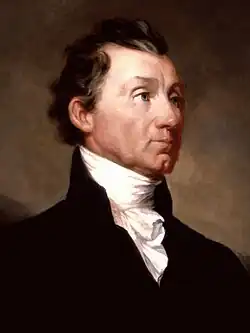 |
James Monroe (1758–1831) [11] |
March 4, 1817 – March 4, 1825 |
Democratic- Republican |
1816 | Daniel D. Tompkins | |
| 1820 | |||||||
| 6 | 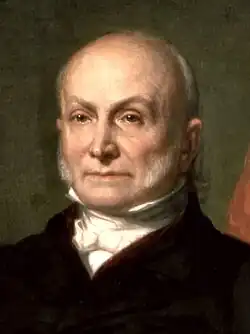 |
John Quincy Adams (1767–1848) [12] |
March 4, 1825 – March 4, 1829 |
Democratic- Republican[f] |
1824 | John C. Calhoun[g] | |
| National Republican | |||||||
| 7 | 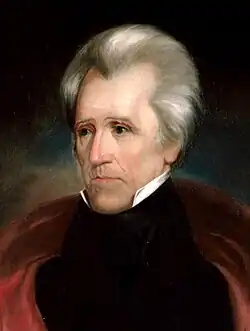 |
Andrew Jackson (1767–1845) [15] |
March 4, 1829 – March 4, 1837 |
Democratic | 1828 | John C. Calhoun[h] | |
| Vacant after December 28, 1832 | |||||||
| 1832 | Martin Van Buren | ||||||
| 8 | 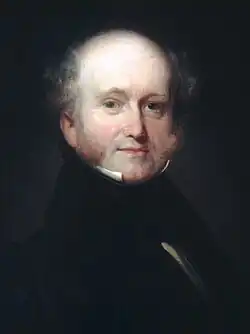 |
Martin Van Buren (1782–1862) [16] |
March 4, 1837 – March 4, 1841 |
Democratic | 1836 | Richard Mentor Johnson | |
| 9 | 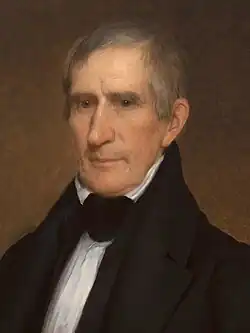 |
William Henry Harrison (1773–1841) [17] |
March 4, 1841 – April 4, 1841[e] |
Whig | 1840 | John Tyler | |
| 10 | 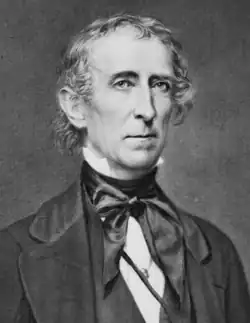 |
John Tyler (1790–1862) [18] |
April 4, 1841[i] – March 4, 1845 |
Whig[j] | – | Vacant throughout presidency | |
| Unaffiliated | |||||||
| 11 | 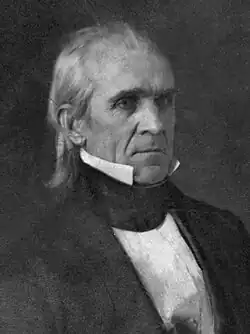 |
James K. Polk (1795–1849) [21] |
March 4, 1845 – March 4, 1849 |
Democratic | 1844 | George M. Dallas | |
| 12 | 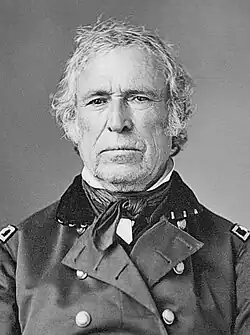 |
Zachary Taylor (1784–1850) [22] |
March 4, 1849 – July 9, 1850[e] |
Whig | 1848 | Millard Fillmore | |
| 13 | 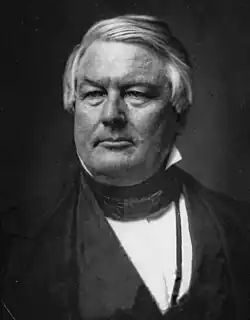 |
Millard Fillmore (1800–1874) [23] |
July 9, 1850[k] – March 4, 1853 |
Whig | – | Vacant throughout presidency | |
| 14 | 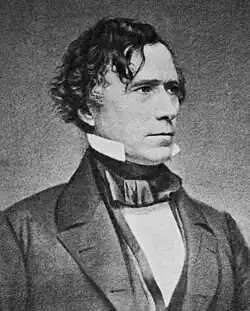 |
Franklin Pierce (1804–1869) [25] |
March 4, 1853 – March 4, 1857 |
Democratic | 1852 | William R. King[e] | |
| Vacant after April 18, 1853 | |||||||
| 15 | 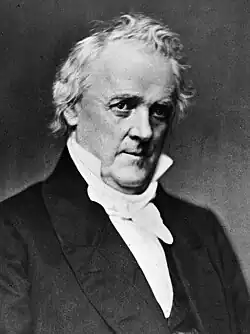 |
James Buchanan (1791–1868) [26] |
March 4, 1857 – March 4, 1861 |
Democratic | 1856 | John C. Breckinridge | |
| 16 | 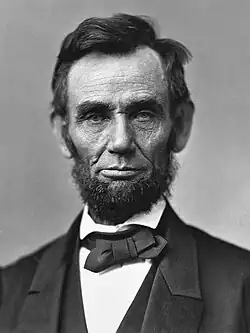 |
Abraham Lincoln (1809–1865) [27] |
March 4, 1861 – April 15, 1865[e] |
Republican | 1860 | Hannibal Hamlin | |
| National Union[l] | 1864 | Andrew Johnson | |||||
| 17 | 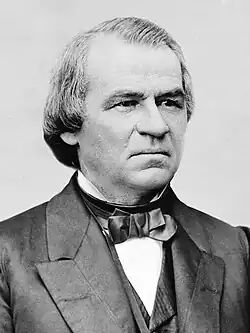 |
Andrew Johnson (1808–1875) [29] |
April 15, 1865[m] – March 4, 1869 |
National Union[n] | – | Vacant throughout presidency | |
| Democratic | |||||||
| 18 | 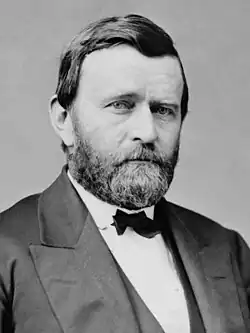 |
Ulysses S. Grant (1822–1885) [30] |
March 4, 1869 – March 4, 1877 |
Republican | 1868 | Schuyler Colfax | |
| 1872 | Henry Wilson[e] | ||||||
| Vacant after November 22, 1875 | |||||||
| 19 | 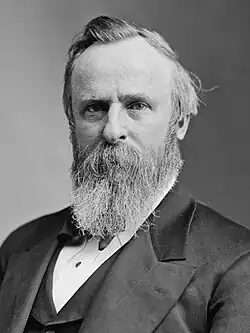 |
Rutherford B. Hayes (1822–1893) [31] |
March 4, 1877 – March 4, 1881 |
Republican | 1876 | William A. Wheeler | |
| 20 | 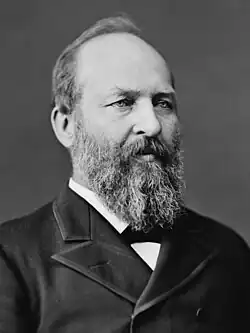 |
James A. Garfield (1831–1881) [32] |
March 4, 1881 – September 19, 1881[e] |
Republican | 1880 | Chester A. Arthur | |
| 21 | 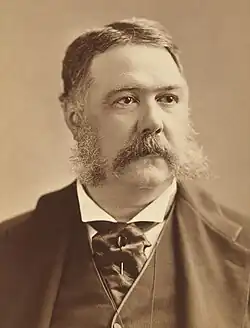 |
Chester A. Arthur (1829–1886) [33] |
September 19, 1881[o] – March 4, 1885 |
Republican | – | Vacant throughout presidency | |
| 22 |  |
Grover Cleveland (1837–1908) 1st term [35] |
March 4, 1885 – March 4, 1889 |
Democratic | 1884 | Thomas A. Hendricks[e] | |
| Vacant after November 25, 1885 | |||||||
| 23 | 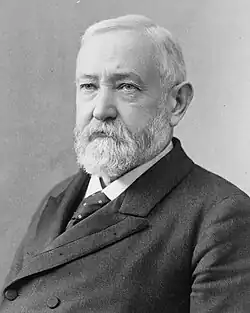 |
Benjamin Harrison (1833–1901) [36] |
March 4, 1889 – March 4, 1893 |
Republican | 1888 | Levi P. Morton | |
| 24 | 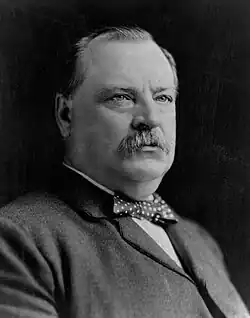 |
Grover Cleveland (1837–1908) 2nd term [35] |
March 4, 1893 – March 4, 1897 |
Democratic | 1892 | Adlai Stevenson I | |
| 25 | 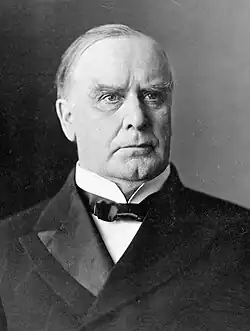 |
William McKinley (1843–1901) [37] |
March 4, 1897 – September 14, 1901[e] |
Republican | 1896 | Garret Hobart[e] | |
| Vacant after November 21, 1899 | |||||||
| 1900 | Theodore Roosevelt | ||||||
| 26 | 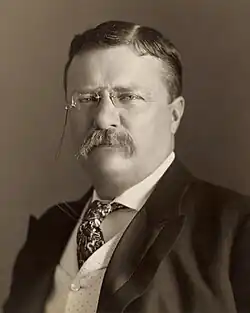 |
Theodore Roosevelt (1858–1919) [38] |
September 14, 1901[p] – March 4, 1909 |
Republican | – | Vacant through March 4, 1905 | |
| 1904 | Charles W. Fairbanks | ||||||
| 27 | 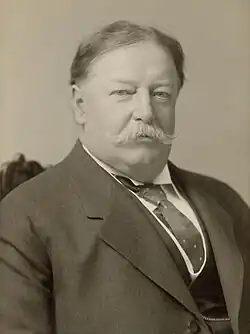 |
William Howard Taft (1857–1930) [40] |
March 4, 1909 – March 4, 1913 |
Republican | 1908 | James S. Sherman[e] | |
| Vacant after October 30, 1912 | |||||||
| 28 | 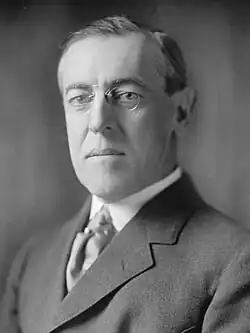 |
Woodrow Wilson (1856–1924) [41] |
March 4, 1913 – March 4, 1921 |
Democratic | 1912 | Thomas R. Marshall | |
| 1916 | |||||||
| 29 | 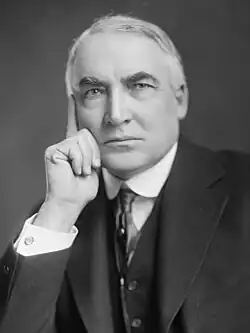 |
Warren G. Harding (1865–1923) [42] |
March 4, 1921 – August 2, 1923[e] |
Republican | 1920 | Calvin Coolidge | |
| 30 | 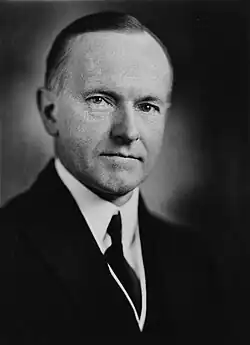 |
Calvin Coolidge (1872–1933) [43] |
August 2, 1923[q] – March 4, 1929 |
Republican | – | Vacant through March 4, 1925 | |
| 1924 | Charles G. Dawes | ||||||
| 31 | 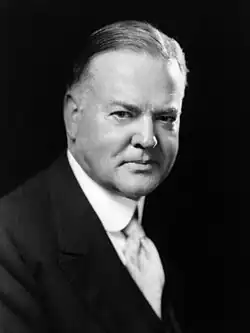 |
Herbert Hoover (1874–1964) [45] |
March 4, 1929 – March 4, 1933 |
Republican | 1928 | Charles Curtis | |
| 32 | 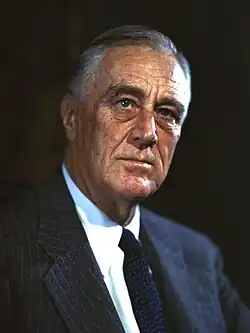 |
Franklin D. Roosevelt (1882–1945) [46] |
March 4, 1933 – April 12, 1945[e] |
Democratic | 1932 | John Nance Garner | |
| 1936 | |||||||
| 1940 | Henry A. Wallace | ||||||
| 1944 | Harry S. Truman | ||||||
| 33 | 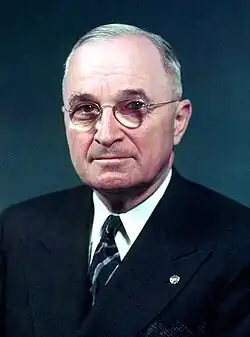 |
Harry S. Truman (1884–1972) [47] |
April 12, 1945[r] – January 20, 1953 |
Democratic | – | Vacant through January 20, 1949 | |
| 1948 | Alben W. Barkley | ||||||
| 34 |  |
Dwight D. Eisenhower (1890–1969) [49] |
January 20, 1953 – January 20, 1961 |
Republican | 1952 | Richard Nixon | |
| 1956 | |||||||
| 35 | 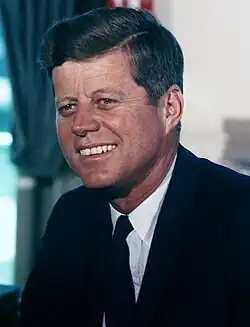 |
John F. Kennedy (1917–1963) [50] |
January 20, 1961 – November 22, 1963[e] |
Democratic | 1960 | Lyndon B. Johnson | |
| 36 | 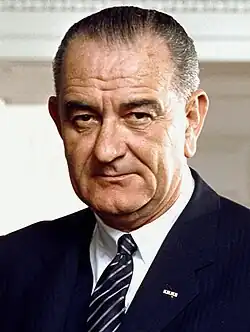 |
Lyndon B. Johnson (1908–1973) [51] |
November 22, 1963[s] – January 20, 1969 |
Democratic | – | Vacant through January 20, 1965 | |
| 1964 | Hubert Humphrey | ||||||
| 37 | 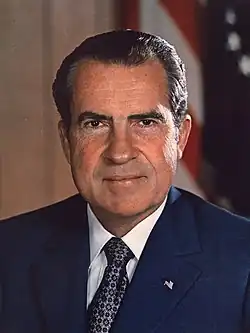 |
Richard Nixon (1913–1994) [53] |
January 20, 1969 – August 9, 1974[h] |
Republican | 1968 | Spiro Agnew[h] | |
| 1972 | |||||||
| Vacant: October 10 – December 6, 1973 | |||||||
| Gerald Ford[t] | |||||||
| 38 | 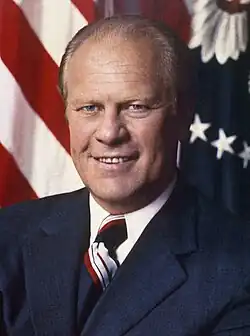 |
Gerald Ford (1913–2006) [54] |
August 9, 1974[u] – January 20, 1977 |
Republican | – | Vacant through December 19, 1974 | |
| Nelson Rockefeller[t] | |||||||
| 39 | 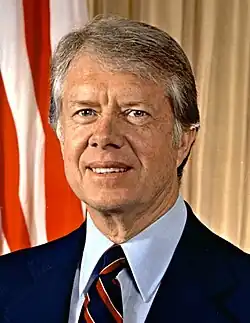 |
Jimmy Carter (1924–2024) [55] |
January 20, 1977 – January 20, 1981 |
Democratic | 1976 | Walter Mondale | |
| 40 | 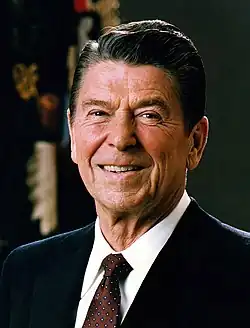 |
Ronald Reagan (1911–2004) [56] |
January 20, 1981 – January 20, 1989 |
Republican | 1980 | George H. W. Bush | |
| 1984 | |||||||
| 41 | 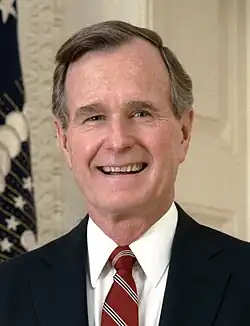 |
George H. W. Bush (1924–2018) [57] |
January 20, 1989 – January 20, 1993 |
Republican | 1988 | Dan Quayle | |
| 42 | 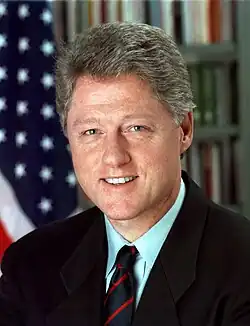 |
Bill Clinton (b. 1946) [58] |
January 20, 1993 – January 20, 2001 |
Democratic | 1992 | Al Gore | |
| 1996 | |||||||
| 43 | 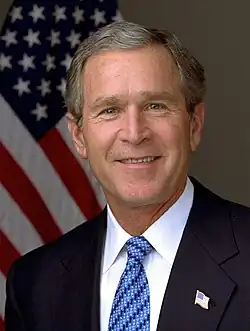 |
George W. Bush (b. 1946) [59] |
January 20, 2001 – January 20, 2009 |
Republican | 2000 | Dick Cheney | |
| 2004 | |||||||
| 44 | 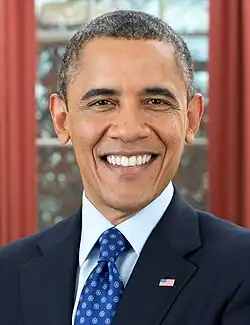 |
Barack Obama (b. 1967) [60] |
January 20, 2009 – January 20, 2017 |
Democratic | 2008 | Joe Biden | |
| 2012 | |||||||
| 45 |  |
Donald Trump (b. 1946) 1st term [61] |
January 20, 2017 – January 20, 2021 |
Republican | 2016 | Mike Pence | |
| 46 | 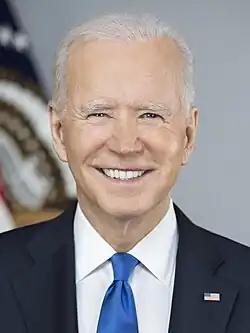 |
Joe Biden (b. 1942) [62] |
January 20, 2021 – January 20, 2025 |
Democratic | 2020 | Kamala Harris | |
| 47 |  |
Donald Trump (b. 1946) 2nd term [61] |
January 20, 2025 – Incumbent |
Republican | 2024 | JD Vance | |
List of living former presidents
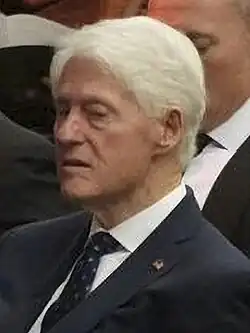
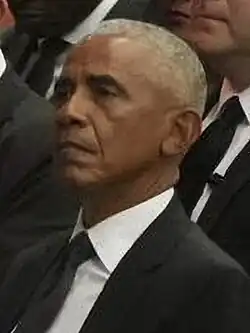
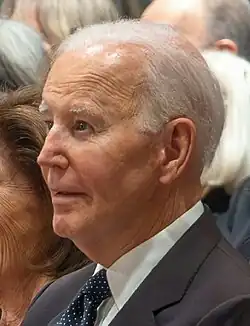
There are four living former presidents.

References
- ↑ LOC; whitehouse.gov.
- ↑ Guide to U.S. Elections (2010), pp. 257–258.
- ↑ LOC.
- ↑ McDonald (2000).
- ↑ Guide to U.S. Elections (2010), pp. 197, 272; Nardulli (1992), p. 179.
- ↑ Pencak (2000).
- ↑ Guide to U.S. Elections (2010), p. 274.
- ↑ Peterson (2000).
- ↑ Banning (2000).
- 1 2 3 Neale (2004), p. 22.
- ↑ Ammon (2000).
- ↑ Hargreaves (2000).
- ↑ Guide to U.S. Elections (2010), p. 228; Goldman (1951), p. 159.
- ↑ Guide to U.S. Elections (2010), p. 892; Houpt (2010), pp. 26, 280.
- ↑ Remini (2000).
- ↑ Cole (2000).
- ↑ Gutzman (2000).
- ↑ Shade (2000).
- ↑ Abbott (2013), p. 23.
- ↑ Cash (2018), pp. 34–36.
- ↑ Rawley (2000).
- ↑ Smith (2000).
- ↑ Anbinder (2000).
- ↑ Abbott (2005), p. 639.
- ↑ Gara (2000).
- ↑ Gienapp (2000).
- ↑ McPherson (b) (2000).
- ↑ McSeveney (1986), p. 139.
- 1 2 3 Trefousse (2000).
- ↑ McPherson (a) (2000).
- ↑ Hoogenboom (2000).
- ↑ Peskin (2000).
- ↑ Reeves (2000).
- ↑ Greenberger (2017), pp. 174–175.
- 1 2 Campbell (2000).
- ↑ Spetter (2000).
- ↑ Gould (a) (2000).
- ↑ Harbaugh (2000).
- ↑ Abbott (2005), pp. 639–640.
- ↑ Gould (b) (2000).
- ↑ Ambrosius (2000).
- ↑ Hawley (2000).
- ↑ McCoy (2000).
- ↑ Senate.
- ↑ Hoff (a) (2000).
- ↑ Brinkley (2000).
- ↑ Hamby (2000).
- ↑ Abbott (2005), p. 636.
- ↑ Ambrose (2000).
- ↑ Parmet (2000).
- ↑ Gardner (2000).
- ↑ Abbott (2005), p. 633.
- ↑ Hoff (b) (2000).
- 1 2 Greene (2013).
- ↑ whitehouse.gov (a).
- ↑ Schaller (2004).
- ↑ whitehouse.gov (b).
- ↑ whitehouse.gov (c).
- ↑ whitehouse.gov (d).
- ↑ whitehouse.gov (e).
- 1 2 whitehouse.gov (f).
- ↑ whitehouse.gov (g).
Notes
- ↑ Presidents are numbered according to uninterrupted periods served by the same person. For example, George Washington served two consecutive terms and is counted as the first president, instead of the first and second, but Grover Cleveland and Donald Trump are counted twice because their two terms were not consecutive. A vice president who temporarily becomes acting president under the Twenty-fifth Amendment to the Constitution is not counted, because the president remains in office during such a period.
- ↑ Reflects the president's political party at the start of their presidency. Changes during their time in office are noted. Also reflects the vice president's political party unless otherwise noted beside the individual's name.
- ↑ Political parties had not been anticipated when the Constitution was drafted, nor did they exist at the time of the first presidential election in 1788–89. When they did develop, during Washington's first term, Adams joined the faction that became the Federalist Party. The elections of 1792 were the first ones in the United States that were contested on anything resembling a partisan basis.[5]
- ↑ The 1796 presidential election was the first contested American presidential election and the only one in which a president and vice president were elected from opposing political parties. Federalist John Adams was elected president, and Jefferson of the Democratic-Republicans was elected vice president.[7]
- 1 2 3 4 5 6 7 8 9 10 11 12 13 14 15 Died in office[10]
- ↑ Early during John Quincy Adams' term, the Democratic-Republican Party dissolved; his allies in Congress and at the state level were referred to as "Adams' Men" during the Adams presidency. When Andrew Jackson became president in 1829, this group became the "Anti-Jackson" opposition, and organized themselves as the National Republican Party.[13]
- ↑ John Calhoun, formerly a Democratic-Republican, founded the Nullifier Party in 1828 to oppose the Tariff of 1828 and advance the cause of states' rights, but was brought on as Andrew Jackson's running mate in the 1828 presidential election in an effort to broaden the democratic coalition led by Jackson.[14]
- 1 2 3 Resigned from office[10]
- ↑ John Tyler succeeded to the presidency upon the death of William Henry Harrison.[19]
- ↑ John Tyler was elected vice president on the Whig Party ticket in 1840. His policy priorities as president soon proved to be opposed to most of the Whig agenda, and he was expelled from the party five months after assuming office.[20]
- ↑ Millard Fillmore succeeded to the presidency upon the death of Zachary Taylor.[24]
- ↑ When he ran for reelection in 1864, Republican Abraham Lincoln formed a bipartisan electoral alliance with War Democrats by selecting Democrat Andrew Johnson as his running mate, and running on the National Union Party ticket.[28]
- ↑ Andrew Johnson succeeded to the presidency upon the death of Abraham Lincoln.[29]
- ↑ While president, Andrew Johnson tried and failed to build a coalition of loyalists under the National Union banner. Near the end of his presidency, Johnson began reassociating with the Democratic Party.[29]
- ↑ Chester A. Arthur succeeded to the presidency upon the death of James A. Garfield.[34]
- ↑ Theodore Roosevelt succeeded to the presidency upon the death of William McKinley.[39]
- ↑ Calvin Coolidge succeeded to the presidency upon the death of Warren G. Harding.[44]
- ↑ Harry S. Truman succeeded to the presidency upon the death of Franklin D. Roosevelt.[48]
- ↑ Lyndon B. Johnson succeeded to the presidency upon the death of John F. Kennedy.[52]
- 1 2 Appointed as vice president under terms of the Twenty-fifth Amendment, Section 2[10]
- ↑ Gerald Ford succeeded to the presidency upon the resignation of Richard Nixon. Even though Ford served out the remainder of Nixon's second term, he was never elected to the presidency or vice presidency.[54]
Related pages
• List of vice presidents of the United States
Official websites
"The Presidents". The White House. Archived from the original on December 1, 2014. Retrieved December 3, 2023.
"U.S. Presidents". Miller Center. Retrieved December 3, 2023.
"The Presidents Timeline". White House Historical Association. Retrieved December 3, 2023.
"Presidents". The American Presidency Project. Retrieved December 3, 2023.