1832 United States presidential election
 | |||||||||||||||||||||||||||||||||||||||||||||||||||||||||||||
288 members of the Electoral College[a] 145 electoral votes needed to win | |||||||||||||||||||||||||||||||||||||||||||||||||||||||||||||
|---|---|---|---|---|---|---|---|---|---|---|---|---|---|---|---|---|---|---|---|---|---|---|---|---|---|---|---|---|---|---|---|---|---|---|---|---|---|---|---|---|---|---|---|---|---|---|---|---|---|---|---|---|---|---|---|---|---|---|---|---|---|
| Turnout | 57.0%[1]  0.3 pp | ||||||||||||||||||||||||||||||||||||||||||||||||||||||||||||
| |||||||||||||||||||||||||||||||||||||||||||||||||||||||||||||
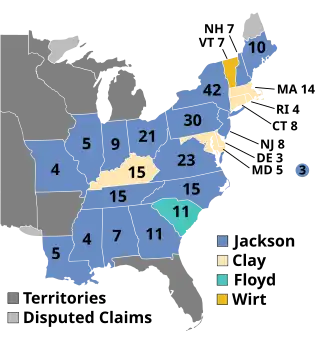 Presidential election results map. Blue denotes states won by Jackson and Van Buren or Wilkins, Astra denotes those won by Clay/Sergeant, Turquoise denotes those won by Floyd/Lee, and Gold denotes those won by Wirt/Ellmaker. Numbers indicate the number of electoral votes allotted to each state. Two votes were not given in Maryland. | |||||||||||||||||||||||||||||||||||||||||||||||||||||||||||||
| |||||||||||||||||||||||||||||||||||||||||||||||||||||||||||||
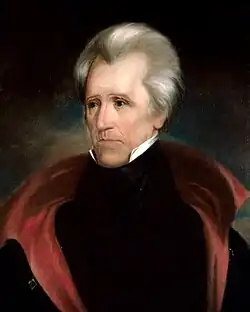
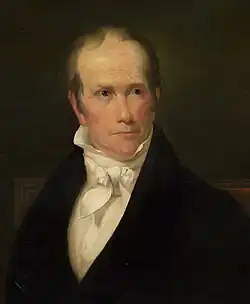
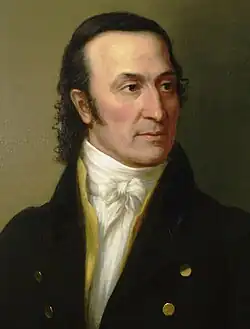
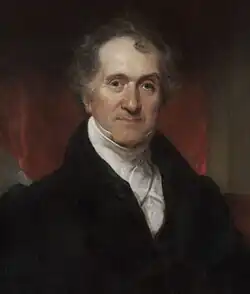
The 1832 United States presidential election was the 12th election in the history of the United States. It occurred from November 2 to December 5, 1832. This election was a four way race between the Democratic nominee, incumbent President Andrew Jackson of Tennessee, the National Republican nominee, Senator Henry Clay of Kentucky, the Nullifer Party nominee, Governor John Floyd of Virginia and the Anti-Masonic Party nominee, former Attorney General William Wirt of Maryland. Jackson won the election with 219 electoral votes, while Clay got only 49 electoral votes, Floyd got only 11 electoral votes and Wirt got only 7 electoral votes.
This election was also the second rematch in U.S. history, the first being John Adams and Thomas Jefferson in 1800. Jackson would also be the last President until Abraham Lincoln in 1864 to win re-election.
Nominations
Democratic Party
Presidential
- Andrew Jackson, 7th President of the United States from Tennessee (1829-1837) (Nominee)
Vice Presidential
- Martin Van Buren, 8th U.S. Minister to the United Kingdom from New York (1831-1832) (Vice presidential nominee)
- Philip P. Barbour, fprmer U.S. representative from Virginia (1814-1825, 1827-1830)
- Richard Mentor Johnson, U.S. representative from Kentucky (1807-1819, 1829-1837) (1836 VP Nominee) (Becomes VPOTUS in 1837)
National Republican Party
Presidential
- Henry Clay, U.S. senator from Kentucky (1806-1807, 1810-1811, 1831-1842) and 7th Speaker of the House (1811–1814, 1815–1820, 1823–1825) (Nominee) (1824 Democratic-Republican Nominee)
Vice Presidential
- John Sargent, former U.S. representative from Pennsylvania (1815-1823, 1828-1829) (Vice presidential nominee)
Nullifer Party
Presidential
- John Floyd, 23rd Governor of Virginia (1830-1834) (Nominee)
Vice Presidential
- Henry Lee, political economist, merchant and politician from Massachusetts (Vice presidential nominee)
Anti-Masonic Party
Presidential
- William Wirt, 9th Attorney General of the United States (1817-1829) (Nominee)
- Richard Rush, 8th Secretary of the Treasury (1825-1829) (1828 National Republican Vice Presidential Nominee)
Vice Presidential
- Amos Ellmaker, Attorney General of Pennsylvania (1816-1819, 1828-1829) (Vice presidential nominee)
- John C. Spencer, state senator from New York (1825-1828)
Notes
- ↑ Electors were elected to all 288 electoral college positions; however, two electors from Maryland pledged to the Clay/Sergeant ticket abstained from casting a vote for president or vice president, bringing the total number of electoral votes cast to 286.
- ↑ In Alabama, Mississippi, North Carolina, and Virginia, the Democratic vice presidential candidate listed on the ballot was Philip P. Barbour. However, all the Democratic electors from those states cast their electoral votes for Van Buren. In Georgia, both a Jackson/Van Buren and a Jackson/Barbour appeared on the ballot, with the Jackson/Van Buren ticket winning. 30 Pennsylvania electors voted for William Wilkins for vice president.
- ↑ Floyd did not appear on the ballot in any state that chose its electors via a popular vote. His electoral votes were awarded by the South Carolina state legislature.
References
- ↑ "National General Election VEP Turnout Rates, 1789-Present". United States Election Project. CQ Press.