Phenylalanine
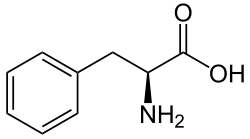
|
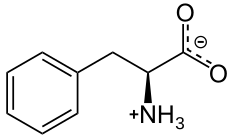
L-Phenylalanine at physiological pH |
|
|
| Names |
| Pronunciation |
, |
| IUPAC name
Phenylalanine |
Systematic IUPAC name
(S)-2-Amino-3-phenylpropanoic acid |
| Identifiers |
|
- L: 63-91-2
 Y - D/L: 150-30-1 Y
- D: 673-06-3 Y
|
3D model (JSmol) |
|
| ChEBI |
|
| ChEMBL |
|
| ChemSpider |
|
| DrugBank |
|
| ECHA InfoCard |
100.000.517 |
IUPHAR/BPS |
|
| KEGG |
|
|
|
| UNII |
|
|
|
|
L: c1ccc(cc1)C[C@@H](C(=O)O)N
|
| Properties |
|
C9H11NO2 |
| Molar mass |
165.19 g·mol−1 |
| Acidity (pKa) |
1.83 (carboxyl), 9.13 (amino)[2] |
| Hazards |
| NFPA 704 (fire diamond) |
|
Except where otherwise noted, data are given for materials in their standard state (at 25 °C [77 °F], 100 kPa). |
| Infobox references |
|
|
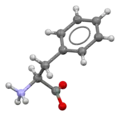
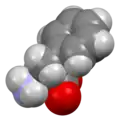
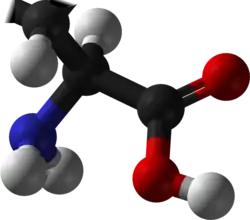
Phenylalanine (symbol Phe or F) is an essential α-amino acid.
This essential amino acid is neutral and nonpolar. This is because of the inert and hydrophobic nature of the benzyl side chain.
The L-isomer is used to biochemically form proteins coded for by DNA.
Phenylalanine is a precursor for tyrosine, the monoamine neurotransmitters dopamine, norepinephrine (noradrenaline), epinephrine (adrenaline), and the skin pigment melanin. It is encoded by the codons UUU and UUC.
References
- 1 2 Ihlefeldt, Franziska Stefanie; Pettersen, Fredrik Bjarte; von Bonin, Aidan; Zawadzka, Malgorzata; Görbitz, Prof. Carl Henrik (2014). "The Polymorphs of L-Phenylalanine". Angewandte Chemie International Edition. 53 (49): 13600–13604. doi:10.1002/anie.201406886. PMID 25336255.
- ↑ Dawson RM, et al. (1959). Data for Biochemical Research. Oxford: Clarendon Press.
Encoded (proteinogenic) amino acids |
|---|
| General topics | | |
|---|
| By properties | | Aliphatic |
- Alanine
- Branched-chain amino acids (Valine
- Isoleucine
- Leucine)
- Methionine
- Proline
- Glycine
|
|---|
| Aromatic | |
|---|
| Polar, uncharged | |
|---|
| Positive charge (pKa) |
- Histidine (≈6.1)
- Lysine (≈10.8)
- Arginine (≈12.5)
- Pyrrolysine
|
|---|
| Negative charge (pKa) | |
|---|
|
|---|
- Amino acids types: Encoded (proteins)
- Essential
- Non-proteinogenic
- Ketogenic
- Glucogenic
- Secondary amino
- Imino acids
- D-amino acids
- Dehydroamino acids
|
|
|---|
| MOR | |
|---|
| DOR | |
|---|
| KOR |
- Agonists: 3CS-nalmefene
- 6'-GNTI
- 8-CAC
- 18-MC
- 14-Methoxymetopon
- β-Chlornaltrexamine
- β-Funaltrexamine
- Adrenorphin (metorphamide)
- Akuammicine
- Alazocine (SKF-10047)
- Allomatrine
- Apadoline
- Asimadoline
- BAM-12P
- BAM-18P
- BAM-22P
- Big dynorphin
- Bremazocine
- BRL-52537
- Butorphan
- Butorphanol
- BW373U86
- Cebranopadol
- Ciprefadol
- CR665
- Cyclazocine
- Cyclorphan
- Cyprenorphine
- Desmetramadol (desmethyltramadol)
- Diamorphine (heroin)
- Diacetylnalorphine
- Difelikefalin
- Dihydroetorphine
- Dihydromorphine
- Dinalbuphine sebacate
- Diprenorphine
- Dynorphin A
- Dynorphin B (rimorphin)
- Eluxadoline
- Enadoline
- Eptazocine
- Erinacine E
- Ethylketazocine
- Etorphine
- Fedotozine
- Fentanyl
- Gemazocine
- GR-89696
- GR-103545
- Hemorphin-4
- Herkinorin
- HS665
- Hydromorphone
- HZ-2
- Ibogaine
- ICI-199,441
- ICI-204,448
- Ketamine
- Ketazocine
- Laudanosine
- Leumorphin (dynorphin B-29)
- Levallorphan
- Levomethorphan
- Levorphanol
- Lexanopadol
- Lofentanil
- LPK-26
- Lufuradom
- Matrine
- MB-1C-OH
- Menthol
- Metazocine
- Metkefamide
- Mianserin
- Mirtazapine
- Morphine
- Moxazocine
- MR-2034
- N-MPPP
- Nalbuphine
- NalBzOH
- Nalfurafine
- Nalmefene
- Nalodeine (N-allylnorcodeine)
- Nalorphine
- Naltriben
- Niravoline
- Norbuprenorphine
- Norbuprenorphine-3-glucuronide
- Noribogaine
- Norketamine
- Oripavine
- Oxilorphan
- Oxycodone
- Pentazocine
- Pethidine (meperidine)
- Phenazocine
- Proxorphan
- Racemethorphan
- Racemorphan
- RB-64
- Salvinorin A (salvia)
- Salvinorin B ethoxymethyl ether
- Salvinorin B methoxymethyl ether
- Samidorphan
- Spiradoline (U-62,066)
- TH-030418
- Thienorphine
- Tifluadom
- Tricyclic antidepressants (e.g., amitriptyline, desipramine, imipramine, nortriptyline)
- U-50488
- U-54,494A
- U-69,593
- Xorphanol
- Antagonists: 4′-Hydroxyflavanone
- 4',7-Dihydroxyflavone
- 5'-GNTI
- 6'-GNTI
- 6β-Naltrexol
- 6β-Naltrexol-d4
- β-Chlornaltrexamine
- Buprenorphine/samidorphan
- Amentoflavone
- ANTI
- Apigenin
- Arodyne
- AT-076
- Aticaprant
- Axelopran
- AZ-MTAB
- Binaltorphimine
- BU09059
- Buprenorphine
- Catechin
- Catechin gallate
- CERC-501 (LY-2456302)
- Clocinnamox
- CVL-354
- Cyclofoxy
- Dezocine
- DIPPA
- EGC
- ECG
- Epicatechin
- Hyperoside
- JDTic
- LY-255582
- LY-2196044
- LY-2444296
- LY-2459989
- LY-2795050
- MeJDTic
- Methylnaltrexone
- ML190
- ML350
- MR-2266
- N-Fluoropropyl-JDTic
- Naloxone
- Naltrexone
- Naltrindole
- Naringenin
- Norbinaltorphimine
- Noribogaine
- Pawhuskin A
- PF-4455242
- RB-64
- Quadazocine
- Taxifolin
- UPHIT
- Zyklophin
- Unknown/unsorted: Akuammicine
- Akuammine
- Coronaridine
- Cyproterone acetate
- Dihydroakuuamine
- Ibogamine
- Tabernanthine
|
|---|
| NOP |
- Agonists: (Arg14,Lys15)Nociceptin
- ((pF)Phe4)Nociceptin(1-13)NH2
- (Phe1Ψ(CH2-NH)Gly2)Nociceptin(1-13)NH2
- Ac-RYYRWK-NH2
- Ac-RYYRIK-NH2
- BU08070
- Buprenorphine
- Cebranopadol
- Dihydroetorphine
- Etorphine
- JNJ-19385899
- Levomethorphan
- Levorphanol
- Lexanopadol
- MCOPPB
- MT-7716
- NNC 63-0532
- Nociceptin (orphanin FQ)
- Nociceptin (1-11)
- Nociceptin (1-13)NH2
- Norbuprenorphine
- Racemethorphan
- Racemorphan
- Ro64-6198
- Ro65-6570
- SCH-221510
- SCH-486757
- SR-8993
- SR-16435
- Sunobinop (S-117957)
- TH-030418
- Antagonists: (Nphe1)Nociceptin(1-13)NH2
- AT-076
- BAN-ORL-24
- BTRX-246040 (LY-2940094)
- J-113,397
- JTC-801
- NalBzOH
- Nociceptin (1-7)
- Nocistatin
- SB-612,111
- SR-16430
- Thienorphine
- Trap-101
- UFP-101
|
|---|
| Unsorted |
- β-Casomorphins
- Amidorphin
- BAM-20P
- Cytochrophin-4
- Deprolorphin
- Gliadorphin (gluteomorphin)
- Gluten exorphins
- Hemorphins
- Kava constituents
- MEAGL
- MEAP
- NEM
- Neoendorphins
- Nepetalactone (catnip)
- Peptide B
- Peptide E
- Peptide F
- Peptide I
- Rubiscolins
- Soymorphins
|
|---|
| Others |
- Enkephalinase inhibitors: Amastatin
- BL-2401
- Candoxatril
- D -Phenylalanine
- Dexecadotril (retorphan)
- Ecadotril (sinorphan)
- Kelatorphan
- Racecadotril (acetorphan)
- RB-101
- RB-120
- RB-3007
- Opiorphan
- Selank
- Semax
- Spinorphin
- Thiorphan
- Tynorphin
- Ubenimex (bestatin)
- Propeptides: β-Lipotropin (proendorphin)
- Prodynorphin
- Proenkephalin
- Pronociceptin
- Proopiomelanocortin (POMC)
- Others: Kyotorphin (met-enkephalin releaser/degradation stabilizer)
|
|---|