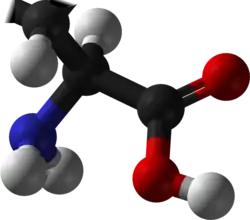
Alanine
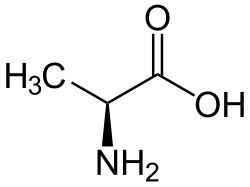
L-Alanine |
| Names |
| IUPAC name
Alanine |
| Other names
2-Aminopropanoic acid |
| Identifiers |
|
- 338-69-2 (D-isomer)
 Y - 56-41-7 (L-isomer) Y
- 302-72-7 (racemic) Y
|
3D model (JSmol) |
|
| ChEBI |
|
| ChEMBL |
|
| ChemSpider |
|
| ECHA InfoCard |
100.000.249 |
| EC Number |
|
IUPHAR/BPS |
|
| KEGG |
|
|
|
| UNII |
|
|
|
|
O=C(O)C(N)C O=C(O)[C@@H](N)C
|
| Properties |
|
C3H7NO2 |
| Molar mass |
89.09 g·mol−1 |
| Appearance |
white powder |
| Density |
1.424 g/cm3 |
| Melting point |
258 °C (496 °F; 531 K) (sublimes) |
|
167.2 g/L (25 °C) |
| log P |
-0.68[1] |
| Acidity (pKa) |
- 2.34 (carboxyl; H2O)
- 9.87 (amino; H2O)[2]
|
|
-50.5·10−6 cm3/mol |
Except where otherwise noted, data are given for materials in their standard state (at 25 °C [77 °F], 100 kPa). |
 N verify (what is YN ?) |
| Infobox references |
|
|
Alanine (abbreviated as Ala or A)[3] is an α-amino acid. It has the chemical formula CH3CH(NH2)COOH.
The L-isomer is one of the 20 amino acids encoded by the genetic code. Its codons are GCU, GCC, GCA, and GCG. It is classified as a non-polar amino acid.[4]
L-Alanine accounts for 7.8% of the primary structure in a sample of 1,150 proteins.[5][6] Leucine is the only amino acid which is more common.
D-Alanine occurs in bacterial cell walls and in some peptide antibiotics.
References
- ↑ "L-alanine_msds".
- ↑ Haynes, William M., ed. (2016). CRC Handbook of Chemistry and Physics (97th ed.). CRC Press. p. 5–88. ISBN 978-1498754286.
- ↑ Nomenclature and symbolism for amino acids and peptides. IUPAC-IUB Recommendations 1983. Pure Appl. Chem. 56 (5), 1984: 595–624.
- ↑ Non-polar: electrons shared so that there is no difference in electric charge between different parts of the molecule.
- ↑ Doolittle, R. F. (1989), "Redundancies in protein sequences", in Fasman, G. D. (ed.), Prediction of protein structures and the principles of protein conformation, New York: Plenum, pp. 599–623, ISBN 0-306-43131-9
- ↑ Primary structure: the exact specification of its atomic structure and its chemical bonds.
Encoded (proteinogenic) amino acids |
|---|
| General topics | | |
|---|
| By properties | | Aliphatic |
- Alanine
- Branched-chain amino acids (Valine
- Isoleucine
- Leucine)
- Methionine
- Proline
- Glycine
|
|---|
| Aromatic | |
|---|
| Polar, uncharged | |
|---|
| Positive charge (pKa) |
- Histidine (≈6.1)
- Lysine (≈10.8)
- Arginine (≈12.5)
- Pyrrolysine
|
|---|
| Negative charge (pKa) | |
|---|
|
|---|
- Amino acids types: Encoded (proteins)
- Essential
- Non-proteinogenic
- Ketogenic
- Glucogenic
- Secondary amino
- Imino acids
- D-amino acids
- Dehydroamino acids
|
|
|---|
| Amino acid-derived | Major excitatory /
inhibitory systems | | Glutamate system |
- Agmatine
- Aspartic acid (aspartate)
- Glutamic acid (glutamate)
- Glutathione
- Glycine
- GSNO
- GSSG
- Kynurenic acid
- NAA
- NAAG
- Proline
- Serine
|
|---|
| GABA system | |
|---|
| Glycine system | |
|---|
| GHB system | |
|---|
|
|---|
| Biogenic amines | | Monoamines | |
|---|
| Trace amines |
- 3-Iodothyronamine
- N-Methylphenethylamine
- N-Methyltryptamine
- m-Octopamine
- p-Octopamine
- Phenylethanolamine
- Phenethylamine
- Synephrine
- Tryptamine
- m-Tyramine
- p-Tyramine
|
|---|
| Others | |
|---|
|
|---|
| Neuropeptides | |
|---|
|
|---|
| Lipid-derived | | Endocannabinoids |
- 2-AG
- 2-AGE (noladin ether)
- 2-ALPI
- 2-OG
- AA-5-HT
- Anandamide (AEA)
- DEA
- LPI
- NADA
- NAGly
- OEA
- Oleamide
- PEA
- RVD-Hpα
- SEA
- Virodhamine (O-AEA)
|
|---|
| Neurosteroids | |
|---|
|
|---|
| Nucleobase-derived | |
|---|
| Vitamin-derived | |
|---|
|
|---|
| K→acetyl-CoA | | lysine→ |
- Saccharopine
- Allysine
- α-Aminoadipic acid
- 2-Oxoadipic acid
- Glutaryl-CoA
- Glutaconyl-CoA
- Crotonyl-CoA
- β-Hydroxybutyryl-CoA
|
|---|
| leucine→ |
- β-Hydroxy β-methylbutyric acid
- β-Hydroxy β-methylbutyryl-CoA
- Isovaleryl-CoA
- α-Ketoisocaproic acid
- β-Ketoisocaproic acid
- β-Ketoisocaproyl-CoA
- β-Leucine
- β-Methylcrotonyl-CoA
- β-Methylglutaconyl-CoA
- β-Hydroxy β-methylglutaryl-CoA
|
|---|
| tryptophan→alanine→ |
- N′-Formylkynurenine
- Kynurenine
- Anthranilic acid
- 3-Hydroxykynurenine
- 3-Hydroxyanthranilic acid
- 2-Amino-3-carboxymuconic semialdehyde
- 2-Aminomuconic semialdehyde
- 2-Aminomuconic acid
- Glutaryl-CoA
|
|---|
|
|---|
| G | G→pyruvate→
citrate | glycine→
serine→ |
- glycine→creatine: Glycocyamine
- Phosphocreatine
- Creatinine
|
|---|
|
|---|
G→glutamate→
α-ketoglutarate | | histidine→ |
- Urocanic acid
- Imidazol-4-one-5-propionic acid
- Formiminoglutamic acid
- Glutamate-1-semialdehyde
|
|---|
| proline→ |
- 1-Pyrroline-5-carboxylic acid
|
|---|
| arginine→ |
- Agmatine
- Ornithine
- Citrulline
- Cadaverine
- Putrescine
|
|---|
| other | |
|---|
|
|---|
G→propionyl-CoA→
succinyl-CoA | | valine→ |
- α-Ketoisovaleric acid
- Isobutyryl-CoA
- Methacrylyl-CoA
- 3-Hydroxyisobutyryl-CoA
- 3-Hydroxyisobutyric acid
- 2-Methyl-3-oxopropanoic acid
|
|---|
| isoleucine→ |
- 2,3-Dihydroxy-3-methylpentanoic acid
- 2-Methylbutyryl-CoA
- Tiglyl-CoA
- 2-Methylacetoacetyl-CoA
|
|---|
| methionine→ |
- generation of homocysteine: S-Adenosyl methionine
- S-Adenosyl-L-homocysteine
- Homocysteine
- conversion to cysteine: Cystathionine
- α-Ketobutyric acid + Cysteine
|
|---|
| threonine→ | |
|---|
| propionyl-CoA→ | |
|---|
|
|---|
| G→fumarate | |
|---|
| G→oxaloacetate | |
|---|
|
|---|
| Other | |
|---|