Kasuga-no-Kami
| Kasuga no Kami | |
|---|---|
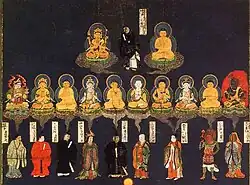 A Detail of a Kasuga Mandala showing some "kami" and their Buddha equivalents (honji suijaku) | |
| Other names | Kasuga Gongen Kasuga Daimyōjin |
| Japanese | 春日神 |
| Major cult centre | Kasuga-taisha |
Kasuga no Kami (春日神) or Kasuga Gongen (春日権現) or Kasuga Daimyōjin (春日大明神) is a god of Kasuga-taisha.[1][2][3] It is composed of five separate gods each with a Shinto and a Buddhist equivalent.[4][3]
The four main kami enshrined at Kasuga-taisha are Ame-no-Koyane, Himegami, Futsunushi no mikoto, and Takemikazuchi no mikoto.[1] They are often imagined as a single entity called Kasuga Daimyōjin.[2] Kasuga Daimyōjin is composed of five divine beings and each consists of a Buddhist deity and Shinto kami counterpart. The fifth deity, Ame-no-Oshikumone, was added much later and is said to be the divine child of Ame-no-Koyane and Himegami.[4][3] The popularity of Kasuga Daimyojin inspired people to worship other gods as collective entities like Kumano Gongen.[5]

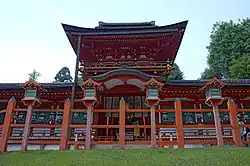
The four main kami (excluding Ame-no-Oshikumone) each have a shrine devoted to them which are all in the same architectural style. They are characterized by sloping gabled roofs, a rectangular structure, katsuogi (decorative logs), and chigi (forked roof structures).[6][3] The first hall is dedicated to Takemikazuchi no mikoto, the second to Futsunushi no mikoto, the third to Ame-no-Koyane, and the final hall is attributed to the consort, Himegami.[7][3] Wakamiya Shrine is dedicated to the fifth god Ame-no-Oshikumone.[8][9][3][3]
The two kami Ame-no-Koyane and Himegami were bunrei transferred from Hiraoka Shrine, and the shrine was thus given the name of Moto-Kasuga ("former Kasuga").[10][11] Those two deities and their son Ame-no-Oshikumone[12][3] are ancestors of the Nakatomi clan and Fujiwara clan.[13][14][3]
Hiraoka Shrine is located on the western side of the Ikoma Mountains in central Osaka Prefecture. Originally it was a center for mountain worship and the kami of Kozudake, the peak immediately behind the shrine, came to be identified with Ame-no-Koyane, the Oyagami of the Nakatomi clan, and the Fujiwara clan.[10][11]
Equivalents
He has five components each of which has a corresponding Buddha.[4][3]
| Shrine Hall | Shinto Deity | Buddhist Deity (Daijo-in) | Buddhist Deity (Ichijo-in) | others |
|---|---|---|---|---|
| First Hall | Takemikazuchi | Shakyamuni | Amoghapasha[15] | |
| Second Hall | Futsunushi | Bhaisajyaguru | ||
| Third Hall | Ame-no-Koyane | Kṣitigarbha | ||
| Fourth Hall | Himegami | Ekādaśamukha | Dainichi Nyorai[3] | |
| Wakamiya Shrine | Ame-no-Oshikumone | Manjushri | āryāvalokiteśvara | |
In popular culture
Kasuga no Kami, Jade Angel is a card in WIXOSS.[16][17][18][19][20]
Related pages
References
- 1 2 Grapard, Allan G. (1992). The protocol of the gods: a study of the Kasuga cult in Japanese history. University of California Press. ISBN 0520070976. OCLC 25873140.
- 1 2 Tyler, Royall (2016). The miracles of the Kasuga deity. Columbia University Press. ISBN 9780231534765. OCLC 954193203.
- 1 2 3 4 5 6 7 8 9 10 11 Allan G. Grapard The Protocol of the Gods: A Study of the Kasuga Cult in Japanese History, University of California press p. 82-83
- 1 2 3 Ten Grotenhuis, Elizabeth (1999). Japanese mandalas : representations of sacred geography. University of Hawai'i Press. ISBN 0824820002. OCLC 39181008.
- ↑ Ashkenazi, Michael (2011). Handbook of Japanese mythology. ABC-CLIO. ISBN 9781849728560. OCLC 755870995.
- ↑ Cali, Joseph (2013). Shinto shrines: a guide to the sacred sites of Japan's ancient religion. University of Hawai'i Press. ISBN 9780824837136. OCLC 1043096844.
- ↑ "Main Sanctuary". www.kasugataisha.or.jp. Archived from the original on 2019-06-24. Retrieved 2019-03-28.
- ↑ https://www.mlit.go.jp/tagengo-db/common/001559851.pdf
- ↑ "Wakamiya Shrine | Search Details". Japan Tourism Agency,Japan Tourism Agency. Retrieved 2024-03-20.
- 1 2 Yoshiki, Emi (2007). Zenkoku 'Ichinomiya' tettei gaido (in Japanese). PHP Institute. ISBN 978-4569669304.
- 1 2 Okada, Shoji (2014). Taiyō no chizuchō 24 zenkoku 'Ichinomiya' meguri (in Japanese). Heibonsha. ISBN 978-4582945614.
- ↑ Ten Grotenhuis, Elizabeth (1999). Japanese mandalas : representations of sacred geography. University of Hawai'i Press. ISBN 0824820002. OCLC 39181008.
- ↑ Shibata, Joue. Saitama Sōsho. (1929) Volume 1: Chichibu Shi, p 111, Chichibu hikomikoto o keizu 『埼玉叢書. 第1巻』内『秩父志』内111頁「秩父彦命御系図」. Sanmeisha
- ↑ Ten Grotenhuis, Elizabeth (1999). Japanese mandalas : representations of sacred geography. University of Hawai'i Press. ISBN 0824820002. OCLC 39181008.
- ↑ https://kuscholarworks.ku.edu/bitstream/1808/17426/1/Fowler.pdf
- ↑ "Kasuga no Kami, Jade Angel (WXDi-P09-070[EN]) [Conflated Diva]". DukeCityGamesRio. Archived from the original on 2024-03-21. Retrieved 2024-03-21.
- ↑ "Kasuga no Kami, Jade Angel (WXDi-P09-070[EN]) [Conflated Diva]". Gaming Giant. Retrieved 2024-03-21.
- ↑ "Your Trusted Marketplace for Collectible Trading Card Games - TCGplayer". www.tcgplayer.com. Retrieved 2024-03-21.
- ↑ "Kasuga no Kami, Jade Angel (WXDi-P09-070[EN]) [Conflated Diva]". Mahoney's Gaming Emporium. Archived from the original on 2024-03-21. Retrieved 2024-03-21.
- ↑ "Kasuga no Kami, Jade Angel - WXDi-P09-070[EN]". Perfect Sphere Games. Archived from the original on 2024-03-21. Retrieved 2024-03-21.
| Main Deities |
|  |
|---|---|---|
| Shrines |
| |
| Misc |
| |