Amoghapasha
| Amoghapasha Avalokiteśvara | |
|---|---|
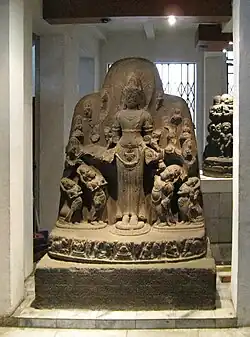 Statue of Amoghapasha found in Padang Roco, Dharmasraya Regency, West Sumatra, Indonesia. | |
| Sanskrit | Amoghapāśa (अमोघपाश) |
| Chinese | 不空羂索觀音 (Bukong Juansuo Guanyin) |
| Japanese | 不空羂索観音 (Fukūkenjaku Kannon) |
| Korean | 불공견쇄관음 (Bul-gong-gyeon-swae Gwan-eum) |
Amoghapasha is a form of the bodhisattva Avalokiteśvara (also known as Guanyin) worshipped in Buddhism. He is one of the six forms of Guanyin.[1]
His name means “Unfailing Lasso” in Sanskrit.[1] The lasso shows her power to help people far from enlightenment.[2] [a]
History
The first known book about Amoghapasha is the Amoghapasha Hridaya Sutra. It was translated into Chinese by the monk Jñānagupta in the year 587. Later, this text became part of a longer one called Amoghapasha Kalparaja.
Statues of him were made as early as the 8th century.[2]
Appearance
He is usually shown with 4, 6, or 8 arms. He may appear with four helpers, including Tara and Hayagriva.[2]
In Japan
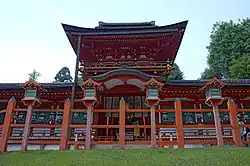
At the Kasuga-taisha shrine in Nara, he is seen as the same as the Shinto god Takemikazuchi. This may be because he wears a deer hide, which was also linked to this god in Nara.[5]
Mantras
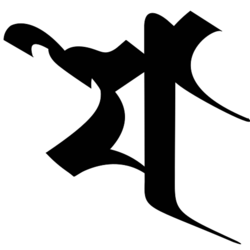
His seed syllable (bījamantra) is Mo. Her mantra is: Om Amoga Pisheye Humpanzha.[6]
In Tibetan Buddhism, and in India and Nepal Amoghapasha is shown as male.[7]
Kasuga Shrine Equivalents
The gods at Kasuga Shrine have Buddhist forms. Amoghapasha matches Takemikazuchi in this system.[8]
| Shrine Hall | Shinto Deity | Buddhist Deity (Daijo-in) | Buddhist Deity (Ichijo-in) |
|---|---|---|---|
| First Hall | Takemikazuchi | Shakyamuni | Amoghapasha[9] |
| Second Hall | Futsunushi | Bhaisajyaguru | |
| Third Hall | Ame-no-Koyane | Kṣitigarbha | |
| Fourth Hall | Himegami | Ekādaśamukha | |
| Wakamiya Shrine | Ame-no-Oshikumone | Manjushri | Āryāvalokiteśvara |
Gallery
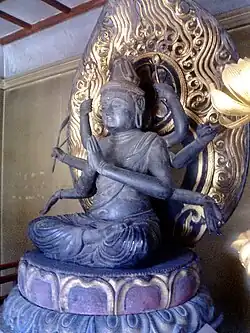 Fukūkenjaku Kannon statue at Hōren-ji
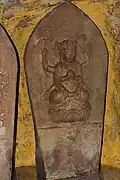 Amoghapasha statue at Fairy Cave, Keelung
 Japanese statues at Linden Museum
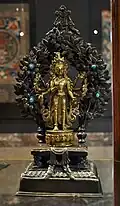 Statue in Brussels from Nepal
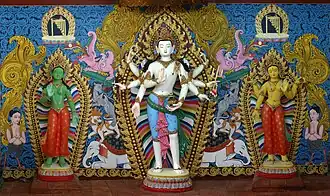 Temple image from Nepal
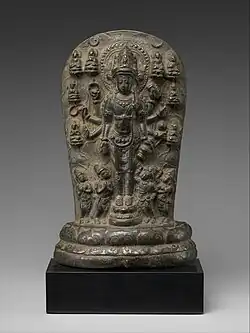 Statue at the Metropolitan Museum of Art
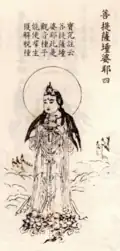 Chinese illustration
 Thai statue
 Large statue in China
- Padang Roco inscription
Related pages
Notes
References
- 1 2 "Avalokiteshvara (Bodhisattva & Buddhist Deity) - Amoghapasha (Unfailing Lasso) (Himalayan Art)". www.himalayanart.org. Retrieved 2025-06-02.
- 1 2 3 J A Schoterman, Ancient Indonesian Sculpture, Marijke J. Klokke & Pauline C. M. Lunsingh Scheurleer, pp. 154–157
- ↑ Fowler, Sharon (2016). Practices of Power. p. 24.
- ↑ Faure, Bernard (2015). The Fluid Pantheon. p. 287.
- ↑ Allan G. Grapard, The Protocol of the Gods: A Study of the Kasuga Cult in Japanese History, University of California Press, pp. 82–83
- 1 2 Net, True Buddha School. "Amoghapasa Bodhisattva - 真佛宗TBSN". True Buddha School Net - TBSN (in Chinese (Taiwan)). Retrieved 2025-06-02.
- ↑ Getty, Alice (1988). The Gods of Northern Buddhism: Their History and Iconography. Dover Publications. ISBN 0486255751.
- ↑ Ten Grotenhuis, Elizabeth (1999). Japanese Mandalas: Representations of Sacred Geography. University of Hawai'i Press. ISBN 0824820002.
- ↑ https://kuscholarworks.ku.edu/bitstream/1808/17426/1/Fowler.pdf
Bibliography
- Fowler, Sherry D. (2016). Accounts and Images of Six Kannon in Japan. University of Hawaii Press. ISBN 978-0-8248-5622-9.
- Faure, Bernard (2015). The Fluid Pantheon: Gods of Medieval Japan, Volume 1. University of Hawaii Press. ISBN 978-0-8248-5702-8.
| Main Deities |
|  |
|---|---|---|
| Shrines |
| |
| Misc |
| |
