Āryāvalokiteśvara
| Āryāvalokiteśvara | |
|---|---|
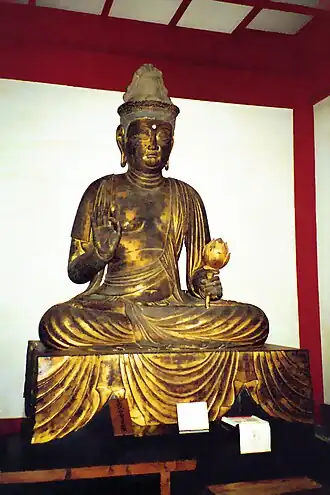 Wooden Seated Statue of Shōkannon (Fukuoka – Kanzeonji) | |
| Sanskrit | Āryāvalokiteśvara (आर्यावलोकितेश्वर) |
| Chinese | 聖觀音 Shèng guānyīn |
| Japanese | 聖観音 (Shō-Kannon) |
Āryāvalokiteśvara (聖観音, Shō-Kannon) is a form of the bodhisattva Avalokiteśvara (also known as Guanyin) worshipped in Buddhism. She is one of the six forms of Guanyin.
Among the forms she is considered the root of the other forms.[1][2][3]
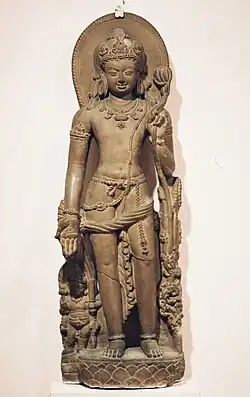
Kasuga shrine equivalents
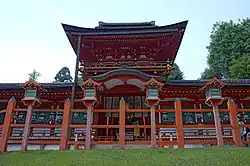
The gods at Kasuga Shrine have Buddhist forms. Āryāvalokiteśvara matches Ame-no-Oshikumone[4] the ancestor god of the Nakatomi clan.[5][6] [7][6]
However there is an internal disagreement in traditions. The temple Ichijo-in considers him to be Āryāvalokiteśvara, but Daigo-in identifies him with Manjushri instead.[4][8][4]
Wakamiya Shrine, a subshrine of kasuga-taisha is dedicated to the fifth new member Ame-no-Oshikumone.[9][10][4]
| Shrine Hall | Shinto Deity | Buddhist Deity (Daijo-in) | Buddhist Deity (Ichijo-in) |
|---|---|---|---|
| First Hall | Takemikazuchi | Shakyamuni | Amoghapasha[11] |
| Second Hall | Futsunushi | Bhaisajyaguru | |
| Third Hall | Ame-no-Koyane | Kṣitigarbha | |
| Fourth Hall | Himegami | Ekādaśamukha | |
| Wakamiya Shrine | Ame-no-Oshikumone | Manjushri | Āryāvalokiteśvara |
Related pages
- Kasuga-no-Kami
- Manjushri
References
- ↑ Getty, Alice (2011-05-29). "The gods of northern Buddhism: their history, iconography and progressive evolution through the northern Buddhist countries – The Principal Forms Of Avalokitesvara [Chapter VI]". www.wisdomlib.org. Retrieved 2023-12-12.
- ↑ "Buddhist Deity: Avalokiteshvara (Wrathful/Semi Forms)". www.himalayanart.org. Retrieved 2023-12-12.
- ↑ D., Orzech, Charles (2011). Esoteric buddhism and the tantras in East Asia, p. 215. Brill. ISBN 978-90-04-18491-6. OCLC 716806704.
- 1 2 3 4 Allan G. Grapard The Protocol of the Gods: A Study of the Kasuga Cult in Japanese History, University of California press p. 82-83
- ↑
- 1 2 Ten Grotenhuis, Elizabeth (1999). Japanese mandalas : representations of sacred geography. University of Hawai'i Press. ISBN 0824820002. OCLC 39181008.
- ↑ Shibata, Joue. Saitama Sōsho. (1929) Volume 1: Chichibu Shi, p 111, Chichibu hikomikoto o keizu 『埼玉叢書. 第1巻』内『秩父志』内111頁「秩父彦命御系図」. Sanmeisha
- ↑ Giolai, Andrea (2020-09-22). "Encounters with the Past: Fractals and Atmospheres at Kasuga Wakamiya Onmatsuri". Journal of Religion in Japan. 9 (1–3): 213–247. doi:10.1163/22118349-00901002. ISSN 2211-8349.
- ↑ https://www.mlit.go.jp/tagengo-db/common/001559851.pdf
- ↑ "Wakamiya Shrine | Search Details". Japan Tourism Agency,Japan Tourism Agency. Retrieved 2024-03-20.
- ↑ https://kuscholarworks.ku.edu/bitstream/1808/17426/1/Fowler.pdf

Other websites
| Main Deities |
|  |
|---|---|---|
| Shrines |
| |
| Misc |
| |