Ame-no-Koyane
| Ame-no-Koyane | |
|---|---|
God of Divine Mirror, Great Divination, Divine Affairs | |
 | |
| Japanese | 天児屋命 |
| Major cult center |
|
| Texts | Kojiki, Nihon Shoki, Izumo-no-kuni Fudoki |
| Personal information | |
| Spouse | Himegami |
| Children |
|
| Parents | Kamimusubi (Kogo Shūi), Kogotomusuhi (Nihon Shoki) |
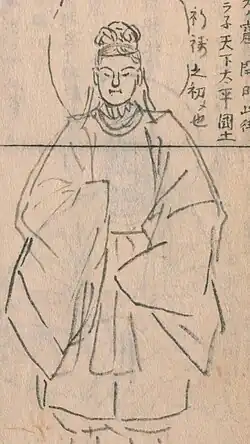
Ame-no-Koyane-no-mikoto (天児屋命, 天児屋根命) is a male deity (kami) in Japanese mythology and Shinto. He is the ancestor god of the Nakatomi clan and its cadet branch the Fujiwara clan.[4][5][6][2][5][6][7][4]
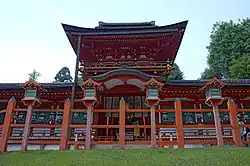
He is also the god of Kasuga-taisha,[8][9][6] he is the third god of the Kasuga-no-Kami.[9] His wife Himegami is the fourth one. [10][6][5] His son Ame-no-Oshikumone is the fifth one.[5][6][10] Those five gods all have Shinto and Buddhist forms. His Buddhist form is Kṣitigarbha.[5][6][10]
At first, he and his consort Himegami were worshipped at Hiraoka Shrine. Later, they were moved to Kasuga Taisha, and Hiraoka Shrine became known as Moto-Kasuga ("former Kasuga").[11][12] These two deities and their son Ame-no-Oshikumone[5][6] are ancestors of the Nakatomi clan and Fujiwara clan.[2][5][6][7][4]
Mythology

In the Kogo Shūi and in the genealogy of Kashima Shrine, Ame-no-Koyane is said to be the son of the creator deity Kamimusubi, one of the three oldest gods.[13][14] The Nihon Shoki gives a different story and says he is the son of Kogotomusubi (興台産霊命).[13]
In the Nihon Shoki, Ame-no-Koyane was “the first in charge of divine affairs.” For this, he performed the Greater Divination. Amaterasu ordered him to protect the divine mirror. He served as the "Imperial Aide" in the Imperial Palace, managing its divine matters.[13]
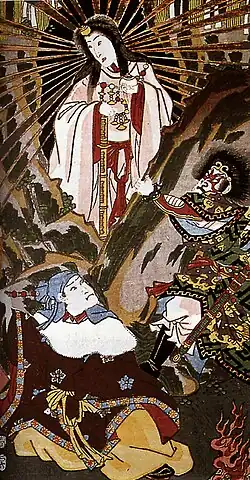
In Japanese mythology, Ame-no-Koyane prayed to the sun goddess Amaterasu to make her come out of the cave of Ama-no-Iwato and bring back light to the world, after Susanoo, the storm god, made her hide away.[4]
During the tenson kōrin, he was one of the five gods who came down from heaven with Ninigi, becoming the ancestor of the Nakatomi clan.[7]
Related pages
References
- ↑ Suzuki, Matoshi. Izu Sukune Keizu Hyakkakeizuko「伊豆宿禰系図」『百家系図稿』1st book
- 1 2 3 4 Shibata, Joue. Saitama Sōsho. (1929) Volume 1: Chichibu Shi, p 111, Chichibu hikomikoto o keizu 『埼玉叢書. 第1巻』内『秩父志』内111頁「秩父彦命御系図」. Sanmeisha
- ↑ Nakata. Akahori, Aoki, Hori-shi: Shokeifu, 3rd book「赤堀、青木、堀氏」『諸系譜』
- 1 2 3 4 Mypaedia, Amenokoyane. Japan: Heibonsha. 1995. OCLC 38516410.
- 1 2 3 4 5 6 7 Ten Grotenhuis, Elizabeth (1999). Japanese mandalas : representations of sacred geography. University of Hawai'i Press. ISBN 0824820002. OCLC 39181008.
- 1 2 3 4 5 6 7 8 Allan G. Grapard The Protocol of the Gods: A Study of the Kasuga Cult in Japanese History, University of California press p. 82-83
- 1 2 3 Ueda, Masaaki (2001). Nihon Jinmei Daijiten, Amenokoyane. Japan: Kōdansha. ISBN 4062108003. OCLC 50718841.
- ↑ Grapard, Allan G. (1992). The protocol of the gods: a study of the Kasuga cult in Japanese history. University of California Press. ISBN 0520070976. OCLC 25873140.
- 1 2 Tyler, Royall (2016). The miracles of the Kasuga deity. Columbia University Press. ISBN 9780231534765. OCLC 954193203.
- 1 2 3 "Main Sanctuary". www.kasugataisha.or.jp. Archived from the original on 2019-06-24. Retrieved 2019-03-28.
- ↑ Yoshiki, Emi (2007). Zenkoku 'Ichinomiya' tettei gaido (in Japanese). PHP Institute. ISBN 978-4569669304.
- ↑ Okada, Shoji (2014). Taiyō no chizuchō 24 zenkoku 'Ichinomiya' meguri (in Japanese). Heibonsha. ISBN 978-4582945614.
- 1 2 3 "Encyclopedia of Shinto: Kami in Classic Texts: Amenokoyane". Kokugakuin University. Establishment of a National Learning Institute for the Dissemination of Research on Shinto and Japanese Culture. Archived from the original on 2006-05-08. Retrieved 2021-03-27.
- ↑ Tanaka. Kashima Daiguji Keizu, Shokeifu「鹿嶋大宮司系図」『諸系譜』. Vol. 1. Japan.
External links
- Shinto Portal - IJCC, Kokugakuin University - Encyclopedia of Shinto
- Ameno Koyane - History of Japan Database
| Main Deities |
|  |
|---|---|---|
| Shrines |
| |
| Misc |
| |
 |
|
|
Mythic Texts and Folktales:
|