Ame-no-Oshikumone
| Ame-no-Oshikumone | |
|---|---|
| Member of Kasuga-no-Kami | |
 | |
| Major cult center | Kasuga-taisha Omura shrine |
| Personal information | |
| Children | Amenotaneko[1] |
| Parents |
|
| Equivalents | |
| Buddhist equivalent | Mañjuśrī (文殊, Monju) or Āryāvalokiteśvara (聖観音, Shō-Kannon)[4][5][6] |
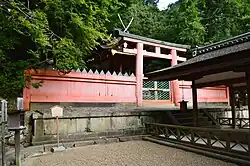
Ame-no-Oshikumone (天押雲根命) is a Japanese historical figure and the ancestor god of the Nakatomi clan. He was the son of Ame-no-Koyane and Himegami.[3] [2] and father of Amenotaneko.[1] and the ancestor of the Nakatomi clan and Fujiwara clan.[2][3] Wakamiya Shrine, a subshrine of Kasuga-taisha is dedicated to him.[7][8][5]
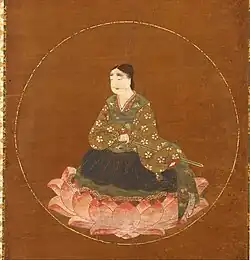
He is in a famous painting "Mandala of Wakamiya of Kasuga Shrine", now on display at the Metropolitan Museum of Art.[9]
He was associated with Susanoo and the Izumo Province.
He was identified as the bodhisattva Mañjuśrī (文殊, Monju) in the temple Daijo-in and as Āryāvalokiteśvara (聖観音, Shō-Kannon) at Ichijo-in[6][5][6][4][5]
He is a part of the group of gods Kasuga-no-Kami.[10] He was added much later than the rest of them and is said to be the divine child of Ame-no-Koyane and Himegami.[3] two other members of Kasuga-no-Kami.[11] Adding him was important because it set an example and helped Japanese people learn to worship other groups of gods.[12]
His two parent kami Ame-no-Koyane and Himegami were bunrei transferred from Hiraoka Shrine, and the shrine was thus given the name of Moto-Kasuga ("former Kasuga").[13][14]
Related pages
References
- 1 2
- 1 2 3 4 5 Shibata, Joue. Saitama Sōsho. (1929) Volume 1: Chichibu Shi, p 111, Chichibu hikomikoto o keizu 『埼玉叢書. 第1巻』内『秩父志』内111頁「秩父彦命御系図」. Sanmeisha
- 1 2 3 4 Ten Grotenhuis, Elizabeth (1999). Japanese mandalas : representations of sacred geography. University of Hawai'i Press. ISBN 0824820002. OCLC 39181008.
- 1 2 Giolai, Andrea (2020-09-22). "Encounters with the Past: Fractals and Atmospheres at Kasuga Wakamiya Onmatsuri". Journal of Religion in Japan. 9 (1–3): 213–247. doi:10.1163/22118349-00901002. ISSN 2211-8349.
- 1 2 3 4 Allan G. Grapard The Protocol of the Gods: A Study of the Kasuga Cult in Japanese History, University of California press p. 82-83
- 1 2 3 Giolai, Andrea (2020-09-22). "Encounters with the Past: Fractals and Atmospheres at Kasuga Wakamiya Onmatsuri". Journal of Religion in Japan. 9 (1–3): 213–247. doi:10.1163/22118349-00901002. ISSN 2211-8349.
- ↑ https://www.mlit.go.jp/tagengo-db/common/001559851.pdf
- ↑ "Wakamiya Shrine | Search Details". Japan Tourism Agency,Japan Tourism Agency. Retrieved 2024-03-20.
- ↑ "Mandala of Wakamiya of Kasuga Shrine (Kasuga wakamiya mandara) | Japan | Nanbokuchō period (1336–92)". The Metropolitan Museum of Art. Retrieved 2023-12-02.
- ↑ Tyler, Royall (2016). The miracles of the Kasuga deity. Columbia University Press. ISBN 9780231534765. OCLC 954193203.
- ↑ Grapard, Allan G. (1992). The protocol of the gods: a study of the Kasuga cult in Japanese history. University of California Press. ISBN 0520070976. OCLC 25873140.
- ↑ Ashkenazi, Michael (2011). Handbook of Japanese mythology. ABC-CLIO. ISBN 9781849728560. OCLC 755870995.
- ↑ Yoshiki, Emi (2007). Zenkoku 'Ichinomiya' tettei gaido (in Japanese). PHP Institute. ISBN 978-4569669304.
- ↑ Okada, Shoji (2014). Taiyō no chizuchō 24 zenkoku 'Ichinomiya' meguri (in Japanese). Heibonsha. ISBN 978-4582945614.

| Main Deities |
|  |
|---|---|---|
| Shrines |
| |
| Misc |
| |