Kumano Gongen
| Kumano Gongen | |
|---|---|
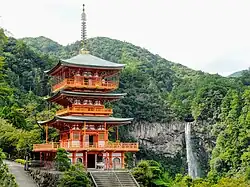 Three-storied Pagoda of Seiganto-ji and Nachi Falls | |
| Major cult centre | Kumano Kodō |
Kumano Gongen (熊野権現), also known as Three Mountains of Kumano (熊野三山),[1][2][3] is a Japanese deity associated with Kumano Shrines.[1][4]
The god is made of 12 smaller gods. Each small god has a Shinto and a Buddhist part,.[5][6][7][8][9][10][11][12][13][14][15][16][17]
This idea is like the worship of Kasuga-no-Kami[18][19] which inspired people to worship this god that way.[20]
There are two common ways to group the gods:
Origins
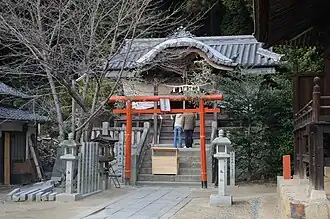
People felt the Kumano area was holy even before written history.[22] They went there to pray and to heal their bodies.[22]
Originally each shrine first worshipped nature in its own way.[22] In the 900s, under Buddhism, the three shrines joined their beliefs.[22]
At that time Japanese people thought Shinto gods were forms of Buddhist buddhas. This mix of Shinto and Buddhism is called shinbutsu-shūgō.[22]
Each Kumano god was linked to a buddha:[21][23][24]
- Kumano Musubi → Thousand-Armed Kannon
- Hayatama → Medicine Buddha
- Ketsumi → Amida Buddha
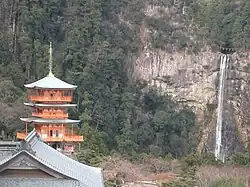
The three mountains were linked to different Pure Lands
- Hongū is linked to the Western Pure Land.
- Shingū is linked to the Eastern Pure Land of Lapis Lazuli.[a]
- Nachi is linked to the Southern Pure Land of Potalaka.[b]
From the Heian period (794-1185) on, people started to see all Kumano as a Pure Land. Scholars still debate which gods the shrines first worshipped.
The 12 gods
These are the 12 gods of Kumano
| Shrine Pavilion | Deity | Original Buddha | Statue Type | |||||
|---|---|---|---|---|---|---|---|---|
| Three goups | Deity group | Number | Translation | Original | ||||
| Upper Four Shrines | Three Gongen | Ryōsho Gongen | First Pavilion | Nishi-no-miya (Yui-miya) | 西宮(結宮) | Izanami-no-Mikoto・Kumano Musubi Okami・Kotoamatsukami | Thousand-Armed Kannon | female form (女形) |
| Second Pavilion | Chū-no-miya (Hayatama Myōjin) | 中宮(早玉明神) | Izanagi-no-Ōkami・Hayatama no Okami | Medicine Buddha | human form (俗形) | |||
| Shōjō Gongen | Third Pavilion | Jōsō (Ketsumi Ōji) | 丞相(家津王子) | Susanoo-no-Mikoto・Ketsumi Mikoto Okami | Amitābha | Dharma form (法形) | ||
| Five Ōji | Fourth Pavilion | Wakamiya | 若宮 | Amaterasu Ōmikami (Nyakuichi Ōji) | Eleven-Faced Avalokiteśvara | female form (女形) | ||
| Middle Four Shrines | Fifth Pavilion | Zenji-miya | 禅児宮 | Ame-no-oshihomimi | Ksitigarbha | Dharma Form (or Human form) | ||
| Sixth Pavilion | Sei-miya | 聖宮 | Ninigi-no-Mikoto | Nagarjuna | Dharma form (法形) | |||
| Seventh Pavilion | Ko-miya | 児宮 | Hikohohodemi-no-Mikoto | Cintāmaṇicakra | Dharma form (法形) | |||
| Eighth Pavilion | Komori-miya | 子守宮 | Ugayafukiaezu | Āryāvalokiteśvara | female form (女形) | |||
| Lower Four Shrines | Four Myōjin | Ninth Pavilion | Ichiman-miya・
Jūman-miya |
一万宮・
十万宮 |
Kagu-tsuchi | Manjushri・Samantabhadra | human form (俗形) | |
| Tenth Pavilion | Meiji Kongō | 米持金剛 | Haniyasu-hime-no-Mikoto | Vaishravana | human form (俗形) | |||
| Eleventh Pavilion | Higyō Yasha | 飛行夜叉 | Mizuhanome-no-Mikoto | Fudō Myōō | yaksha form (夜叉形) | |||
| Twelfth Pavilion | Kanjō Jūgosho | 勧請十五所 | Wakumusubi-no-Mikoto | Shakyamuni Tathāgata | human form (俗形) | |||
Some believers count Nachi Falls as a thirteenth holy spot and god.[26]
Others believe the god Kumanokusubi is the main god, not Izanami. Kumanokusubi is the fifth son of Amaterasu and the god of Kumano-taisha.[27]
In popular culture
There is a character of the same name in the game Tokyo Afterschool Summoners.[28]
Related pages
Notes
References
- 1 2 https://edizionicafoscari.unive.it/media/pdf/books/978-88-6969-528-5/978-88-6969-528-5-ch-05.pdf
- ↑ "Encyclopedia of Shinto - Home : Shrines and Cultic Practices : Kumano Shinkō". Encyclopedia of Shinto. 2007-02-24. Archived from the original on 2007-09-30. Retrieved 2025-06-21.
- ↑ Kumano Sanzan Archived 2008-06-09 at the Wayback Machine, World Heritage Registration Association, accessed on October 13, 2008
- ↑ "Discover the unique spiritual culture of Kumano with exclusive insight from a chief priest at Kumano Hongu Taisha". The KANSAI Guide - The Origin of Japan, KANSAI. 2022-07-04. Retrieved 2024-03-11.
- 1 2 "Tsunohazumura Kumano Twelve Shrines with Manifestations of Buddha (Tsunohazumura Kumano Jūnisho Gongen no Yashiro) from "Guide to Famous Spots of Edo Vol. 4"". www.library.metro.tokyo.lg.jp. Retrieved 2025-06-21.
- 1 2 "Important Cultural Property|Mishōtai (Round tablet) with images of twelve Kumano-gongen|Nara National Museum". www.narahaku.go.jp. Retrieved 2025-06-21.
- 1 2 3 Greve, Gabi (2017-10-24). "Japan - Shrines and Temples: Kumano Junisha Gongen". Japan - Shrines and Temples. Retrieved 2025-06-21.
- 1 2 "Kumano Nachi Taisha|Wakayama Prefecture World Heritage Center". Kumano Nachi Taisha|Wakayama Prefecture World Heritage Center. Retrieved 2025-06-21.
- 1 2 "Walking the Land of Gods: The Kumano Grand Shrines". Centrip Japan. 2025-02-02. Retrieved 2025-06-21.
- 1 2 "Temple 47, Yasakaji". QR Translator. Retrieved 2025-06-21.
- 1 2 "Visiting Kumano Sanzan – PHOTOGUIDE.JP". Retrieved 2025-06-21.
- 1 2 3 "Shintosim Dictionary - Japanese Shrine Types & Classification". www.onmarkproductions.com. Retrieved 2025-06-21.
- 1 2 3 https://www.onmarkproductions.com/html/gongen-list-japan.html#KumanoSanshoGongen
- 1 2 "Kumano Nachi Taisha Shrine – Nachikatsuura, Wakayama Prefecture, Shikoku". Henro. Retrieved 2025-06-21.
- 1 2 SHIKOKU, Organization for Promotion of Tourism in. "Temple 51, Ishiteji". Tourism SHIKOKU (in Japanese). Retrieved 2025-06-21.
- 1 2 Suzuki, Masataka. "Hikosan shinkō". Encyclopedia of Shinto. Archived from the original on 2025-06-21. Retrieved 2025-06-21.
- 1 2 https://www.dmcjapan-knt.com/pdf/Mie_Prefecture.pdf
- ↑ Ten Grotenhuis, Elizabeth (1999). Japanese mandalas : representations of sacred geography. University of Hawai'i Press. ISBN 0824820002. OCLC 39181008.
- ↑ Allan G. Grapard The Protocol of the Gods: A Study of the Kasuga Cult in Japanese History, University of California press p. 82-83
- ↑ Ashkenazi, Michael (2011). Handbook of Japanese mythology. ABC-CLIO. ISBN 9781849728560. OCLC 755870995.
- 1 2 "Kumano Sanzan|Wakayama Prefecture World Heritage Center". Kumano Sanzan|Wakayama Prefecture World Heritage Center. Retrieved 2025-06-21.
- 1 2 3 4 5 "Kumano Sanzan". Archived from the original on 2019-08-22. Retrieved 2014-10-15.
- ↑ "Sacred site "Kumano Sanzan"". Archived from the original on 2009-03-03. Retrieved 2008-06-12.
- ↑ Breen, John; Teeuwen, Mark (2013). Shinto in History: Ways of the Kami. Taylor & Francis. p. 194. ISBN 978-1-136-82704-4.
- ↑ Miyaie [1992: 60] according to the table
- ↑ "Kumano Nachi Taisha|Wakayama Prefecture World Heritage Center". Kumano Nachi Taisha|Wakayama Prefecture World Heritage Center. Retrieved 2024-03-24.
- ↑ "Nihon no kami yomi kakkai jiten" (in Japanese). Kawaguchi Kenji (ed.). Kashiwa Shobo. 1999. ISBN 978-4-7601-1824-3.
{{cite book}}: CS1 maint: others (link) - ↑ "Kumano Gongen - Tokyo Afterschool Summoners Wiki". Tokyo Afterschool Summoners. 2025-06-01. Retrieved 2025-06-26.
Sources
- Tamura, Yoshiro (2000). Japanese Buddhism — A Cultural History (First ed.). Tokyo: Kosei Publishing Company. pp. 232 pages. ISBN 4-333-01684-3.
- Breen, John, Mark Teeuwen (editors) (July 2000). Shinto in History: Ways of the Kami. Honolulu: University of Hawaii Press. ISBN 978-0-8248-2363-4. OCLC 43487317.
{{cite book}}:|first=has generic name (help) - D. Max Moerman, Localizing Paradise: Kumano Pilgrimage and the Religious Landscape of Premodern Japan. Harvard University Press, 2004. ISBN 0674013956
- Moerman, David (1997). The ideology of landscape and the theater of state: Insei pilgrimage to Kumano (1090–1220), Japanese Journal of Religious Studies 24 (3-4), 347-374
