Symphony No. 5 (Beethoven)
| Symphony in C minor | |
|---|---|
| No. 5 | |
| by Ludwig van Beethoven | |
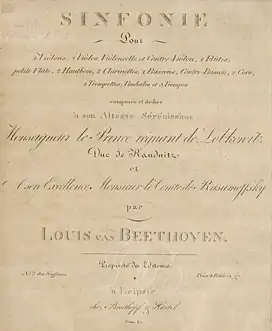 Cover of the symphony, with the dedication to Prince J. F. M. Lobkowitz and Count Rasumovsky | |
| Key | C minor |
| Opus | 67 |
| Form | Symphony |
| Composed | 1804–1808 |
| Dedication |
|
| Duration | About 30–40 minutes |
| Movements | Four |
| Scoring | Symphony orchestra |
| Premiere | |
| Date | 22 December 1808 |
| Location | Theater an der Wien, Vienna |
| Conductor | Ludwig van Beethoven |
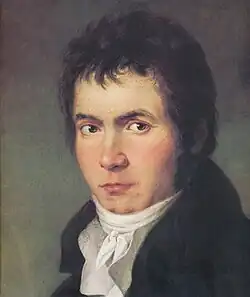
Symphony No. 5 in C minor, Op. 67 is a symphony by Ludwig van Beethoven. It is the fifth of his nine symphonies. It was written between 1804 and 1808. This symphony is one of the most popular and well-known works of classical music.[1]
There are four movements: an opening sonata allegro, a slower andante, and a fast scherzo which leads straight in to the finale.
The symphony was first performed in Vienna's Theater an der Wien on 22 December 1808. Beethoven conducted the piece himself. His Sixth Symphony was also performed for the first time at the same concert.[2]
Instrumentation
The fifth symphony is made for piccolo (4th movement only), two flutes, two oboes, two clarinets in B♭ (movements 1-3) and C (movement 4), two bassoons, contrabassoon (4th movement only) two horns in E♭ (movements 1 & 3) and C (movements 2 & 4), two trumpets in C, three trombones, timpani and strings. It takes 30 to 35 minutes to play.
The music
The symphony begins with a four-note "short-short-short-long" motif which is heard twice (slightly lower the second time): (ⓘ)
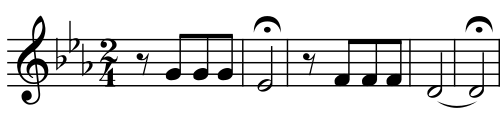
The opening of the symphony is so famous that it has often been quoted. Other composers have used it in their compositions, e.g. Sergei Rachmaninoff in his song Fate. It has often been used in popular culture, from disco to rock and roll, and in film and television. During World War II, the BBC used the four-note motif to introduce its radio news broadcasts because "short-short-short-long" spells the letter "V" in Morse code. The "V" meant "Victory". It was played very quietly on a drum.[3]
The third movement of the symphony uses this rhythm sometimes as an accompaniment.
When Beethoven wrote this symphony he was in his mid-thirties. He was becoming more and more deaf. He found this terribly hard to bear. He thought that he, of all people, should have perfect hearing. He felt very depressed, but he decided not to commit suicide, but to stay alive and write down all the music he had in his head. He wrote about this in a letter called the Heiligenstadt Testament.[4][5]
Form
I. Allegro con brio
The first movement opens with the four-note motif mentioned above. It is in sonata form. The second theme in the exposition is in the relative key of E-flat major as expected. It is more lyrical, and is accompanied by the cellos and basses playing four note motif. The development section goes through multiple keys. The recapitulation returns to C minor, and features an oboe solo. The second theme is restated in C major. The key returns to C minor for the coda.
II. Andante con moto
The second movement is in A-flat major. It is a lyrical work in double variation form; two themes are played and varied in alternation. Following the variations there is a long coda.
III. Scherzo: Allegro
The third movement is a scherzo, back in C minor. It opens with a theme played by the cellos and double basses. The woodwinds and violins answer by a contrasting theme. This sequence is played twice. The horns play the main theme of the movement; it is based on the four-note motif from the first movement. The trio section is in C major. It is written in a contrapuntal texture. When the scherzo returns for the final time, it is performed very quietly by pizzicato strings and staccato woodwinds. There is a transition to the fourth movement without any pause in between. [6]
Some performances of this movement will repeat the scherzo and trio a second time before playing the modified scherzo. In particular, ensembles playing on period instruments do this practice.
IV. Allegro-Prest
The fourth movement is in C major. It is one of the first times that a piccolo, contrabassoon, and trombones are used in a symphony. It is written in a modified version of sonata form. After the development section, there is a reprise of the scherzo. After the recapitulation, there is a long coda where the themes are restated in compressed form. The tempo increases to presto. And the symphony ends on several loud C-major chords.[7]
References
- ↑ Schauffler, Robert Haven (1933). Beethoven: The Man Who Freed Music. Garden City, New York: Doubleday, Doran, & Company. p. 211.
- ↑ Kinderman, William (1995). Beethoven. Berkeley: University of California Press. p. 122. ISBN 0-520-08796-8.
- ↑ Karpf, Jason (18 July 2013). "V for Victory and Viral". The Funky Adjunct. Archived from the original on 2 February 2016. Retrieved 31 August 2015.
- ↑ "Beethoven's complete Heiligenstadt Testament". nac-cna.ca. Retrieved 2026-01-28.
- ↑ "Beethoven's deafness". lvbeethoven.com. Retrieved 31 August 2015.
- ↑ Lockwood, Lewis (2003). Beethoven: The Music and the Life. New York: W. W. Norton. ISBN 0-393-05081-5.
- ↑ Rosen, Charles (1997). The Classical Style (2nd ed.). New York: W. W. Norton. p. 72.
Other websites


- Beethoven's Symphony No. 5 – A Beginners' Guide – Overview, analysis and the best recordings – The Classic Review
- General discussion and reviews of recordings
- Brief structural analysis
- Analysis of the Beethoven 5th Symphony, The Symphony of Destiny on the All About Ludwig van Beethoven Page
- Project Gutenberg has two MIDI-versions of Beethoven's 5th symphony: Etext No. 117 and Etext No. 156
- Program notes for a performance & lecture by Jeffrey Kahane and the Los Angeles Chamber Orchestra.
- Sketch to the Scherzo from op. 67 Fifth Symphony from Eroica Skbk (1803), MIDI, Unheard Beethoven Website
- Original finale in C minor to Fifth Symphony op. 67, Gardi 23 (1804), MIDI, Unheard Beethoven Website
- Symphony No. 5 on YouTube, played by British Symphony Orchestra, Felix Weingartner (rec. 1932)
- Symphony No. 5 on YouTube, played by Berlin Philharmonic, Wilhelm Furtwängler (rec. 1947)
Scores
- Symphony No. 5: Scores at the International Music Score Library Project
- Piano reduction of the 5th Symphony, Mutopia Project
- Public domain sheet music both typset and scanned on Cantorion.org
- Full Score of Beethoven's Fifth Symphony from Indiana University