MIDI
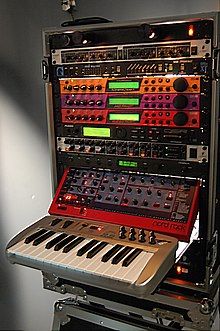
MIDI (/ˈmɪdi/; Musical Instrument Digital Interface) is a technical standard. It describes a communications protocol, digital interface, and electrical connectors. It connect a large variety of electronic musical instruments, digital devices for playing, editing, and recording music.[1]
A MIDI recording is not an audio signal. It is more like a piano roll, identifying the pitch, start and stop time and other properties of each individual note.[2]
The personal computer market stabilized at the same time,[3][4] popularizing the MIDI format, and helped computers become a viable option for music production.[5]

Sources
- ↑ Swift, Andrew. (May 1997), "A brief Introduction to MIDI", SURPRISE, Imperial College of Science Technology and Medicine, archived from the original on 30 August 2012, retrieved 22 August 2012
- ↑ Russ, Martin (2012). Sound Synthesis and Sampling. CRC Press. p. 192. ISBN 978-1136122149. Retrieved 26 April 2017.
- ↑ Helen Casabona; David Frederick. Advanced MIDI Applications. Alfred Music. p. 15. ISBN 9781457438936.
- ↑ MIDI INTERFACES FOR THE IBM PC Archived 21 October 2015 at the Wayback Machine, Electronic Musician, September 1990
- ↑ Manning, Peter. Electronic and Computer Music. 1985. Oxford: Oxford University Press, 1994. Print.