Operation Linebacker II
| Operation Linebacker II | |||||
|---|---|---|---|---|---|
| Part of the Vietnam War | |||||
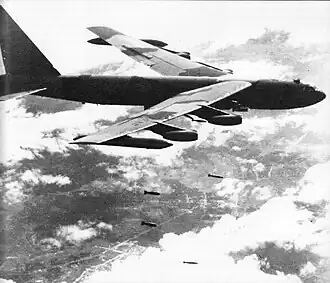 An American Boeing B-52 Stratofortress is bombing Vietnam. | |||||
| |||||
| Belligerents | |||||
 United States |
 North Vietnam | ||||
| Commanders and leaders | |||||
|
John W. Vogt Jr. John C. Meyer Damon W. Cooper |
Lieutenant General Văn Tiến Dũng, Chief of Staff Major General Phùng Thế Tài, Deputy Chief of Staff Colonel Lê Văn Tri, Air Defence Commander – Air Force | ||||
| Strength | |||||
|
197 to 207 B-52s, 14 tactical air groups composed of 1,077 aircraft of all types from three air bases and six aircraft carriers. |
14 SA-2 missile batteries[5] 100 aircrafts (including 31 MiG-21s and 16 MiG-17s) Various anti-aircraft units (smaller weapons) | ||||
| Casualties and losses | |||||
|
U.S. estimated: 12 tactical aircrafts were shot down 15 B-52s shot down 5 B-52s severely damaged (one crashed in Laos) 5 B-52s minor damaged 43 KIA 49 POWs[6] North Vietnam estimated: 81 U.S. aircrafts shot down (including 34 B-52s and 4 F-111s)[7] |
1,624 civilian deaths Unknown military casualties (considered to be very high)[8] 6 MiG-21s shot down | ||||
Operation Linebacker II (also known as the Christmas bombings; Vietnam called it the Điện Biên Phủ in the air because of its similarity to the Battle of Điện Biên Phủ) was the name given for the last United States' twelve-day bombing campaign and offensive against North Vietnam during the Vietnam War. It started from 18 December to 30 December 1972 and it targeted major cities of Hanoi and Haiphong of North Vietnam because the Paris Peace Accords was not going well at the time. It aimed to destroy many North Vietnamese military sites as possible, North Vietnam also against these United States Air Force's attacks by reinforcing air defence network with the support from the Soviet Union. On 20 December 1972, after six Boeing B-52 Stratofortress aircraft bombers got shot down by North Vietnam's surface-to-air missiles (SAM), the United States focused on its efforts to attack these SAM batteries. On 26 December 1972, 120 Boeing B‐52 Stratofortress aircraft bombers were taken off and successfully completed its mission with eight aircrafts damaged/shot down. Many aircrafts, including Republic F-105 Thunderchief, Douglas A-3 Skywarrior and McDonnell Douglas F-4 Phantom II had supported the attacks. The bombing campaign ended on 30 December but two more were also executed until 2 January 1973, when North Vietnam agreed to resume the Paris Peace Accords talks.
References
- ↑ Pribbenow, Merle L. (2001). "Rolling Thunder and Linebacker Campaigns: The North Vietnamese View". The Journal of American-East Asian Relations. 10 (3/4): 197–210. doi:10.1163/187656101793645524. JSTOR 23613043.
- ↑ Beagle, T. W. (2001). Operation Linebacker II (Report). Air University Press. pp. 35–50.
- ↑ "Operation Linebacker II: The 11-Day War". HistoryNet. 29 December 2020. Retrieved 7 November 2023.
- ↑ "How Operation Linebacker II Took the North Vietnamese By Surprise". HistoryNet. 4 January 2023. Retrieved 7 November 2023.
- ↑ Zaloga 2007, p. 22
- ↑ Robt. F. Dorr and Lindsay Peacock. Boeing's Cold War Warrior: B-52 Stratofortress. Publicado em 1995.
- ↑ Pribbenow, p. 327.
- ↑ John Morocco, Rain of Fire. Boston: Boston Publishing Company, 1985, p. 150.