United States and allied war crimes in the Vietnam War
During the Vietnam War (1955–1975) the United States, alongside allies like South Korea, committed war crimes. These included murder, rape, and torture.
From 1965 to 1973, the United States and its allies committed war crimes against both North and South Vietnam.
United States
My Lai massacre
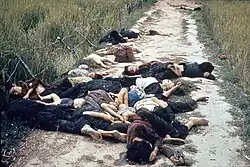
On 16 March, 1968, the United States Armed Forces entered My Lai village because they suspected that at least one Viet Cong soldier was hiding there. They did not find any soldiers in the village.
Instead of leaving, they began shooting the people in the village, mostly women and children. Rapes occurred.
U.S. soldier Hugh Thompson Jr. ended the killing spree. He threatened to shoot the soldiers who were killing people if they didn't stop. He also began rescuing the remaining residents of My Lai.[1][2]
This was perhaps the first report of US war crimes in the Vietnam War, leading to mass protests and demonstrations in the U.S. against the Vietnam War.
Sơn Thắng massacre
In Sơn Thắng on 19 February, 1970, the United States Marines massacred 16 civilians (including 7 women and 8 children).[3] The Marines reported that the civilians were Viet Cong fighters. Four Marines were charged with crimes, but Major General Charles F. Widdecke dropped each soldier's sentence to less than a year.[3]
Incident on Hill 192
A gang rape and massacre of NVA soldiers by four US soldiers happened in November of 1966. 4 American soldiers killed 13 NVA soldiers and skinned bodies, beheaded, dismembered, disemboweled including eat some bodies of NVA soldiers . The victim in rape was Phan Thi Mao, a Vietnamese woman. The event only caught attention three years later, when The New Yorker magazine published an article regarding the rape. Four soldiers were charged for their crimes, but all of them were reduced later.[4]
Thủy Bồ incident
From 31 January to 1 February 1967, the US Marines fired shots against women, children, infants and elderly people in Thủy Bồ village. A total of 145 civilians were killed in the attacks.[5][6] The village was described as "friendly" towards US forces before the event.
South Korea
Phong Nhất–Phong Nhị massacres
On 12 February, 1968, the South Korean army massacred hundreds of unarmed Vietnamese civilians in Phong Nhat and Phong Nhi villages.[7] At least 280 people were killed, mostly women and children, like the U.S.'s massacres.[7] To this day, the South Korean government has never acknowledged its role in these massacres.[7]
Hà My massacre
On 21 February, 1968. South Korean soldiers killed 135 unarmed civilians, including women, children, and elderly people. Like Phong Nhất and Phong Nhị, the South Korean government never acknowledged the part it played in the massacre.[6]
Other information
The United States, alongside countries like South Korea, were using chemical and biological weapons like Agent Orange on civilians in both North and South Vietnam from 1965 to 1973.
Related pages
References
- ↑ "The My Lai Massacre | American Experience | PBS". www.pbs.org. Retrieved 2025-06-30.
- ↑ "Vietnamese villagers killed by U.S. soldiers in My Lai Massacre | March 16, 1968". HISTORY. 2010-02-09. Retrieved 2025-06-30.
- 1 2 Tucker, Spencer C. (2011-05-20). The Encyclopedia of the Vietnam War: A Political, Social, and Military History, 2nd Edition [4 volumes]: A Political, Social, and Military History. ABC-CLIO. ISBN 978-1-85109-961-0.
- ↑ Lang, Daniel (1969-10-10). "Casualties of War". The New Yorker. ISSN 0028-792X. Retrieved 2025-06-30.
- ↑ Turse, Nick (2013-01-15). Kill Anything That Moves: The Real American War in Vietnam. Henry Holt and Company. ISBN 978-0-8050-9547-0.
- 1 2 Kwon, Heonik (2006-11-10). After the Massacre: Commemoration and Consolation in Ha My and My Lai. University of California Press. ISBN 978-0-520-24797-0.
- 1 2 3 "Efforts continue to uncover the truth about the massacre by South Korean troops during the Indochina Wars". asia.fes.de. Retrieved 2025-06-30.