Neopentane
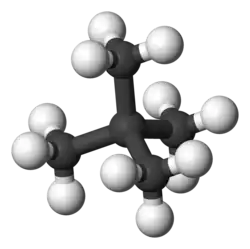 | |
| Names | |
|---|---|
| Preferred IUPAC name
2,2-Dimethylpropane | |
Other names
| |
| Identifiers | |
3D model (JSmol) |
|
| Beilstein Reference | 1730722 |
| ChEBI | |
| ChemSpider | |
| ECHA InfoCard | 100.006.677 |
| EC Number |
|
| Gmelin Reference | 1850 |
| MeSH | neopentane |
PubChem CID |
|
| UNII | |
| UN number | 2044 |
CompTox Dashboard (EPA) |
|
SMILES
| |
| Properties | |
| C(CH3)4 | |
| Molar mass | 72.15 g·mol−1 |
| Appearance | Colorless gas |
| Odor | Odorless |
| Density | 3.255 kg/m3 (gas, 9.5 °C) 601.172 kg/m3 (liquid, 9.5 °C) |
| Melting point | −16.5 °C (2.3 °F; 256.6 K) |
| Boiling point | 9.5 °C (49.1 °F; 282.6 K) |
| Vapor pressure | 146 kPa (at 20 °C)[1] |
| kH | 4.7 nmol Pa−1 kg−1 |
| Thermochemistry | |
| Std enthalpy of formation ΔfH |
−168.5–−167.3 kJ mol−1 |
| Std enthalpy of combustion ΔcH |
−3.51506–−3.51314 MJ mol−1 |
| Standard molar entropy S |
217 J K−1 mol−1 |
| Specific heat capacity, C | 121.07–120.57 J K−1 mol−1 |
| Hazards | |
| GHS labelling: | |
Pictograms |
  |
Signal word |
Danger |
Hazard statements |
H220, H411 |
Precautionary statements |
P210, P273, P377, P381, P391, P403, P501 |
| NFPA 704 (fire diamond) | |
| Related compounds | |
Related alkanes |
|
Related compounds |
|
Except where otherwise noted, data are given for materials in their standard state (at 25 °C [77 °F], 100 kPa). | |
| Infobox references | |


Neopentane, also called 2,2‑dimethylpropane, is an organic compound. It is one of the isomers of pentane, the hydrocarbon with chemical formula C5H12. The formula is also written as C(CH3)4.
Neopentane is the simplest chemical to have a quaternary carbon atom.