Pentane
 | |||
 | |||
| |||
| Names | |||
|---|---|---|---|
| Preferred IUPAC name
Pentane | |||
| Other names
Quintane[1] | |||
| Identifiers | |||
| |||
3D model (JSmol) |
|||
| Beilstein Reference | 969132 | ||
| ChEBI | |||
| ChEMBL | |||
| ChemSpider | |||
| DrugBank | |||
| ECHA InfoCard | 100.003.358 | ||
| EC Number |
| ||
| Gmelin Reference | 1766 | ||
| MeSH | pentane | ||
PubChem CID |
|||
| RTECS number |
| ||
| UNII | |||
| UN number | 1265 | ||
CompTox Dashboard (EPA) |
|||
SMILES
| |||
| Properties[2] | |||
| C5H12 | |||
| Molar mass | 72.15 g·mol−1 | ||
| Appearance | Colourless liquid | ||
| Odor | Gasoline-like[3] | ||
| Density | 0.626 g mL−1; 0.6262 g mL−1 (at 20 °C) | ||
| Melting point | −130.5 to −129.1 °C; −202.8 to −200.3 °F; 142.7 to 144.1 K | ||
| Boiling point | 35.9 to 36.3 °C; 96.5 to 97.3 °F; 309.0 to 309.4 K | ||
| 40 mg L−1 (at 20 °C) | |||
| log P | 3.255 | ||
| Vapor pressure | 57.90 kPa (at 20.0 °C) | ||
| kH | 7.8 nmol Pa−1 kg−1 | ||
| Acidity (pKa) | ~45 | ||
| Basicity (pKb) | ~59 | ||
| λmax | 200 nm | ||
| -63.05·10−6 cm3/mol | |||
Refractive index (nD) |
1.358 | ||
| Viscosity | 0.240 mPa·s (at 20 °C) | ||
| Thermochemistry | |||
| Std enthalpy of formation ΔfH |
−174.1–−172.9 kJ mol−1 | ||
| Std enthalpy of combustion ΔcH |
−3.5095–−3.5085 MJ mol−1 | ||
| Standard molar entropy S |
263.47 J K−1 mol−1 | ||
| Specific heat capacity, C | 167.19 J K−1 mol−1 | ||
| Hazards | |||
| GHS labelling: | |||
Pictograms |
Template:GHS flame Template:GHS exclamation mark Template:GHS health hazard Template:GHS environment | ||
Signal word |
Danger | ||
Hazard statements |
H225, H304, H336, H411 | ||
Precautionary statements |
P210, P261, P273, P301+P310, P331 | ||
| NFPA 704 (fire diamond) | |||
| Flash point | −49.0 °C (−56.2 °F; 224.2 K) | ||
Autoignition temperature |
260.0 °C (500.0 °F; 533.1 K) | ||
| Explosive limits | 1.5–7.8%[3] | ||
| Lethal dose or concentration (LD, LC): | |||
LD50 (median dose) |
| ||
LC50 (median concentration) |
130,000 mg/m3 (mouse, 30 min) 128,200 ppm (mouse, 37 min) 325,000 mg/m3 (mouse, 2 hr)[4] | ||
| NIOSH (US health exposure limits): | |||
PEL (Permissible) |
TWA 1000 ppm (2950 mg/m3)[3] | ||
REL (Recommended) |
TWA 120 ppm (350 mg/m3) C 610 ppm (1800 mg/m3) [15-minute][3] | ||
IDLH (Immediate danger) |
1500 ppm[3] | ||
| Related compounds | |||
Related alkanes |
|||
Except where otherwise noted, data are given for materials in their standard state (at 25 °C [77 °F], 100 kPa). | |||
 verify (what is  ?) | |||
| Infobox references | |||
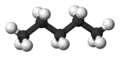
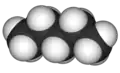

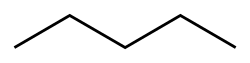
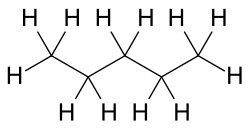
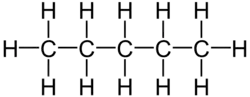
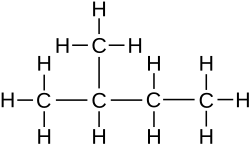
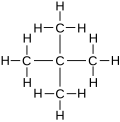
Pentane is an organic compound with the chemical formula of C
5H
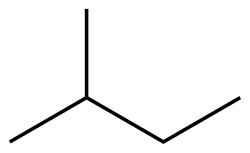
12. It is an alkane with five carbon atoms. Usually, "pentane" represents all three isomers (n-pentane, isopentane and neopentane). But in the IUPAC, pentane only represents n-pentane. In the IUPAC, the other two isomers is 2-methylbutane and 2,2-dimethylpropane. Cyclopentane's chemical formula is C
5H
10, so it is not an isomer of pentane.
Isomers
| Common name | normal pentane unbranched pentane n-pentane |
isopentane | neopentane |
| IUPAC name | pentane | 2-methylbutane | 2,2-dimethylpropane |
| Molecular diagram |
 |
 |
 |
| Skeletal diagram |
|
 |
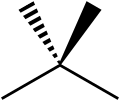 |
Reaction
All isomers of pentane burn with oxygen to make carbon dioxide and water:
- C
5H
12+8O
2->5CO
2+6H
2O.
References
- ↑ Hofmann, August Wilhelm Von (1 January 1867). "I. On the action of trichloride of phosphorus on the salts of the aromatic monamines". Proceedings of the Royal Society of London. 15: 54–62. doi:10.1098/rspl.1866.0018. S2CID 98496840. Archived from the original on 28 April 2018. Retrieved 4 April 2018 – via rspl.royalsocietypublishing.org.
- ↑ Record of n-Pentane in the GESTIS Substance Database of the Institute for Occupational Safety and Health, accessed on 19 April 2011.
- 1 2 3 4 5 NIOSH Pocket Guide to Chemical Hazards. "#0486". National Institute for Occupational Safety and Health (NIOSH).
- ↑ "n-Pentane". Immediately Dangerous to Life or Health Concentrations. National Institute for Occupational Safety and Health.