Cyclopentane
| |||
| Names | |||
|---|---|---|---|
| Preferred IUPAC name
Cyclopentane | |||
| Other names
pentamethylene | |||
| Identifiers | |||
3D model (JSmol) |
|||
| ChEBI | |||
| ChemSpider | |||
| ECHA InfoCard | 100.005.470 | ||
| EC Number |
| ||
PubChem CID |
|||
| RTECS number |
| ||
| UNII | |||
CompTox Dashboard (EPA) |
|||
SMILES
| |||
| Properties | |||
| C5H10 | |||
| Molar mass | 70.1 g/mol | ||
| Appearance | clear, colorless liquid | ||
| Odor | mild, sweet | ||
| Density | 0.751 g/cm3 | ||
| Melting point | −93.9 °C (−137.0 °F; 179.2 K) | ||
| Boiling point | 49.2 °C (120.6 °F; 322.3 K) | ||
| 156 mg·l−1 (25 °C)[1] | |||
| Solubility | soluble in ethanol, acetone, ether | ||
| Vapor pressure | 45 kPa (20 °C) [2] | ||
| Acidity (pKa) | ~45 | ||
| -59.18·10−6 cm3/mol | |||
Refractive index (nD) |
1.4065 | ||
| Hazards | |||
| Occupational safety and health (OHS/OSH): | |||
Main hazards |
Flammable[3] | ||
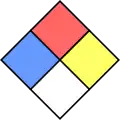
| NFPA 704 (fire diamond) | |||
| Flash point | −37.2 °C (−35.0 °F; 236.0 K) | ||
Autoignition temperature |
361 °C (682 °F; 634 K) | ||
| Explosive limits | 1.1%-8.7%[3] | ||
| NIOSH (US health exposure limits): | |||
PEL (Permissible) |
none[3] | ||
REL (Recommended) |
TWA 600 ppm (1720 mg/m3)[3] | ||
IDLH (Immediate danger) |
N.D.[3] | ||
| Related compounds | |||
Related compounds |
cyclopropane, cyclobutane, cyclohexane | ||
Except where otherwise noted, data are given for materials in their standard state (at 25 °C [77 °F], 100 kPa). | |||
 verify (what is  ?) | |||
| Infobox references | |||
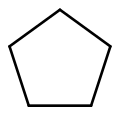
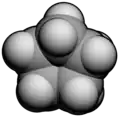
Cyclopentane (also called C pentane) has a chemical formula C5H10. It is usually formed by cracking cyclohexane in the presence of high temperature and pressure.[4]
References
- ↑ Record of cyclopentane in the GESTIS Substance Database of the Institute for Occupational Safety and Health, accessed on 28 February 2015.
- ↑ "Icsc 0353 - Cyclopentane".
- 1 2 3 4 5 NIOSH Pocket Guide to Chemical Hazards. "#0171". National Institute for Occupational Safety and Health (NIOSH).
- ↑ "What is a Cyclopentane? - Definition from Corrosionpedia".