Cyclohexane
| |||
| |||
| Names | |||
|---|---|---|---|
| Preferred IUPAC name
Cyclohexane[1] | |||
| Other names
Hexanaphthene (archaic)[2] | |||
| Identifiers | |||
| |||
3D model (JSmol) |
|||
| ChEBI | |||
| ChEMBL | |||
| ChemSpider | |||
| DrugBank | |||
| ECHA InfoCard | 100.003.461 | ||
| KEGG | |||
PubChem CID |
|||
| UNII | |||
CompTox Dashboard (EPA) |
|||
SMILES
| |||
| Properties | |||
| C6H12 | |||
| Molar mass | 84.16 g·mol−1 | ||
| Appearance | Colorless liquid | ||
| Odor | Sweet, gasoline-like | ||
| Density | 0.7781 g/mL, liquid | ||
| Melting point | 6.47 °C (43.65 °F; 279.62 K) | ||
| Boiling point | 80.74 °C (177.33 °F; 353.89 K) | ||
| Immiscible | |||
| Solubility | Soluble in ether, alcohol, acetone Miscible with olive oil | ||
| Vapor pressure | 78 mmHg (20 °C)[3] | ||
| -68.13·10−6 cm3/mol | |||
Refractive index (nD) |
1.42662 | ||
| Viscosity | 1.02 cP at 17 °C | ||
| Thermochemistry | |||
| Std enthalpy of formation ΔfH |
-156 kJ/mol | ||
| Std enthalpy of combustion ΔcH |
-3920 kJ/mol | ||
| Hazards | |||
| NFPA 704 (fire diamond) | |||
| Flash point | −20 °C (−4 °F; 253 K) | ||
Autoignition temperature |
245 °C (473 °F; 518 K) | ||
| Explosive limits | 1.3%-8%[3] | ||
| Lethal dose or concentration (LD, LC): | |||
LD50 (median dose) |
12705 mg/kg (rat, oral) 813 mg/kg (mouse, oral)[4] | ||
LCLo (lowest published) |
17,142 ppm (mouse, 2 hr) 26,600 ppm (rabbit, 1 hr)[4] | ||
| NIOSH (US health exposure limits): | |||
PEL (Permissible) |
TWA 300 ppm (1050 mg/m3)[3] | ||
REL (Recommended) |
TWA 300 ppm (1050 mg/m3)[3] | ||
IDLH (Immediate danger) |
1300 ppm[3] | ||
| Related compounds | |||
Related cycloalkanes |
Cyclopentane Cycloheptane | ||
Related compounds |
Cyclohexene Benzene | ||
Except where otherwise noted, data are given for materials in their standard state (at 25 °C [77 °F], 100 kPa). | |||
 verify (what is  ?) | |||
| Infobox references | |||
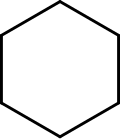
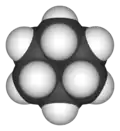

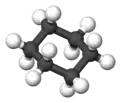

Cyclohexane is the cycloalkane molecule with the formula C
6H
12, with 6 carbon atoms connected to each other in a ring shape, and each connected to two hydrogen atoms. It is used when making adipic acid and caprolactam, which can them be used to make nylon. It has no color and is flammable.
References
- ↑ "Front Matter". Nomenclature of Organic Chemistry : IUPAC Recommendations and Preferred Names 2013 (Blue Book). Cambridge: The Royal Society of Chemistry. 2014. pp. P001 – P004. doi:10.1039/9781849733069-FP001. ISBN 978-0-85404-182-4.
- ↑ Hexanaphthene Archived 2018-02-12 at the Wayback Machine, dictionary.com
- 1 2 3 4 5 NIOSH Pocket Guide to Chemical Hazards. "#0163". National Institute for Occupational Safety and Health (NIOSH).
- 1 2 "Cyclohexane". Immediately Dangerous to Life or Health Concentrations. National Institute for Occupational Safety and Health.