Symphony No. 5 (Shostakovich)
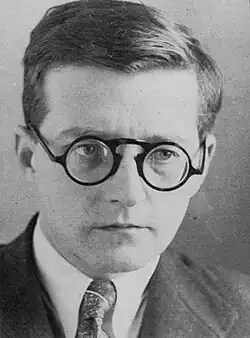
Symphony No. 5 in D minor, Op. 47, is a piece of music for orchestra by Dmitri Shostakovich. It was first played in Leningrad by the Leningrad Philharmonic in 1937, conducted by Yevgeny Mravinsky.[1] This concert went very well,[2] and the listeners liked it so much that they gave a standing ovation for more than 30 minutes.[3] Today, Symphony No. 5 is one of Shostakovich's most played symphonies.[4]
History
In 1934, Shostakovich wrote an opera called Lady Macbeth of the Mtsensk District. In 1936, Stalin went to see the opera and did not like it. The next day, Pravda, the newspaper of the Soviet government, wrote a very bad review of the opera and Shostakovich. The composer then stopped his fourth symphony from being played.[5]
Before the fifth symphony was played, Shostakovich wrote an introduction called "A Soviet Artist’s Reply to Just Criticism." The symphony is also called by this name.[6][7]
The symphony's first concert was in Leningrad on 21 November 1937. During the concert, Yevgeny Mravinsky conducted the Leningrad Philharmonic. This started a long partnership between him and Shostakovich.[1] Mravinsky also conducted the first concerts of Shostakovich's sixth, eighth, ninth, tenth, and twelfth symphonies.[8]
References to other works
The symphony uses parts of Shostakovich's song Vozrozhdenije (Op. 46 No. 1, written in 1936–37), mostly in the last movement. The song is based on a poem by Alexander Pushkin about rebirth. This might explain some of the reasons the symphony was written.[9] Shostakovich also used a melody from the "Habanera" from Bizet's Carmen in the first movement. This is a reference to Shostakovich's love for Elena Konstantinovskaya, who did not want to marry him. She moved to Spain and married Roman Karmen instead.[10][11]
Instruments
The work is written for two flutes and piccolo, two oboes, two clarinets and E♭ clarinet, two bassoons and contrabassoon, four horns, three B♭ trumpets, three trombones, tuba, timpani, snare drum, triangle, cymbals, bass drum, tam-tam, glockenspiel, xylophone, two harps (one part), piano, celesta, and strings.[12]
Form
The symphony has four parts, also called movements:
- Moderato
- Allegretto
- Largo
- Allegro non troppo
I. Moderato
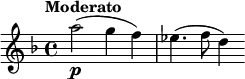
The first movement, in D minor, is in sonata form. It starts with a canon of minor sixths that change to minor thirds.[13] The first theme (melody) is played by the first violins.[12]
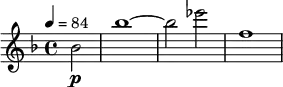
The second theme, measures 50 - 120, in E♭ minor is very different from the first. The notes are longer and have bigger intervals, like octaves, fourths, and sevenths.[13] Close to the end of the movement, the second theme is played again as a canon by flutes and horns, then by violins and piccolo. The movement ends with the celesta playing a rising melody and slowly dying away.[14]
II. Allegretto

The second movement is in A minor. It has a minuet and a trio and is sometimes called a scherzo. The movement starts with a loud melody from the cellos and basses,[15] and then has softer lines from the woodwinds and horns. This movement also has notable violin and flute solos.[16]
The movement ends in A minor with four fortissimo measures.[17]
III. Largo

Shostakovich starts the Largo in F♯ minor with violins in three groups, rather than two. Violas and cellos are in two groups each. There are no brass instruments in this movement.[16]
IV. Allegro non troppo

The last movement starts with a loud brass line. It changes from D minor to D major.[16]
Reception
Some listeners cried when they heard the third movement for the first time.[18] Both the public and critics liked the symphony so much that some Soviet leaders did not believe it. The leader of the Leningrad Philharmonic at the time, Mikhail Chulaki, said that some government officials did not like that Mravinsky lifted the music above his head to the listeners. Two officials, V. N. Surin and Boris M. Yarustovsky, went to hear the symphony. They said that the listeners were "hand-picked" Shostakovich supporters.[19]
The Soviet government liked the symphony, but the public thought the symphony was speaking out against Stalin. The government and the public thought two different things about the same symphony.[20]
Critics
Shostakovich wrote an article in Vechernyaya Moskva on January 25, 1938, a few days before the symphony was played in Moscow for the first time:[21]
Among the reviews, which often analyzed the work in thorough detail, one that particularly delighted me stated that the Fifth Symphony was a Soviet artist's no-nonsense response to fair criticism.[22]
Government critics called the symphony a turning point for Shostakovich.[23] This may be because the government wanted to show that they could make artists write what they wanted.[23]
Alexei Tolstoy wrote a review of the symphony where he said it was like a Soviet Bildungsroman, or coming-of-age story, about the growth of Shostakovich into a Soviet.[20] In the first movement, the composer has a mental crisis that is shown with lots of energy. The second movement is a short time of relief. In the third movement, the growth starts to happen. Tolstoy wrote that the last movement is "an enormous optimistic lift".[24]
Not everyone agreed with Tolstoy, even after another article by Shostakovich confirmed what he wrote. Boris Asafyev wrote that the symphony was written for all of humankind, not just one man.[25]
References
- 1 2 "Symphony No. 5". Boston Symphony Orchestra. Retrieved 7 May 2026.
- ↑ Schwarz 1980, p. 267
- ↑ Wilson 2006, p. 158
- ↑ Wright 2010, p. 353.
- ↑ Laurel 2000, p. 95
- ↑ "THE STORY BEHIND: Shostakovich's Symphony No.5". Rhode Island Philharmonic. 19 September 2023. Retrieved 4 April 2026.
- ↑ "Shostakovich's Symphony No. 5: Keeping Score | PBS". www.pbs.org. Retrieved 4 April 2026.
- ↑ Tassie, Gregor, Yevgeny Mravinsky: The Noble Conductor, The Scarecrow Press, p. 199 (2005) (ISBN 978-0810854277.)
- ↑ BBC Radio 3 Discovering Music, retrieved on 25 April 2009.
- ↑ Andrew Clark (13 March 2009). "A Liverpool orchestra at its peak". Financial Times. Archived from the original on 10 December 2022. Retrieved 14 May 2009.
- ↑ Stephen Johnson. "Shostakovich: A Journey Into Light". BBC Radio 3. Retrieved 14 May 2009.
- 1 2 Steinberg 1995, p. 546.
- 1 2 Blokker 1979, p. 66.
- ↑ Blokker 1979, p. 68.
- ↑ Blokker 1979, p. 69.
- 1 2 3 Dulas, Mathew (April 2021). "A Masterpiece Amid Musical Suppression: An Analysis of Dmitri Shostakovich's Symphony No. 5". openprairie.sdstate.edu. pp. 24–27. Retrieved 3 May 2026.
- ↑ Jakob Knaus: A «Happy Birthday» for the Russian Revolution. The hidden musical quote was a secret weapon for Dmitri Shostakovich. In: Neue Zürcher Zeitung. 14 October 2017, page 47
- ↑ MacDonald 1990, pp. 123–124.
- ↑ Wilson 2006, pp. 158–159.
- 1 2 Maes 2002, p. 353.
- ↑ Hulme 2010, p. 190.
- ↑ Shostakovich, Dmitri (25 January 1938). "Мой творческий ответ". Вечерняя Москва (in Russian). No. 19. p. 3. Archived from the original on 2 January 2023. Retrieved 2 January 2023.
Среди отзывов, часто очень обстоятельно анализировавших это произведение, особенную радость доставил мне один, где говорилось, что пятая симфония — это деловой творческий ответ советского художника на справедливую критику
- 1 2 Maes 2002, p. 304.
- ↑ Taruskin 2006, p. 32.
- ↑ Sollertinsky & Sollertinsky 1980, p. 84.
Books
- Blokker, Roy (1979). The Music of Dmitri Shostakovich: The Symphonies. with Robert Dearling. Cranbury, New Jersey: Associated University Presses. ISBN 0-8386-1948-7.
- Fay, Laurel (2000). Shostakovich: A Life. Oxford: Oxford University Press. ISBN 0-19-513438-9.
- Hulme, Derek C. (2010). Dmitri Shostakovich Catalogue (4th ed.). Lanham: The Scarecrow Press. ISBN 978-0-8108-7264-6.
- MacDonald, Ian (1990). The New Shostakovich. Boston: Northeastern University Press. ISBN 1-55553-089-3.
- Maes, Francis (2002). A History of Russian Music: From Kamarinskaya to Babi Yar. Translated by Arnold J. Pomerans and Erica Pomerans. Berkeley, Los Angeles and London: University of California Press. ISBN 0-520-21815-9.
- Schwarz, Boris (1980). Sadie, Stanley (ed.). The New Grove Dictionary of Music and Musicians. Vol. 17. London: MacMillan. ISBN 0-333-23111-2.
- Schwarz, Boris (1983). Music and Musical Life in Soviet Russia: Enlarged Edition, 1917-1981. Bloomington: Indiana: University Press. ISBN 0-253-33956-1.
- Sollertinsky, Dmitri; Sollertinsky, Ludmilla (1980). Pages from the Life of Dmitri Shostakovich. Translated by Graham Hobbs and Charles Midgley. New York and London: Harcourt Brace Jovanovich. ISBN 0-15-170730-8.
- Steinberg, Michael (1995). The Symphony: A Listener's Guide. Oxford and New York: Oxford University Press. ISBN 0-19-512665-3.
- Taruskin, Richard (2006). "Public lies and unspeakable truth: interpreting Shostakovich's Fifth Symphony". In Fanning, David (ed.). Shostakovich Studies. Cambridge: Cambridge University Press. ISBN 978-0-521-02831-8.
- Wilson, Elizabeth (2006). Shostakovich: A Life Remembered (2nd ed.). Princeton University Press. ISBN 978-0691128863.
- Wright, Craig (2010). Listening to Western Music. Cengage Learning. ISBN 978-1-4390-8347-5.
Other websites
- Symphony No. 5 (Shostakovich): Scores at the International Music Score Library Project
- Rebirth: The text to Alexander Pushkin's poem used in Vozrozhdenije