Homo sapiens
| Homo sapiens Temporal range: Middle Pleistocene–Present | |
|---|---|
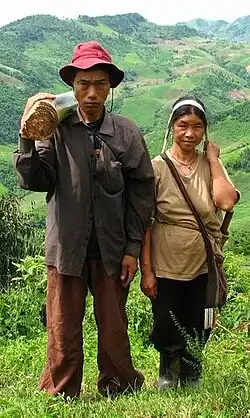 | |
| Male and female H s. sapiens (Akha in northern Thailand, 2010 photograph) | |
Scientific classification  | |
| Kingdom: | Animalia |
| Phylum: | Chordata |
| Class: | Mammalia |
| Order: | Primates |
| Suborder: | Haplorhini |
| Infraorder: | Simiiformes |
| Family: | Hominidae |
| Subfamily: | Homininae |
| Tribe: | Hominini |
| Genus: | Homo |
| Species: | H. sapiens |
| Binomial name | |
| Homo sapiens Linnaeus, 1758 | |
| Subspecies | |
|
H. s. sapiens | |
Homo sapiens is the modern human species. Homo sapiens is a name in binomial nomenclature. It means that modern humans belong to the genus Homo and the species sapiens. It is abbreviated H. sapiens.
Modern humans are the only living species of the genus Homo. There were other species in this genus (like Homo habilis and Homo erectus), but they are extinct.
Homo sapiens are sometimes called "anatomically modern humans".
Origin
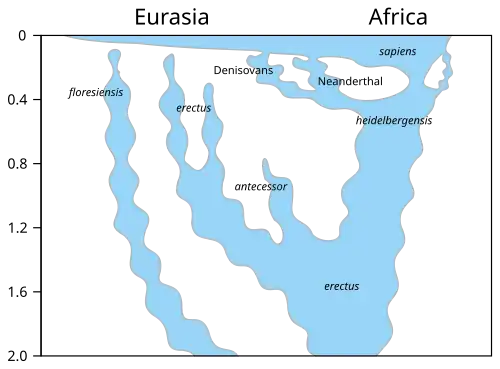
Blue areas show presence at a given time and place.[2]
Most scholars agree that modern humans originated in East Africa. This is the near-consensus position held within the scientific community.[3][4][5][6][7]
The hypothesis that humans have a single origin was published in Charles Darwin's The Descent of Man (1871). Modern studies of mitochondrial DNA support this theory. So does evidence based on physical anthropology of fossil humans.
According to genetic and fossil evidence, older versions of H. sapiens evolved only in Africa, between 200,000 and 100,000 years ago. Then members of one branch of H. sapiens left Africa by 90,000 years ago. Over time, it replaced earlier human populations such as Neanderthals and Homo erectus.
Neanderthal genome
Sequencing of the full Neanderthal genome suggests Neanderthals and some modern humans share some ancient genetic lineages. Some populations may have as much as 4% Neanderthal DNA, according to the authors of this study. The reason for this admixture is not known.[8]
This DNA overlap may exist because both Neanderthals and modern humans had a common ancestor, according to an August 2012 study.[9][10]
Evolution
The genus Homo evolved out of the last common ancestor roughly 10 to 2 million years ago. The species H. sapiens evolved from Homo erectus roughly 1.8 to 0.2 million years ago.
Scientific study of human evolution focuses mostly on how the genus Homo developed. However, it usually involves studying other hominids and hominines as well, such as Australopithecus.
Extinct subspecies
Within the Homo sapiens species, modern humans belong to the only living subspecies: Homo sapiens sapiens. Homo sapiens idaltu, the other known subspecies, is now extinct.[11]
Homo neanderthalensis, which became extinct 30,000 years ago, has sometimes been classified as a subspecies, "Homo sapiens neanderthalensis". Genetic studies now suggest that the functional DNA of modern humans and Neanderthals diverged 500,000 years ago.[12]
Similarly, some scientists have classified the discovered specimens of the Homo rhodesiensis species as a subspecies, but this classification is not widely accepted.
Earliest fossils of the species
Until recently it was thought that anatomically modern humans first appeared in the fossil record in Africa about 195,000 years ago. However, studies of molecular biology suggest that 200,000 years ago, modern humans diverged from the common ancestor of all human populations.[13][14][15][16][17]
A broad study of African genetic diversity found the ǂKhomani San people had the greatest genetic diversity among the 113 distinct populations sampled. This makes them one of 14 "ancestral population clusters". The research also placed the origin of modern human migration in south-western Africa, near the coastal border of Namibia and Angola.[18][19]
In the 1960s an archaeological site at Jebel Irhoud in Morocco was dated as about 40,000 years old. However, it was re-dated in the 2000s. It is now thought to be between 300,000 and 350,000 years old. The skull form is almost identical to modern humans,[20] though the jaw is different.
The forces of natural selection have continued to operate on human populations, with evidence that certain regions of the genome show selection in the past 15,000 years.[21]
Related pages
References
- ↑ Global Mammal Assessment Team (2008). "Homo sapiens". The IUCN Red List of Threatened Species. 2008. IUCN: e.T136584A4313662. doi:10.2305/IUCN.UK.2008.RLTS.T136584A4313662.en. Archived from the original on 7 December 2017. Retrieved 12 January 2018.
- ↑ Stringer, C. (2012). "What makes a modern human". Nature. 485 (7396): 33–35. doi:10.1038/485033a. PMID 22552077. S2CID 4420496.
- ↑ Liu, Hua; Prugnolle, Franck; Manica, Andrea; Balloux, François (2006). "A Geographically Explicit Genetic Model of Worldwide Human-Settlement History". The American Journal of Human Genetics. 79 (2): 230–237. doi:10.1086/505436. PMC 1559480. PMID 16826514.
- ↑ "Out of Africa revisited". Science. 308 (5724). Sciencemag.org: 921g. 2005-05-13. doi:10.1126/science.308.5724.921g. S2CID 220100436. Retrieved 2009-11-23.
- ↑ Nature (2003-06-12). "Access: human evolution: out of Ethiopia". Nature. 423 (6941): 693–695. doi:10.1038/423692a. PMID 12802315. S2CID 26693109. Retrieved 2009-11-23.
- ↑ "Origins of modern humans: multiregional or out of Africa?". ActionBioscience. Archived from the original on 2010-11-22. Retrieved 2009-11-23.
- ↑ "Modern humans - single origin (out of Africa) vs multiregional". Asa3.org. Retrieved 2009-11-23.
- ↑ Green R.E.; et al. (2010). "A draft sequence of the Neanderthal genome". Science. 328 (5979). Science (journal): 710–22. Bibcode:2010Sci...328..710G. doi:10.1126/science.1188021. PMC 5100745. PMID 20448178.
- ↑ Study casts doubt on human-Neanderthal interbreeding theory, The Guardian, Tuesday 14 August 2012
- ↑ Anders Eriksson and Andrea Manica Effect of ancient population structure on the degree of polymorphism shared between modern human populations and ancient hominins PNAS 2012 : 1200567109v1-201200567. July 20, 2012
- ↑ Human evolution: the fossil evidence in 3D, by Philip L. Walker and Edward H. Hagen, Dept. of Anthropology, University of California, Santa Barbara. Retrieved April 5, 2005.
- ↑ Green R.E.; et al. (2006). "Analysis of one million base pairs of Neanderthal DNA". Nature. 444 (7117): 16, 330–336. Bibcode:2006Natur.444..330G. doi:10.1038/nature05336. PMID 17108958. S2CID 4320907.
- ↑ "nsf.gov - National Science Foundation (NSF) News - New clues add 40,000 years to age of human species - US National Science Foundation (NSF)". Archived from the original on 2009-12-10. Retrieved 2015-05-05.
- ↑ "Age of ancient humans reassessed". BBC News. February 16, 2005. Retrieved April 10, 2010.
- ↑ The oldest Homo sapiens: – URL retrieved May 15, 2009
- ↑ Alemseged, Z., Coppens, Y., Geraads, D. (2002). "Hominid cranium from Homo: description and taxonomy of Homo-323-1976-896". Am J Phys Anthropol. 117 (2): 103–12. doi:10.1002/ajpa.10032. PMID 11815945.
{{cite journal}}: CS1 maint: multiple names: authors list (link) - ↑ Stoneking, Mark; Soodyall, Himla (1996). "Human evolution and the mitochondrial genome". Current Opinion in Genetics & Development. 6 (6): 731–6. doi:10.1016/S0959-437X(96)80028-1. PMID 8994844.
{{cite journal}}: CS1 maint: multiple names: authors list (link) - ↑ Henn, Brenna; Gignoux, Christopher R.; Jobin, Matthew (2011). "Hunter-gatherer genomic diversity suggests a southern African origin for modern humans". Proceedings of the National Academy of Sciences of the United States of America. 108 (13). National Academy of Sciences: 5154–62. doi:10.1073/pnas.1017511108. PMC 3069156. PMID 21383195.
- ↑ Gill, Victoria (May 1, 2009). "Africa's genetic secrets unlocked". BBC News.; the results were published in the online edition of the journal Science.
- ↑ Ghosh P. 2017. First of our kind found in Morocco. BBC News Science & Environment.
- ↑ Wade, N (2006-03-07). "Still evolving, human genes tell new story". The New York Times. Retrieved 2008-07-10.