Bickerse ligue
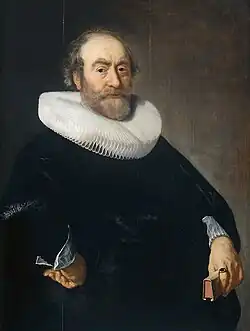
The Bickerse ligue (Bickerse league) was a political and economic power factor in Amsterdam during the Dutch Golden Age.[1]
History
The league was formed by Andries Bicker, member of the patrician Bicker family. He was the most powerful politician in Amsterdam (Holland) from from the 1620s until 1650. The league was formed with relatives, sympathizers and in close cooperation with the De Graeff family,[2] the so called Bicker-De Graeff clan. They where liberal and republican minded, focused on Amsterdam's economic boom. The ligue wanted to end Eighty Years' War with Spain and a reduction of the army. They where also against the monarchist ambitions of the Dutch stadholders Frederick Henry and his son William II of Orange-Nassau.[3]
Summary
- Political power: The Bicker League consisted of seven members of the Bicker family who held various political offices in Amsterdam and the States of Holland. They controlled the government of Amsterdam and, through their economic and political strenght, thus the province of Holland for several decades.[4]
- Economic influence: Through their work in the Amsterdam city administration, the Dutch East India Company (VOC) and the Dutch West India Company (WIC), the family reached enormous influence on the economics of the Dutch Republic.[1]
- Alliance with the De Graeff family:[5] The Bicker family formed an alliance with the De Graeff family through marriage. Together they created a strong power base in Amsterdam that significantly influenced politics.[1]
- Goal: One of the main goals was to end the Eighty Years' War with Spain, which brought them into great conflict with the stadtholders from the House of Orange-Nassau. It was finally achieved with the Peace of Münster in 1648.
- Time frame: The power of the ligue extended over much of the early to mid-17th century and was closely linked to the rise of Dutch power during this period.
- Meaning: The Bickerse ligue was a central structure of the ruling oligarchy of the Netherlands. It shows the power of the wealthy patrician families during this period.[1]
Members
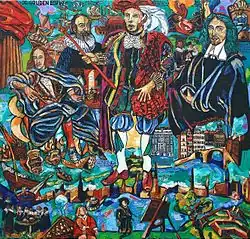
Bicker family
(seven members of the Bicker family[1])
- Andries Bicker (1586–1652), leader of the Bickerse ligue; regent and burgomaster of Amsterdam, diplomat and statesman, wholesaler
- Jacob Bicker (1588–1647), member of the Amsterdam city government, wholesaler
- Johan (Jan) Bicker (1591-1653), member of the Amsterdam city government, wholesaler
- Cornelis Bicker van Swieten (1592-1654), "deputy-"leader of the Bickerse ligue;[6] Amsterdam regent and burgomaster, wholesaler
- Roelof Bicker (1611–1656), member of the Amsterdam city government
- Jacob Jacobsz Bicker (1612-1676), mayor of the military garrison of Amsterdam
- Hendrick Jacobsz Bicker (1615–1651), captain of the Amsterdam militia
Prominent allies and supporters
(temporarily[1])
- Adriaan Pauw (1585–1653), Grand Pensionary of Holland from 1631–1636 and from 1651–1653; supporter of the Bickerse ligue until 1649[7]
- Jacob Dircksz de Graeff (1571–1638), Amsterdam regent and burgomaster; ally of the Bickerse ligue[8]
- Cornelis de Graeff (1599–1664), statesman, diplomat, regent and burgomaster of Amsterdam[9]
Notes
- 1 2 3 4 5 6 Graeff Forschung. chapter "Verwandtschaften" - section "Kapitel II) Graeff'sche Verwandtschaften" - "c) Bicker" (by Matthias Laurenz Gräff)
- ↑ Leiders van de Gouden Eeuw, by Gerben Hellinga. Walburg Pers, p 105, 2009 (Korte biografieën van stadhouders, raadspensionarissen, regenten en andere leiders uit de zeventiende eeuw)
- ↑ Leiders van de Gouden Eeuw, by Gerben Hellinga. Walburg Pers, p 17, 2009 (Korte biografieën van stadhouders, raadspensionarissen, regenten en andere leiders uit de zeventiende eeuw)
- ↑ "Triumph of Peace". Archived from the original on 2012-03-01. Retrieved 2011-03-18.
- ↑ van de stad. het Athenaeum Illustre en de Universiteit van Amsterdam, 1632-1960, by Peter Jan Knegtmans, p 33 · 2007
- ↑ 1650 bevochten eendracht, by Willem Frijhoff, Marijke Spies, p 80 · 1999
- ↑ 1650 bevochten eendracht, by Willem Frijhoff, Marijke Spies · 1999
- ↑ Verleden van Nederland. Een nieuwe geschiedenis, by Jan Bank, Geert Mak, Gijsbert van Es, Piet de Rooy, René van Stipriaan · 2021
- ↑ VU Research Portal. Amsterdam en Oranje. De politieke cultuur van de buitenplaats in Hollands Gouden Eeuw, by R. van der Laarse; published in "Buitenplaatsen in de Gouden Eeuw. De rijkdom van het buitenleven in de Republiek", p 72
Literature
- Israel, Jonathan I. (1995) The Dutch Republic – Its Rise, Greatness, and Fall – 1477–1806, Clarendon Press, Oxford, ISBN 978-0-19-820734-4
- Burke, P. (1994) Venice and Amsterdam. A study of seventeenth-century élites.