Bicker-De Graeff clan
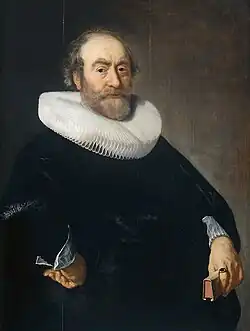

The Bicker-De Graeff clan was a political power force during the Dutch Golden Age. Both patrician families belonged to the leading republican class of Amsterdam and Holland.[1]
History
Early to mid 17th century
The Bicker-De Graeff clan was a leading political force in the Dutch Republic after the revolt against the Spanish kingdom.[2] The clan was formed through numerous marriages and the political orientation of both families. This group was liberal and republican.
In 1627 they took over the political power in Amsterdam from the orthodox and conservative group.[3] The first wo mayors where Jacob Dircksz de Graeff and his nephew Andries Bicker. They controlled the government of Amsterdam. Through their economic and political power they have a huge influence within the province of Holland.[4][5][6]
The Bickers had also a political network of relatives over Holland. A prime example of this is Johan de Witt, the leading statesman of the Republic of the United Netherlands. He was married to Wendela Bicker, daughter of Jan Bicker and Agneta de Graeff van Polsbroek.[7][8]
The Bicker and De Graeff families tried to copy⁶ the centralist, autocratic style of government of the Florentine Medici in Amsterdam.[9] Their royal ambitions were showed in the construction of the new town hall, the Stadhuis Op den Dam. They showed it also in confident and unconventional politics. Due to their trade interests, the Bickers, also known as the "Bickers League", focused on a peace with the Spanish (Eighty Years' War). This war slowed the economic growth and social development of the United Netherlands. It also strengthened the power of the dutch stadtholder as commander-in-chief of the armed forces.
The clan came into opposition to the growing influence of the Dutch stadtholders from the House of Orange-Nassau. They also where against the princely display of pomp and the behavior of stadholder Frederik Henry van Oranje-Nassau.[10] He was no sovereign, and stood under the command the Dutch States General. This displeased the Republicans and led to a conflict with him.[11]
The "clan-leader" Andries Bicker was one of the strongest opponents of the stadtholder. He also controlled Dutch foreign policy.[12] Their Amsterdam power-block (mostly of the Bickers) within the States of Holland where supported by the towns of Dordrecht, Rotterdam and Delft.[13] Therefore, in 1638, the stadtholder tried to overthrow the Bickers. He had no success. In the 1640s Andries and Cornelis Bicker, Cornelis and Andries de Graeff[14] and Jacob de Witt, advocated for an end to the war and a reduction of the army.[15]
From the Peace of Münster in 1648 to the Rampjaar 1672
In 1647, due to immense political pressure from the entire Bicker-De Graeff clan,[16][17] the United Provinces entered into peace negotiations with Spain. The Peace of Münster ended the Eighty Years' War in 1648. After that, they believed that a standing army was no longer necessary. This led to a deep conflict with the new stadtholder, William II.[18] In 1650, his attack on Amsterdam against the Bickers failed. However, he succeeded in forcing the "ultra-republican" brothers Andries and Cornelis Bicker to resign.[19][20] This was a compromise between the Amsterdam mayors Cornelis de Graeff and Johan Huydecoper van Maarsseveen.[21]
After the deaths of the brothers Andries, Jan, and Cornelis Bicker during the next years, the more moderate De Graeffs became leaders of Amsterdam.[22][23] After the death of William II of Orange De Graeff promoted the First Stadtholderless Period.[24] In that era, he and his nephew Grand pensionary Johan de Witt were regarded as the leading republican protagonists.[25] The progressive cooperation between De Graeff and his protégé De Witt[24] was an important axis. It ordered the political system of the republic.[26]
The De Graeffs, Cornelis, Andries and Pieter de Graeff, and their relatives (Johan and Cornelis de Witt among others) where in power until the Rampjaar 1672. In this year the House of Orange-Nassau rise to power again.[27]
Analysis
The Dutch historian and archivist Bas Dudok van Heel about the inpact of the Bicker-De Graeff families and their missed (high) noble rank: In Florence families like Bicker and De Graeff would have been uncrowned princes. Here, in 1815, they should at least have been raised to the rank of count, but the southern Dutch nobility would not have put up with that. What you got here remained nothing half and nothing whole.[28]
Notes
- ↑ Graeff Forschung. chapter "Verwandtschaften" - section "Kapitel II) Graeff'sche Verwandtschaften" - "c) Bicker" (by Matthias Laurenz Gräff)
- ↑ The Familial State. Ruling Families and Merchant Capitalism in Early Modern Europe, by Julia Adams, p 99 (2005)
- ↑ https://books.google.gr/books?id=FdX7DwAAQBAJ&pg=PA20&dq=bicker+de+graeff+clan&hl=de&newbks=1&newbks_redir=0&source=gb_mobile_search&sa=X&ved=2ahUKEwig0ZbTs8-QAxXY-gIHHZ3wArsQ6AF6BAgLEAM#v=onepage&q=bicker%20de%20graeff%20clan&f=false The Dutch Overseas Empire, 1600-1800, by Pieter C. Emmer, Jos J.L. Gommans, p 19/20 (2020)]
- ↑ "Triumph of Peace". Archived from the original on 2012-03-01. Retrieved 2011-03-18.
- ↑ Familial State: Ruling Families and Merchant Capitalism in Early Modern Europe, by Julia Adams, p. 99 (2005)
- ↑ van de stad. het Athenaeum Illustre en de Universiteit van Amsterdam, 1632-1960, by Peter Jan Knegtmans, p 33 · 2007
- ↑ Willem Frijhoff, Marijke Spies: Dutch Culture in a European Perspective: 1650, hard-won unity., p 78 (Leseprobe, books.google.at).
- ↑ Panhuysen, L. (2005) De Ware Vrijheid, De levens van Johan en Cornelis de Witt. p 181-183.
- ↑ Julia Adams: The familial state: ruling families and merchant capitalism in early modern europe., p 101.
- ↑ Leiders van de Gouden Eeuw, by Gerben Hellinga. Walburg Pers, p 17, 2009 (Korte biografieën van stadhouders, raadspensionarissen, regenten en andere leiders uit de zeventiende eeuw)
- ↑ Verleden van Nederland. Een nieuwe geschiedenis, by Jan Bank, Geert Mak, Gijsbert van Es, Piet de Rooy, René van Stipriaan · 2021
- ↑ Seefahrer in schwedischen Diensten: Seeschifffahrt und Technologietransfer im 17. Jahrhundert, by Hielke van Nieuwenhuize, p 232 (2022)
- ↑ Political Representation: Communities, Ideas and Institutions in Europe (c. 1200 - C. 1690), p 191
- ↑ Amsterdam: a brief life of the city. Von Geert Mak, Harvill Press (1999), p 123
- ↑ Oliver Krause: Die Variabilität frühneuzeitlicher Staatlichkeit. Die niederländische „Staats“-Formierung der Statthaltosen Epoche (1650–1672) als interkontinentales Regiment (Franz Steiner Verlag, Stuttgart 2018)
- ↑ Amsterdam: a brief life of the city. Von Geert Mak, Harvill Press (1999), p 123
- ↑ Buitenplaatsen in de Gouden Eeuw: De rijkdom van het buitenleven in de Republik. Herausgegeben von Y. Kuiper, Ben Olde Meierink, Elyze Storms-Smeets, p 71 (2015)
- ↑ Israel, J. (1995) The Dutch Republic, Its Rise, Greatness, and Fall 1477-1806. p. 602.
- ↑ Geschiedenis van Amsterdam, Band 3, p 158, by Hajo Brugmans. Spectrum, 1973
- ↑ Johan Engelbert Elias, De Vroedschap van Amsterdam, 1578-1795, Deel 1, p 175
- ↑ Israel, J. (1995) The Dutch Republic, Its Rise, Greatness, and Fall 1477-1806, p. 607
- ↑ Israel, J. (1995) The Dutch Republic, Its Rise, Greatness, and Fall 1477-1806, p 704.
- ↑ Ons Amsterdam
- 1 2 The World, by Simon Sebag Montefiore (2022)
- ↑ Life/Death Rhythms of Capitalist Regimes – Debt before Dishonour, p 98, by Will Slatyer (2014)
- ↑ DeWitt" — an annotation to Thomas Carlyle's "Signs of the Times" Rachel Klotz '13, English 0600J, Brown University, 2010
- ↑ Amsterdam tijdens de Verenigde Provinciën en de Bataafse Republiek (Familie De Graeff im Jahre 1672)
- ↑ Geert Mak, Die vielen Leben des Jan Six: Geschichte einer Amsterdamer Dynastie: Geert Mak, Die vielen Leben des Jan Six: Geschichte einer Amsterdamer Dynastie
Literature
- Israel, Jonathan I. (1995) The Dutch Republic – Its Rise, Greatness, and Fall – 1477–1806, Clarendon Press, Oxford, ISBN 978-0-19-820734-4
- Burke, P. (1994) Venice and Amsterdam. A study of seventeenth-century élites.