Bicker family
| Bicker Bicker van Swieten | |
|---|---|
| noble and patrician family | |
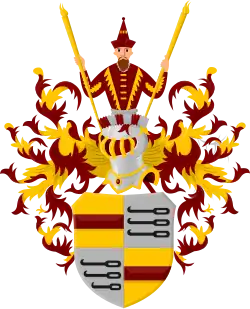 | |
| Country |  Netherlands |
| Parent house | Helmer (paternal) / Van den Anxter (maternal) |
| Titles | jonkheer, ridder |
| Style(s) | heer van Swieten, Engelenburg |
| Founded | 16th century |
| Founder | Dirk Helmer (named 1383/90) |
| Cadet branches | Bicker van Swieten, Bicker Caarten |
Bicker (also: Bicker van Swieten) is a Dutch noble and patrician family.
History
The Bicker family belonged to the patrician class of Amsterdam since 1390. In the 17th century, the Dutch Golden Age, they have played an important role. The family was also known as the Bickerse ligue. Together with the De Graeffs, they led the Dutch States Party and were at the centre of the politics.[1][2] The Bicker-De Graeff clan tried to copy the centralist, autocratic style of government of the Florentine Medici in Amsterdam.[3] Their wealth was based on trading. They focused on Amsterdam's economic boom. Politically, they were opponents of the House of Orange. For nearly half a century, the Bicker family played a leading role in Amsterdam and Dutch politics. Along with several other republican statesmen, the family advocated for the abolition of the stadtholders of the House of Orange-Nassau.[1] The Bickers campaigned for an end to the Eighty Years' War between the United Netherlands and the Kingdom of Spain. This took place in 1648 with the Peace of Münster.[4][5][6]
The Dutch historian and archivist Bas Dudok van Heel about the inppact of the Bicker-De Graeff family clan family and their missed (high) noble rank: In Florence families like Bicker and De Graeff would have been uncrowned princes. Here, in 1815, they should at least have been raised to the rank of count, but the southern Dutch nobility would not have put up with that. What you got here remained nothing half and nothing whole.[7]
Since 1815 the Bicker family belongs to the new Dutch nobility with the honorific of jonkheer.[8]
Notes
- 1 2 "Triumph of Peace". Archived from the original on 2012-03-01. Retrieved 2011-03-18.
- ↑ Biography of Andries Bicker at the dutch DBNL
- ↑ Julia Adams: The familial state: ruling families and merchant capitalism in early modern europe., p 101.
- ↑ Oliver Krause: Die Variabilität frühneuzeitlicher Staatlichkeit. Die niederländische „Staats“-Formierung der Statthaltosen Epoche (1650–1672) als interkontinentales Regiment (Franz Steiner Verlag, Stuttgart 2018)
- ↑ Amsterdam: a brief life of the city. By Geert Mak, Harvill Press (1999), p 123
- ↑ Buitenplaatsen in de Gouden Eeuw: De rijkdom van het buitenleven in de Republik. By Y. Kuiper, Ben Olde Meierink, Elyze Storms-Smeets, p 71 (2015)
- ↑ Geert Mak, Die vielen Leben des Jan Six: Geschichte einer Amsterdamer Dynastie
- ↑ Nederlands adelsboek, p 24
Literature
- Israel, Jonathan I. (1995) The Dutch Republic – Its Rise, Greatness, and Fall – 1477–1806, Clarendon Press, Oxford, ISBN 978-0-19-820734-4
- Rowen, Herbert H. (1986) John de Witt – Statesman of the "True Freedom", Cambridge University Press, ISBN 0-521-52708-2
- Zandvliet, Kees De 250 rijksten van de Gouden Eeuw – Kapitaal, macht, familie en levensstijl (2006 Amsterdam; Nieuw Amsterdam Uitgevers)
- Burke, P. (1994) Venice and Amsterdam. A study of seventeenth-century élites.
Other websites
