Grand Duchy of Tuscany
Grand Duchy of Tuscany | |||||||||||||||||
|---|---|---|---|---|---|---|---|---|---|---|---|---|---|---|---|---|---|
| 1569–1801 1814–1860 | |||||||||||||||||
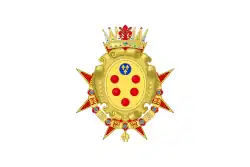  Top: Flag (1532–1737)
Bottom: Flag (1765–1800, 1815–1848, 1849–1860) 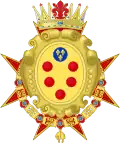 | |||||||||||||||||
| Motto: Sotto una Fede et Legge un Signor solo for Under one Faith and Law one Lord alone | |||||||||||||||||
| Anthem: La Leopolda | |||||||||||||||||
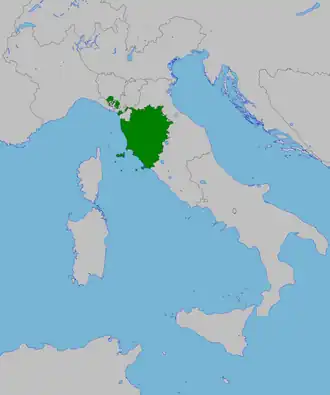 Borders of the Grand Duchy of Tuscany (1815–1847) | |||||||||||||||||
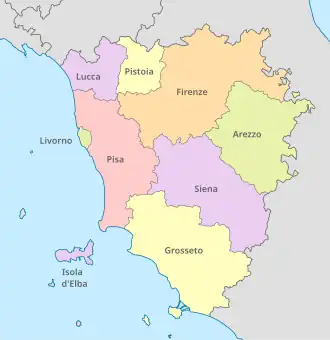 Administrative divisions of the Grand Duchy of Tuscany at the end of 1847 | |||||||||||||||||
| Capital | Florence 43°N 11°E / 43°N 11°E | ||||||||||||||||
| Official languages | Italian | ||||||||||||||||
| Religion | Roman Catholicism (official) | ||||||||||||||||
| Government |
| ||||||||||||||||
| Grand Duke | |||||||||||||||||
• 1569–1574 (first) | Cosimo I | ||||||||||||||||
• 1859–1860 (last) | Ferdinand IV | ||||||||||||||||
| History | |||||||||||||||||
• Cosimo I elevated to Grand Duke | 27 August 1569 | ||||||||||||||||
• End of Medici rule | 9 July 1737 | ||||||||||||||||
| 21 March 1801 | |||||||||||||||||
| 30 May 1814 | |||||||||||||||||
• Deposition of the Grand Duke | 16 August 1859 | ||||||||||||||||
• Merged to form the United Provinces of Central Italy | 8 December 1859 | ||||||||||||||||
• Annexed to Sardinia | 22 March 1860 | ||||||||||||||||
| Area | |||||||||||||||||
• 1852 | 8,381 sq mi (21,710 km2)[2] | ||||||||||||||||
| Population | |||||||||||||||||
• 1801 | 1,096,641[3] | ||||||||||||||||
• 1857 | 1,783,279[4] | ||||||||||||||||
| Currency |
| ||||||||||||||||
| |||||||||||||||||
| Today part of | Italy | ||||||||||||||||
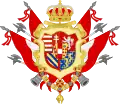

The Grand Duchy of Tuscany (Italian: Granducato di Toscana, Latin: Magnus Ducatus Etruriae) was a monarchy in Tuscany, an area in the north-west of the Italian Peninsula. It existed, with interruptions, from 1569 to 1859. It replaced the Duchy of Florence. It was ruled by the Grand Duke of Tuscany. The capital of the grand duchy was Florence. Until the House of Lorraine took over from the Medici, Tuscany was a state of the Holy Roman Empire until the Peace of Westphalia in 1648. Under the Medici the heir to the grand ducal throne was called the "Grand Prince of Tuscany" whereas the Lorrainers used various titles for the heir apparent.
- ↑ "Statuto del Granducato di Toscana". Archivio delle Costituzioni Storiche (in Italian). Università di Torino: Dipartimento di Scienze Giuridiche. Retrieved 13 March 2026.
Art. 13 –. Al solo Granduca appartiene il potere esecutivo: ... Art. 17 – Il potere legislativo sarà collettivamente esercitato dal Granduca e da due Assemblee deliberanti
(Article 13 - Executive power belongs to the Grand Duke alone: ... Article 17 – Legislative power will be exercised collectively by the Grand Duke and two deliberative Assemblies ...). - ↑ Fisher, Richard S. (1852). The Book of the World. Vol. 2. p. 362.
- ↑ Bowring 1839, p. 6.
- ↑ Ministero di Agricultura, Industria e Commercio (1864). "Censimento degli antichi Stati Sardi e Censimenti Di Lombardia, di Parma e dl Modena" (PDF). Stamperia Reale. p. 177. Retrieved 12 February 2026.