Zenpō-kōen-fun
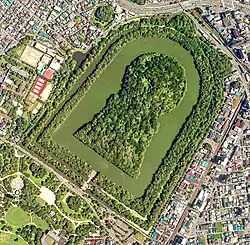
Zenpō-kōen-fun (前方後円墳) are a special kind of Kofun. They are for high status people and very large. They have a round and a rectangular part that together look like a keyhole.[1][2][3][4][5][6][7][8][9][10]
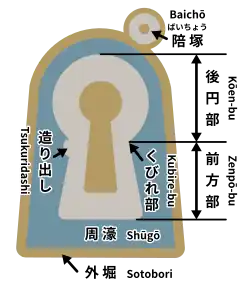
They are sometimes called Keyhole-shaped tumuli,[4] but that term is also used for Zenpō-kōhō-fun.
There are many types of Kofun including Zenpō-kōen-fun and Zenpō-kōhō-fun and Round Kofun and Square Kofun [11]
References
- ↑ https://kimotsuki-town.jp/material/files/group/67/tukazakiannaiban2.pdf
- ↑ "About kofun -Scale and order- | Nonaka Kofun-Project for the Preservation and Utilization of Artifacts from Nonaka Kofun/Osaka University Department of Archaeology". www.let.osaka-u.ac.jp. Retrieved 2025-12-07.
- ↑ Milligan, Mark (2022-01-19). "Satellite imagery reveals new insights into the Kofun keyhole burial mounds". HeritageDaily - Archaeology News. Retrieved 2025-12-07.
- 1 2 "前方後円墳, ぜんぽうこうえんふん, zenpōkōenfun". Nihongo Master. Retrieved 2025-12-07.
- ↑ "Kofun facts for kids". kids.kiddle.co. Retrieved 2025-12-07.
- ↑ Dreamscapes, Japan. "Japan Photo Tour - Kofun Mounds". JAPAN DREAMSCAPES. Retrieved 2025-12-07.
- ↑ "Ancient Japan: Jōmon to Kofun Periods | Art and Architecture in Japan Class Notes". fiveable.me. Retrieved 2025-12-07.
- ↑ "The UNESCO Mozu-Furuichi Tombs - Japan Airlines". jal.japantravel.com. Retrieved 2025-12-07.
- ↑ Sasaki, Kenichi (2017-01-01). "The Kofun era and early state formation". Routledge Handbook of Premodern Japanese History.
- ↑ https://www.researchgate.net/publication/359546920_Japanese_Kofun_in_Maps_given_by_a_Spaceborne_Digital_Elevation_Model_based_on_Multiple_Satellite_Data_Sets
- ↑ "About kofun -Scale and order- | Nonaka Kofun-Project for the Preservation and Utilization of Artifacts from Nonaka Kofun/Osaka University Department of Archaeology". www.let.osaka-u.ac.jp. Retrieved 2025-12-07.