Tenshō (Momoyama period)
Tenshō (天正) was a Japanese era name (年号,, nengō,; lit. "year" name) after Genki and before Bunroku. This period started in July 1573 and ended in December 1592.[1] During this time, the emperors were Ōgimachi-tennō (正親町天皇)[2] and Go-Yōzei-tennō (後陽成天皇).[3]
Events of the Tenshō era
Oda Nobunaga suggested that a new era should begin in 1573.[5] The general meaning of Tenshō was "heavenly righteousness".[6]
- 1573 (Tenshō 1, 7th month): Shogun Ashikaga Yoshiaki became a Buddhist priest.[7]
- 1576 (Tenshō 3, 5th month): Battle of Nagashino.[8]
- 1576 (Tenshō 4): Takeda Katuyori ordered the rebuilding of the Asama Shrine at the base of Mount Fuji in Suruga province.[9]
- 1582 (Tenshō 10): Oda Nobunaga orders the destroyed of structures built by Takeda at the Asama Shrine.[9]
- 1582 (Tenshō 10, 3rd month): Battle of Temmokuzan.[10]
- 20 February 1582 (Tenshō 10, 28th day of the 10th month):A Jesuit missionary and four Japanese Catholic boys went to Rome to see Pope Gregory XIII.[11] This is sometimes called the "Tenshō Embassy".[12] or the "Boys' Mission of the Tenshō Period" (Tenshō Shōnen Shisetsu).[13]
- 1583 (Tenshō 11, 4th month): Battle of Shizugatake.[14]
- 1583 (Tenshō 12, 4th month): Battle of Komaki and Nagakute.[15]
- 1584 (Tenshō 13, 7th month): Toyotomi Hideyoshi is named kampaku by Emperor Ōgimachi.[16]
- 17 December 1586 (Tenshō 14, 7th day of the 11th month): Emperor Ogimachi abdicated;[17] and his grandson received the succession (senso). Soon after, Emperor Go-Yōzei's role as monarch was confirmed (sokui).[17]
- 1586 (Tenshō 14, 12th month): A marriage is arranged between the youngest sister of Hideyoshi and Tokugawa Ieyasu.[17]
- 1586 (Tenshō 14, 12th month): The kampaku, Toyotomi Hideyoshi, was nominated to be Daijō-daijin.[17]
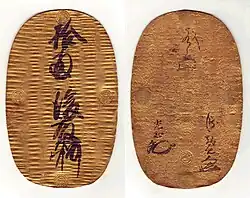
- 1587 (Tenshō 15): Gold or silver coins called Tenshō-tsūhō were minted.[18] The gold coins (Tenshō-ōban) were oval shaped.[1]
In 1589-1590 (in the 23rd year of the reign of King Seonjo of Joseon), a diplomatic mission led by Hwang Yun-gil was sent to Japan.[19] The Joseon ambassador was received by Hideyoshi.[20]
In popular culture
The fictional plot of the classic Akira Kurosawa film The Seven Samurai takes place in the 15th year of Tenshō.[21]
Related pages
References
- 1 2 Nussbaum, Louis-Frédéric (2002). Japan Encyclopedia. Harvard University Press. p. 961. ISBN 978-0-674-01753-5.
- ↑ Nussbaum, Louis-Frédéric (2002). Japan Encyclopedia. Harvard University Press. p. 739. ISBN 978-0-674-01753-5.
- ↑ Nussbaum, Louis-Frédéric (2002). Japan Encyclopedia. Harvard University Press. p. 265. ISBN 978-0-674-01753-5.
- ↑ Andrew Mark Watsky (2004). Chikubushima: Deploying the Sacred Arts in Momoyama Japan. University of Washington Press. p. 24. ISBN 978-0-295-98327-1.
- ↑ Jansen, Marius B. (2002). The Making of Modern Japan. Harvard University Press. p. 14. ISBN 978-0-674-03910-0.
- ↑ Hall, John W.; Hall, John Whitney; Brown, Delmer M.; Jansen, Marius B.; McCullough, William H.; Kanai, Madoka; Shively, Donald H.; Yamamura, Kozo; Duus, Peter (1988). The Cambridge History of Japan. Cambridge University Press. p. 14. ISBN 978-0-521-22355-3.
- ↑ Klaproth, Julius von (1834). Nipon o dai itsi ran: ou Annales des empereurs du Japon. Oriental Translation Fund. p. 389.
- ↑ Klaproth, Julius von (1834). Nipon o dai itsi ran: ou Annales des empereurs du Japon. Oriental Translation Fund. p. 391.
- 1 2 Ponsonby-Fane, Richard. (1962). Studies in Shinto and Shrines, p.462.
- ↑ Klaproth, Julius von (1834). Nipon o dai itsi ran: ou Annales des empereurs du Japon. Oriental Translation Fund. p. 395.
- ↑ Nussbaum, Louis-Frédéric (2002). Japan Encyclopedia. Harvard University Press. p. 446. ISBN 978-0-674-01753-5.
- ↑ McKelway, Matthew P. (2006). Capitalscapes: Folding Screens And Political Imagination in Late Medieval Kyoto. University of Hawaii Press. p. 164. ISBN 978-0-8248-2900-1.
- ↑ Cooper, Michael. "When Four Boys Went to Meet the Pope, 400 Years Ago," Archived 2021-02-27 at the Wayback Machine Japan Times. 21 February 1982; retrieved 2011-12-7.
- ↑ Klaproth, Julius von (1834). Nipon o dai itsi ran: ou Annales des empereurs du Japon. Oriental Translation Fund. p. 398.
- ↑ Klaproth, Julius von (1834). Nipon o dai itsi ran: ou Annales des empereurs du Japon. Oriental Translation Fund. p. 399.
- ↑ Klaproth, Julius von (1834). Nipon o dai itsi ran: ou Annales des empereurs du Japon. Oriental Translation Fund. p. 401.
- 1 2 3 4 Klaproth, Julius von (1834). Nipon o dai itsi ran: ou Annales des empereurs du Japon. Oriental Translation Fund. p. 402.
- ↑ Munro, Neil Gordon (1904). Coins of Japan. Box of curios printing and publishing Company. p. 80.
- ↑ Rutt, Richard et al. (2003). Korea: a Historical and Cultural Dictionary, p. 190.
- ↑ Kang, Etsuko Hae-Jin (1997). Diplomacy and Ideology in Japanese-Korean Relations: From the Fifteenth to the Eighteenth Century. Palgrave Macmillan. p. 275. ISBN 978-0-312-17370-8.
- ↑ Galloway, Patrick (2005). Stray Dogs & Lone Wolves: The Samurai Film Handbook. Stone Bridge Press. p. 71. ISBN 978-1-880656-93-8.
Other websites
- National Diet Library, "The Japanese Calendar" -- historical overview plus illustrative images from library's collection
| Tenshō | 1st | 2nd | 3rd | 4th | 5th | 6th | 7th | 8th | 9th | 10th | 11th | 12th | 13th | 14th | 15th | 16th | 17th | 18th | 19th | 20th |
|---|---|---|---|---|---|---|---|---|---|---|---|---|---|---|---|---|---|---|---|---|
| 1573 | 1574 | 1575 | 1576 | 1577 | 1578 | 1579 | 1580 | 1581 | 1582 | 1583 | 1584 | 1585 | 1586 | 1587 | 1588 | 1589 | 1590 | 1591 | 1592 |
| Preceded by: Genki |
Era or nengō: Tenshō |
Succeeded by: Bunroku |