Tenmei
Tenmei (天明) was a Japanese era name (年号, nengō, lit. year name), also known as Temmei, after An'ei and before Kansei. This period started in April 1781 and ended in January 1789.[1] During this time, the emperor was Kōkaku-tennō (光格天皇).[2]
The nengō Tenmei means "Heavenly Radiance".[3] The kanji means "dawn" or "daybreak".[4]
Events of the Tenmei era
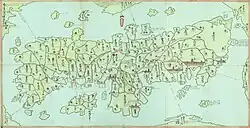
- 1782 (Tenmei 2): Great Tenmei Famine began.[1]
- 1782 (Tenmei 2): The emperor received a written study of silver currency in China and Japan. The work was made by Minamoto no Masatsuna.[5]
- 1783 (Tenmei 3): Mount Asama (浅間山,, Asama-yama) erupted in Shinano Province and loss of life was estimated at 20,000+.[6]
- 1783 (Tenmei 3): Famine was worse; food reserves used up[7]
- 1784 (Tenmei 4): Nationwide events honored Kōbō-Daishi who was the founder of Shingon Buddhism. Kōbō-Daishi died 950 years earlier.[5]
- 1784 (Tenmei 4): The son of Tanuma Okitsugu was assassinated in Edo Castle.[8]
- 17 September 1786 (Tenmei 6, 25th day of the 8th month): Shogun Tokugawa Ieharu died and was buried in Edo.
- 1787 (Tenmei 7): Tokugawa Ienari became the 11th shogun of the Tokugawa shogunate.[9]
- 1787 (Tenmei 7): Matsudaira Sadanobu becomes the shogunate's senior official (rōjū).[10]
- 1787 (Tenmei 7): Kutsuki Masatsuna published Seiyō senpu (Notes on Western Coinage).[11]
- 1788 (Tenmei 7): Riots in rice shops in Edo and Osaka.
- 1788 (Tenmei 8): Great Fire of Kyoto; the Imperial Palace was destroyed.[12]
Related pages
References
- 1 2 Nussbaum, Louis-Frédéric (2002). Japan Encyclopedia. Harvard University Press. p. 956. ISBN 978-0-674-01753-5.
- ↑ Nussbaum, Louis-Frédéric (2002). Japan Encyclopedia. Harvard University Press. p. 546. ISBN 978-0-674-01753-5.
- ↑ Screech, Timon (2000). Shogun's Painted Culture: Fear and Creativity in the Japanese States, 1760-1829. Reaktion Books. p. 100. ISBN 978-1-86189-064-1.
- ↑ Spahn, Mark; Hadamitzky, Wolfgang; Fujie-Winter, Kimiko (1996). 漢字熟語字典. Tuttle Publishing. p. 46. ISBN 978-0-8048-2058-5.
- 1 2 Klaproth, Julius von (1834). Nipon o dai itsi ran: ou Annales des empereurs du Japon. Oriental Translation Fund. p. 420.
- ↑ Screech, (2006), Secret Memoirs of the Shoguns: Isaac Titsingh and Japan, 1779-1822, pp. 146-148; Hall, John Whitney. (1955). Tanuma Okitsugu, 1719-1788: Forerunner of Modern Japan, p. 122.
- ↑ Hall, Tanuma Okitsugu, p. 170.
- ↑ Screech, pp. 148-151, 163-170, 248.
- ↑ Hall, John W.; Hall, John Whitney; Brown, Delmer M.; Jansen, Marius B.; McCullough, William H.; Kanai, Madoka; Shively, Donald H.; Yamamura, Kozo; Duus, Peter (1988). The Cambridge History of Japan. Cambridge University Press. p. 21. ISBN 978-0-521-22355-3.
- ↑ Nussbaum, Louis-Frédéric (2002). Japan Encyclopedia. Harvard University Press. p. 617. ISBN 978-0-674-01753-5.
- ↑ Screech, (2000). Shogun's Painted Culture: Fear and Creativity in the Japanese States, 1760-1829, pp. 123, 125; See -- online image of 2 adjacent pages from library collection of Kyoto University of Foreign Studies and Kyoto Junior College of Foreign Languages
- ↑ Ropke, Ian Martin (1999). Historical Dictionary of Osaka and Kyoto. Scarecrow Press. p. 118. ISBN 978-0-8108-3622-8.
Other websites
- National Diet Library, "The Japanese Calendar" -- historical overview plus illustrative images from library's collection
| Tenmei | 1st | 2nd | 3rd | 4th | 5th | 6th | 7th | 8th | 9th |
|---|---|---|---|---|---|---|---|---|---|
| 1781 | 1782 | 1783 | 1784 | 1785 | 1786 | 1787 | 1788 |
| Preceded by: An'ei |
Era or nengō: Tenmei |
Succeeded by: Kansei |