Society of Women Engineers
| Formation | May 27, 1950 |
|---|---|
| Type | Engineering Society |
| Headquarters | Chicago, Illinois |
Region served | International |
| Website | swe |
The Society of Women Engineers (SWE) is a worldwide group that helps and teaches women in engineering and technology. It started in 1950 and is based in the United States.[1] SWE supports women in these fields and has more than 47,000 members. These members are part of about 100 professional groups, 300 college groups, and 60 groups in other countries.
Beginnings
The SWE archives have old letters from Elsie Eaves that show how SWE began. In 1919, some women at the University of Colorado started a small group called the American Society of Women Engineers and Architects.[2] This group was only known on their campus but helped start the idea for SWE.[3] Some women in this group were Lou Alta Melton, Hilda Counts, and Elsie Eaves. They wrote letters to engineering schools across the country asking about women students and graduates in engineering.[4] They got answers from 139 women at 23 universities.[5] Some schools said they did not allow women in their engineering programs. For example, a professor at the University of North Carolina said they had never had women students in engineering and did not expect to have any soon.[6]
Some schools were okay with women in engineering but did not support a separate group for women. However, the Dean at North Carolina State University, Blake R Van Leer, supported women joining engineering. He encouraged Katharine Stinson, who later became SWE president, to join, and his daughter Maryly started a SWE branch.[7][8]
Many women who answered the letters liked the idea of a group for women engineers. Alice Goff from Michigan said such a group would help all women, especially those new to the job.[6] In Michigan, women started a group called the T-Square Society in 1914. It was a place where women could work together and share ideas safely, but it was not clear if it was a business or social group.[9]
History
The Society of Women Engineers (SWE) officially started in 1950, but its beginnings go back to the late 1940s. During World War II, many men were away fighting, so women had more chances to work in engineering. Female student groups at Drexel Institute of Technology in Philadelphia, and at Cooper Union and City College of New York, began meeting and making connections. On April 3, 1949, seventy students from 19 universities met at Drexel to start organizing.[10] Maryly Van Leer Peck, the national vice president, and her mother Ella Lillian Wall Van Leer, a women’s rights activist, helped a lot. They opened one of the first SWE branches at Georgia Tech after Maryly’s father, Blake R Van Leer, worked to allow women to attend. Blake also encouraged many women to join his engineering program at NC State. The Van Leer family supported SWE throughout their lives.[11][12][13]
On May 27–28, 1950, about fifty women from the four original SWE districts — New York City, Philadelphia, Washington, D.C., and Boston — met for the first national meeting in New Jersey.[14][15] They chose Beatrice Hicks as the first SWE president. The first official annual meeting was held in 1951 in New York City.[16]
In 1957, when the USSR launched Sputnik, interest in technology grew. Many engineering schools started accepting women. SWE’s membership doubled to 1,200, and the group moved its headquarters to New York City.
In the next ten years, more young women became engineers, but few reached management jobs. [17] SWE started special meetings called the Henniker Conferences to talk about women’s place in engineering. In 1973, SWE made an agreement with the National Society of Professional Engineers to get more women and students involved.
At the same time, SWE joined the larger women’s movement. In 1972, SWE and other women’s science and tech groups met to form an alliance for fairness in science and engineering. This meeting helped start the Business and Professional Women’s Foundation.[18] In 1973, SWE supported the Equal Rights Amendment (ERA), which aimed to give equal rights to women. SWE also decided not to hold meetings in states that did not approve the ERA. The ERA was first suggested in the 1920s but still has not been approved.
By 1982, SWE had 13,000 members in 250 groups across the U.S. The group’s leadership grew so big that SWE created a regional plan to better connect leaders and members. Today, SWE has over 47,000 student and professional members and continues as a nonprofit group that supports women in engineering.
SWE exists because there are still fewer women in engineering compared to men. The group encourages female students and promotes engineering as a good career for women. Engineering is mostly male because of social ideas about gender. Theories like the STEM pipeline study why some science and engineering fields have more men or women. The Van Leer family still supports SWE today.[19][13][20]
Mission
The Society of Women Engineers (SWE) wants to help women reach their full potential as engineers and leaders. SWE also works to show that engineering and technology help improve life and that diversity and inclusion are important.[21] The group welcomes people of all genders and backgrounds to support diversity.[22]
SWE gives many scholarships every year to women studying science, technology, engineering, and math (STEM) in college and graduate school.[23] In 2019, SWE gave out about 260 scholarships worth more than $810,000.[24] Because SWE is a nonprofit, these scholarships come from donations and support from companies. SWE’s CEO, Karen Horting,[25] said the scholarships are possible thanks to generous donors and partners. She hopes to grow the program to help more students studying engineering and technology.[26]
Archives
When SWE was starting, the organizers collected a lot of information and created archives. A group to manage these archives was formed in 1953. The archives officially began in 1957 and are kept at the Walter P. Reuther Library at Wayne State University in Detroit, Michigan.[27] The archives include information about an early group of women architects and engineers from 1920. They also tell the story of SWE’s history and women’s roles in engineering. These records show that many women helped with important projects like the Space Race, which is often seen as mostly men’s work.[28] In 1993, SWE made the Walter P. Reuther Library its official place for historical materials.
In Houston, the Houston Area Section of SWE has its own collection of letters, records, photos, and publications. These are kept in the Carey C. Shuart Women’s Archive and Research Collection.[29]
Current Work

The Society of Women Engineers (SWE) helps women at all stages, from young students in kindergarten through high school, to college students, and working professionals. SWE has programs that help college and professional members connect with their local communities.
Conferences
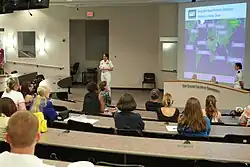
SWE is organized both locally and nationally. SWE holds yearly regional events called We Local in many places around the world. These events bring together members at different career levels and are similar to the big annual conference. SWE also hosts one large annual conference in a different city each year. In 2024, more than 20,000 people attended the three-day conference, making it the biggest event of its kind.[30] The conference includes workshops for professional growth, inspiring speakers, and a career fair.
Outreach
Every year, SWE groups worldwide hold events to help girls in primary and secondary school learn about engineering as a possible career. In 2022, SWE held over 200 outreach events that reached more than 10,000 girls.[31] SWE also supports SWENext, a program for students aged 5 to 18 to join the SWE community. SWENext runs many events, including the Invent It. Build It. competition at the annual conference. In 2018, SWE started a podcast series called SWE’s Diverse Podcasts, which talks about women in engineering and technology.[32]
SWE Achievement Award
In 1952, the Society of Women Engineers gave its first and highest honor, the Achievement Award, to Dr. Mária Telkes. She received it for her important work using solar energy. Since then, the Achievement Award has been given every year to a woman engineer who has made great contributions in any area of engineering over a long time.[33]
- 1952 - Mária Telkes
- 1953 - Elsie Gregory MacGill
- 1954 - Edith Clarke
- 1955 - Margaret H. Hutchinson Rousseau
- 1956 - Elise Harmon
- 1957 - Rebecca Sparling
- 1958 - Mabel MacFerran Rockwell
- 1959 - Désirée Le Beau
- 1960 - Esther M. Conwell
- 1961 - Laurel van der Wal
- 1962 - Laurence Delisle Pellier
- 1963 - Beatrice Hicks
- 1964 - Grace Murray Hopper
- 1965 - Martha J. B. Thomas
- 1966 - Dorothy Martin Simon
- 1967 - Marguerite Rogers
- 1968 - Isabella Karle
- 1969 - Alice Stoll
- 1970 - Irmgard Flugge-Lotz
- 1971 - Alva T. Matthews
- 1972 - Nancy Fitzroy
- 1973 - Irene Peden
- 1974 - Barbara Crawford Johnson
- 1975 - Sheila Widnall
- 1976 - Ada Pressman
- 1977 - Mildred Dresselhaus
- 1978 - Giuliana Cavaglieri Tesoro
- 1979 - Jessie G. Cambra
- 1980 - Carolyn M. Preece
- 1981 - Thelma Estrin
- 1982 - Harriett B. Rigas
- 1983 - Joan Berkowitz
- 1984 - Geraldine Cox
- 1985 - Y.C.L. Susan Wu
- 1986 - Yvonne Brill
- 1987 - Nance K. Dicciani
- 1988 - Roberta Nichols
- 1989 - Doris Kuhlmann-Wilsdorf
- 1990 - Lynn Conway
- 1991 - Julia Weertman
- 1992 - Evangelia Micheli-Tzanakou
- 1993 - Elsa Reichmanis
- 1994 - Elsa Garmire
- 1995 - Manijeh Razeghi
- 1996 - Barbara Liskov
- 1997 - Ilene Busch-Vishniac
- 1998 - Lisa C. Klein
- 1999 - Shirley E. Schwartz
- 2000 - F. Suzanne Jenniches
- 2001 - Judith A. Clapp
- 2002 - Ümit Özkan
- 2003 - Mitra Dutta
- 2004 - Kristina M. Johnson
- 2005 - Bonnie J. Dunbar
- 2006 - Elaine S. Oran
- 2007 - Pamela Kay Strong
- 2008 - Melanie Cole
- 2009 - Aslaug Haraldsdottir
- 2010 - Chieko Asakawa
- 2011 - Cristina Amon
- 2012 - Yildiz Bayazitoglu
- 2013 - Eve Sprunt
- 2014 - Frances Hurwitz
- 2015 - Naira Hovakimyan
- 2016 - Stephanie Watts Butler
- 2017 - Frances H. Arnold
- 2018 - Jacqueline Chen
- 2019 - Not Awarded
- 2020 - Jayshree Seth
- 2021 - Qian Lin
- 2022 - Tina M. Nenoff
- 2023 - Thea Feyereisen
- 2024 - Lori Zipes
- 2025 - Priti Wanjara
Publications
In 1951, just one year after SWE started, the society began publishing the Journal of the Society of Women Engineers. This journal had technical articles and news about the society. In 1954, the journal was replaced by the SWE Newsletter, a magazine that mainly shared news about SWE and the engineering industry. In 1980, the magazine’s name changed to US Woman Engineer. Then in 1993, the name changed again to SWE, which is still the name today. The full title is 'SWE, magazine of the Society of Women Engineers.[34]
In 2011, SWE published the fifth volume of the magazine to celebrate its 60th anniversary. This issue looked more closely at SWE’s history using old records. Today, SWE Magazine is published five times a year.[35]
Past presidents
- 1950–1952, Beatrice Hicks[36]
- 1952–1953, Lillian Murad
- 1953–1955, Katharine Stinson
- 1955–1956, Lois Graham
- 1956–1958, Miriam Gerla
- 1958–1961, Catherine Eiden
- 1961–1963, Patricia Brown
- 1963–1964, Aileen Cavanagh
- 1964–1966, Isabelle French
- 1966–1968, Alice Martin
- 1968–1970, Lydia Pickup
- 1970–1974, Olive Salembier
- 1972–1974, Naomi McAfee
- 1974–1976, Carolyn Phillips
- 1976–1978, Lt. Col. Arminta Harness
- 1978–1979, Paula Loring (now Simon)
- 1979–1980, Ada Pressman
- 1980–1981, Sharon Loeffler
- 1981–1982, Helen Grenga
- 1982–1983, Evelyn Murray-Lenthall
- 1983–1984, Barbara Wollmershauser
- 1984–1985, Sharon Lindquist-Skelley
- 1985–1986, Susan Whatley
- 1986–1987, Bette A. Krenzer
- 1987–1988, Kathleen Harer
- 1988–1989, Suzanne Jenniches
- 1989–1990, Glynis Hinschberger
- 1990–1991, Margaret Hickel
- 1991–1992, Jill Baylor now Jill Tietjen
- 1992–1993, Anna Salguero
- 1993–1994, Kathryn Cunningham
- 1994–1995, Jaclyn Spear
- 1995–1996, Ruthann Omer
- 1996–1997, Margaret Layne
- 1997–1998, Gloria Montano
- 1998–1999, Roberta Banaszak Gleiter
- 1999–2000, Sherita T. Ceasar
- 2000–2001, Gail G. Mattson
- 2001–2002, Shelley A. M. Wolff
- 2002–2003, Rachel A. B. McQuillen
- 2003–2004, Alma Martinez Fallon
- 2004–2005, Violettee V. Brown
- 2005–2006, Ronna F. Robertson
- 2006–2007, Jude A. Garzolini
- 2007–2008, Michelle Tortolani
- 2008–2009, Virginia Counts
- 2009–2010, Nora Lin
- 2010–2011, Siddika Demir
- 2011–2012, Melissa Tata
- 2012–2013, Alyse Stofer
- 2013–2014, Stacey DelVecchio
- 2014–2015, Elizabeth Bierman
- 2015–2016, Colleen Layman (now Scholl)
- 2016–2017, Jessica Rannow
- 2017–2018, Jonna Gerken
- 2018–2019, Cindy Hoover[37]
- 2019-2020, Penny Wirsing
- 2020-2021, Heather Doty
- 2021-2022, Rachel Morford
- 2022-2023 Dayna Johnson
- 2023-2024 Alexis McKittrick[38]
- 2023-2024 Karen Roth
- 2024-2025 Inaas Darrat
Notable historical members
- Joy Lim Arthur[39]
- Mary Blade
- Yvonne Clark
- Lois Cooper
- Hilda Counts
- Elsie Eaves
- Margaret R. Fox
- Lillian Moller Gilbreth (First Honorary Member)[40]
- Isabel Hardwich
- Judith Arlene Resnik
- Harriett B. Rigas
- Ruth Schnapp
- Ruth Shafer
- Dorothy Martin Simon
- Cicely Thompson
- Maryly Van Leer Peck
- Olwen Wooster[41]
References
- ↑ "Society of Women Engineers". Society of Women Engineers. Retrieved 2020-03-29.
- ↑ "Collection: American Society of Women Engineers and Architects Records | ArchivesSpace@Wayne". archives.wayne.edu. Archived from the original on 2023-04-16. Retrieved 2022-04-09.
- ↑ Bix, Amy Sue (2013). Girls coming to tech! : a history of American engineering education for women. Cambridge, Massachusetts. ISBN 9781461957249. OCLC 869736038.
{{cite book}}: CS1 maint: location missing publisher (link) - ↑ LaFrance, Adrienne (2017-05-23). "Historic Rejection Letters to Women Engineers". The Atlantic. Retrieved 2019-09-14.
- ↑ Hahn, Laura D. (2018). Women and Ideas in Engineering : Twelve Stories from Illinois. Wolters, Angela S. Champaign: University of Illinois Press. ISBN 978-0252050671. OCLC 1048922881.
- 1 2 Kindya, Marta Navia (6 August 1990). "Four decades of the Society of Women Engineers". Society of Women Engineers. Retrieved 6 August 2018 – via Amazon.
- ↑ "Defense demands women engineers". thejohnsonian. 1942-03-20.
- ↑ "Guide to the North Carolina State University College of Engineering Annual Reports". NCSU. Archived from the original on 2014-04-25. Retrieved 2009-06-11.
- ↑ Oldenziel, Ruth (1997). "Decoding the silence: Women engineers and male culture in the U.S., 1878–1951". History and Technology. 14 (1–2): 65–95. doi:10.1080/07341519708581922.
- ↑ "Women Students Form a Society of Engineers". New York Herald Tribune. Apr 4, 1949.
- ↑ "The Bonham Daily Favorite (Bonham, Tex.), ed. 1 Sunday, September 16, 1962". 16 September 1962.
- ↑ Girls Coming to Tech. MIT Press. January 14, 2014. ISBN 9780262320276. Retrieved January 14, 2014.
- 1 2 "Oral-History:Maryly van Leer Peck". 10 June 2016.
- ↑ "First Ladies". SWE Philadelphia Section. Archived from the original on 6 August 2019. Retrieved 2020-03-20.
- ↑ Evans, Phyllis (28 May 1950). "Minutes, Society of Women Engineers, Green Engineering Camp, Ringwood, N.J., 28 May 1950, Box 1, Folder 2, Society of Women Engineers National Records, Walter P. Reuther Library and Archives of Labor and Urban Affairs, Wayne State University, Detroit, Michigan". Society of Women Engineers. Archived from the original on 20 March 2020. Retrieved 20 March 2020.
The meeting was called to order by the president Phyllis Evans. The meeting was a continuation of the meeting held on May 27th, 1950. [...]a motion was made and passed to make Dr. Gilbreth an honorary member.
- ↑ "Commemorating SWE Founders Day". All Together. 2016-05-25. Retrieved 2018-01-10.
- ↑ Cole, Sandford S. (August 19–24, 1973) [31 July 1973]. Fitzroy, Nancy D. (ed.). "Career Guidance for Women Entering Engineering". Proceedings of an Engineering Foundation Conference (New England College, Henniker, New Hampshire). Retrieved 6 August 2018.
- ↑ "Timeline & Historical Docs". Business and Professional Women's Foundation. Archived from the original on 2018-04-08. Retrieved 26 March 2020.
- ↑ "Blake van Leer to Speak at the Miami eCommerce Summit".
- ↑ "Blake van Leer to Speak at the Miami eCommerce Summit | MarTech Cube". 27 June 2022. Archived from the original on 9 March 2026. Retrieved 30 April 2026.
- ↑ "About SWE - Society of Women Engineers". societyofwomenengineers.swe.org. Retrieved 25 August 2020.
- ↑ "Women engineer future through SWE". news.mit.edu. 16 February 2006. Retrieved 2016-09-27.
- ↑ "SWE Scholarship Deadline: May 1 for Incoming Freshmen". All Together. 2018-04-24. Retrieved 2019-09-14.
- ↑ "Scholarships | Society of Women Engineers". societyofwomenengineers.swe.org. 22 May 2019. Retrieved 2020-08-25.
- ↑ "Karen Horting CAE, Executive Director & CEO - Society of Women Engineers". swe.org. Archived from the original on 2020-08-06.
- ↑ UGC, Chicago Tribune. "The Society of Women Engineers Awards Record Value in Scholarships To-Date". Chicago Tribune. Retrieved 2016-10-05.
- ↑ "Anniversaries and Archives: SWE Collection Plays Central Role in 60th Celebration" (PDF). Walter P. Reuther Library Newsletter. 14: 4. Fall 2010.
In 2009, SWE Archivist Troy Eller developed the SWE Grassroots Oral History Project to continue gathering stories from women engineers around the country.
- ↑ Eller, Troy (Aug 15, 2012). "Publicity, Recruitment, and History: Society of Women Engineers". Centaurus. 54 (4): 299–304. doi:10.1111/j.1600-0498.2012.00275.x.
- ↑ "Finding Aids | University of Houston Libraries". Archived from the original on 2017-03-08. Retrieved 2026-04-30.
- ↑ "Conferences | Society of Women Engineers". societyofwomenengineers.swe.org. Archived from the original on 2018-11-23. Retrieved 2018-01-27.
- ↑ "Outreach Assessment - Society of Women Engineers". 2018-12-12. Archived from the original on 2023-10-13. Retrieved 2024-05-25.
- ↑ "Listen to Your Friends and Colleagues in SWE Podcasts". SWE. 25 January 2018. Retrieved 25 June 2023.
- ↑ "SWE Achievement Award Recipients". Engineering and Technology History Wiki (ETHW). 2022-12-15. Retrieved 2023-01-09.
- ↑ "SWE Magazine". Society of Women Engineers. Archived from the original on 1 July 2014. Retrieved 28 July 2014.
- ↑ "Past Issues". Society of Women Engineers - Magazine. Retrieved 2023-10-25.
- ↑ "SWE's Past Presidents". Society of Women Engineers. Archived from the original on 2020-06-28. Retrieved 2020-06-28.
- ↑ "Board of Directors, President". Society of Women Engineers. Archived from the original on 2020-03-29. Retrieved 2020-03-29.
- ↑ "Alexis McKittrick: Ph.D. Engineer Leading the Society of Women Engineers". 24 May 2021. Archived from the original on 26 May 2024. Retrieved 30 April 2026.
- ↑ "Joy and Paul Arthur create endowment for engineers" (PDF). NMSU. Archived from the original (PDF) on 2018-12-24.
- ↑ "The SWE Story... timeline of achievement". Society of Women Engineers. December 18, 2018. Archived from the original on April 7, 2022. Retrieved April 30, 2026.
- ↑ Eather, Steve, "Wooster, Olwen Abigail (1917–1981)", Australian Dictionary of Biography, Canberra: National Centre of Biography, Australian National University, retrieved 2021-10-12