Mária Telkes
Mária Telkes | |
|---|---|
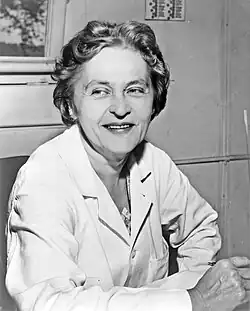 Telkes in 1956 | |
| Born | 12 December 1900 |
| Died | 2 December 1995 (aged 94) Budapest, Hungary |
| Other names | Sun Queen |
| Alma mater | University of Budapest, Ph.D. Physical Chemistry |
| Known for | Solar Energy Technologies |
| Board member of | Solar Energy Society |
| Awards | National Inventors Hall of Fame, Society of Women Engineers Achievement Award, National Academy of Sciences, Building Research Advisory Board Award |
| Engineering career | |
| Discipline | Physics, Thermoelectricity |
| Institutions | Cleveland Clinic Foundation, Westinghouse, Massachusetts Institute of Technology, New York University, University of Delaware |
| Projects | Water-powered Desalination machines, Dover Sun House, Solar powered oven |
| Significant advance | Solar heating, cooling, and thermal storage systems (several patents) |
Mária Telkes (December 12, 1900 – December 2, 1995) was an Hungarian-American biophysicist, engineer, and inventor. She worked with solar energy.[1]
She moved to the United States in 1925 to work as a scientist. She became an American citizen in 1937. In 1939, she started working at the Massachusetts Institute of Technology (MIT) to find useful ways to use solar energy.[1]
During World War II, she made a solar water distillation device to make water drinkable. This device helped save the lives of pilots and sailors who were in trouble at sea.[1][2][3] She wanted to make a version for poor people living in dry areas.[4] Her coworkers called her The Sun Queen.[5][6] She is known as one of the first people to make solar energy storage systems. After the war, she became a research professor at MIT.
In the 1940s, she worked with architect Eleanor Raymond to build one of the first houses heated by the sun, called the Dover Sun House.[7][8] It stored energy every day. In 1953, they made a solar oven that people, even children, could use in different parts of the world.[8]
In 1952, Telkes was the first person to win the Society of Women Engineers Achievement Award. She also received a lifetime achievement award from the National Academy of Sciences and a Building Research Advisory Board Award in 1977.[2] She had more than 20 patents for her inventions.[9][7]
References
- 1 2 3 "NIHF Inductee Maria Telkes Invented Solar Power Storage". www.invent.org. Retrieved 2022-12-06.
- 1 2 "Mária Telkes | American physical chemist and biophysicist | Britannica". www.britannica.com. Retrieved 2022-12-06.
- ↑ Rinde, Meir (July 14, 2020). "The Sun Queen and the Skeptic: Building the World's First Solar Houses". Distillations. Retrieved 5 July 2021.
- ↑ Saxon, Wolfgang (1996-08-13). "Maria Telkes, 95, an Innovator Of Varied Uses for Solar Power". The New York Times. ISSN 0362-4331. Retrieved 2022-12-06.
- ↑ "How Mária Telkes Became 'The Sun Queen' | National Inventors Hall of Fame". www.invent.org. Retrieved 14 March 2022.
- ↑ Oakes, Elizabeth H. (2007). "Maria Telkes". Encyclopedia of World Scientists. Infobase Publishing. p. 714. ISBN 978-1-4381-1882-6.
- 1 2 "Maria Telkes | Lemelson-MIT Program". lemelson.mit.edu. Retrieved 2019-04-03.
- 1 2 "Maria Telkes | Lemelson". lemelson.mit.edu. Retrieved 2022-12-06.
- ↑ Weerts, Gwen (1 July 2021). "Mária Telkes: All hail the Sun Queen". SPIE - The International Society of Optics and Photonics. Retrieved 14 March 2022.