Rook (chess)
| Chess pieces | ||
|---|---|---|
 |
King |  |
 |
Queen |  |
 |
Rook |  |
 |
Bishop |  |
 |
Knight |  |
 |
Pawn |  |
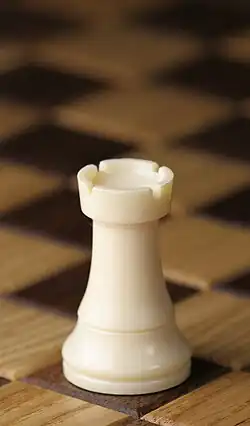
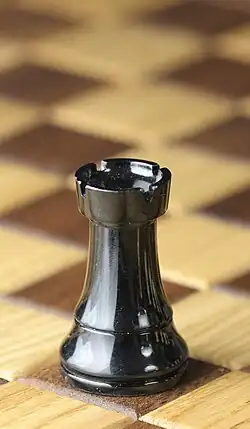
A rook (from Persian رخ rokh) is a piece in the board game of chess. It gets its name from its name in the old Indo-Persian game (see History of chess). Each player starts the game with two rooks. When recording games, it is shortened to R, and when printed a figurine is used.
Starting place and moving
| a | b | c | d | e | f | g | h | ||
| 8 | 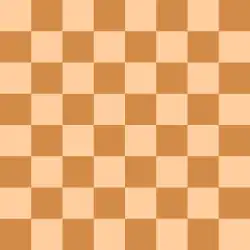    | 8 | |||||||
| 7 | 7 | ||||||||
| 6 | 6 | ||||||||
| 5 | 5 | ||||||||
| 4 | 4 | ||||||||
| 3 | 3 | ||||||||
| 2 | 2 | ||||||||
| 1 | 1 | ||||||||
| a | b | c | d | e | f | g | h | ||
In chess notation, the white rooks start on the a1 and h1 squares, and the black rooks start on the a8 and h8 squares.
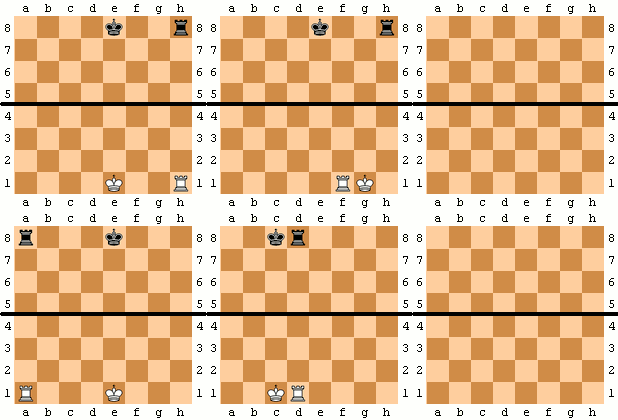
The rook moves forward or back on the files through any number of squares without other pieces on them, and sideways on the ranks. This is shown in the diagram below. Like other pieces, it captures by going into the square on which an enemy piece stands.
The rook and king also take part in a special move called castling.
Use in a game
A rook is a strong long-range piece. It is often given a value of about five pawns. This makes it stronger than a bishop or knight, but weaker than a queen. Rooks are usually strongest when they have open ranks or files. They often become more useful in the endgame, when there are fewer pieces to block them.[1]
References
- ↑ "All the Names of Chess Pieces and Their Moves You Should Know". Debsie. Retrieved 10 June 2026.