Queen (chess)
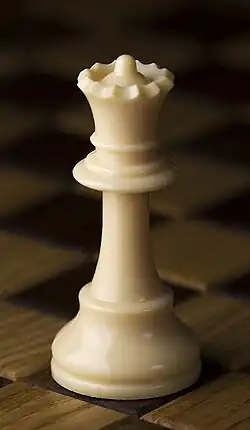
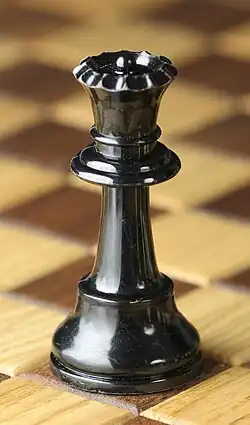
| Chess pieces | ||
|---|---|---|
 |
King |  |
 |
Queen |  |
 |
Rook |  |
 |
Bishop |  |
 |
Knight |  |
 |
Pawn |  |
The queen is a chess piece that stands next to the king at the start of a game.The queen starts on the d1 square for white and the d8 square for black. It can move any number of unoccupied squares diagonally, vertically, or horizontally. When recording games, it is shortened to Q.
The queen's movement
| 8 |          | |||||||
| 7 | ||||||||
| 6 | ||||||||
| 5 | ||||||||
| 4 | ||||||||
| 3 | ||||||||
| 2 | ||||||||
| 1 | ||||||||
| a | b | c | d | e | f | g | h | |
The queen moves like both the bishop and rook. Both players start with one queen. A player may promote a pawn to a queen when the pawn reaches the end of the board.
History of the queen in chess
The Indo-Persian game lasted for nearly a thousand years, until the end of the 15th century. In it, the piece next to the Shah was the Firzān or Visier, who was a counsellor. This piece had a movement even more limited than the king. It moved just one square at a time, on the diagonal. Not surprising, then, that when the move changed into its modern form, the Italians called the new game schacci alla rabioso (~furious chess).[1][2]