Prefixes in trivial names
Trivial names are names for chemicals that are separate from the rules of systematic names. There are still many prefixes in trivial names with shared meanings. These prefixes are normally used for small alkanes and their simple derivatives. Many isomers of larger alkanes do not have trivial names.
Alkanes
n-
 | 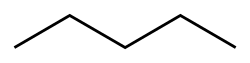 | 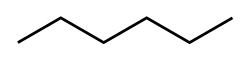 |
| n-Butane | n-Pentane | n-Hexane |
The italic, lower case letter n is used as a hyphenated prefix which is read as "normal". The n- prefix usually means the isomer of a compound where the carbon atoms are in a long straight line.
In IUPAC names, the n- prefix is deleted and the name of the alkane is used to mean the straight chain isomer specifically.
Iso-
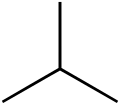 | 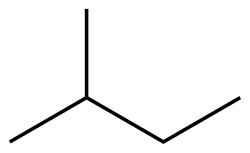 | 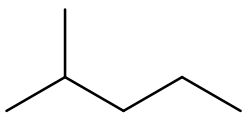 |
| Isobutane | Isopentane | Isohexane (2-Methylpentane) |
In the most general sense, the prefix "iso-" means something that is an isomer of the n- compound. It is more specifically used to mean the isomer of the n-alkane where there is a single methyl group branching off the tail end of the chain.
Isooctane is a notable exception to the "iso" pattern. The pattern would give the name to 2-methylheptane, but the name is actually used for 2,2,4-trimethylpentane. This compound is important because it is used to define the octane rating scale.
Isoprene is another exception: the reason for this name is unknown, but it probably came from "iso-" and propylene. A correct name using this prefix would be "isopentadiene".
The names isobutane and isopentane were retained by IUPAC until 2013. IUPAC no longer recommends using any of the "iso-" names except for isoprene.[1]
Neo-
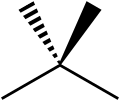 | 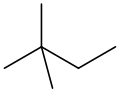 | 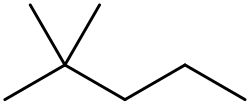 |
| Neopentane | Neohexane (2,2-Dimethylbutane) | Neoheptane (2,2-Dimethylpentane) |
The prefix "neo-" was used to indicate the isomer of pentane with a quaternary carbon. More generally, the "neo-" prefix means a carbon chain that ends with a quaternary carbon.
Neopentane was retained by IUPAC until 2013. IUPAC now recommends systematic names for all branched hydrocarbons.[1]
Alkyl groups and derivatives with one functional group
The names for alkyl groups follow similar rules, but also need to consider positional isomers where the group has the same skeletal formula but has the subsituent on a different atom. This adds a large number of possible isomers, only very small alkanes - propane through pentane - have common names for all their derived alkyl groups.
Only two trivial names for alkyl groups, isopropyl and tert-butyl, are retained by IUPAC.[2] Other butyl and pentyl group trivial names were accepted until 2013, but systematic names are now preferred.[3]
n- and sec- groups
The prefixes n- and sec- are for compounds derived from the n- isomer of the parent hydrocarbon. n-, read as "normal", has the substituent on the end of the chain. sec- has the substituent one step away from the end.
iso- and tert- groups
The prefixes iso- and tert- are for compounds derived from the iso isomer of the parent hydrocarbon. An iso- group has the substituent at the far end of the carbon chain from the branch, and a tert- group has the substituent at the same carbon atom as the branch (a tertiary carbon).
Propane does not have isomers, so the isopropyl group is derived from the linear group. It follows the pattern of other iso- groups, but the length of the carbon chain away from the branch is zero.
neo- group
The neo- prefix is used like iso-, where the substituent is at the far end of the carbon chain from a quaternary carbon atom.
Sources
- 1 2 IUPAC Chemical Nomenclature and Structure Representation Division (2013). "P-61.2.1". In Favre, Henri A.; Powell, Warren H. (eds.). Nomenclature of Organic Chemistry: IUPAC Recommendations and Preferred Names 2013. IUPAC–RSC. ISBN 978-0-85404-182-4.
- ↑ IUPAC Chemical Nomenclature and Structure Representation Division (2013). "P-29.6". In Favre, Henri A.; Powell, Warren H. (eds.). Nomenclature of Organic Chemistry: IUPAC Recommendations and Preferred Names 2013. IUPAC–RSC. ISBN 978-0-85404-182-4.
- ↑ IUPAC Chemical Nomenclature and Structure Representation Division (2013). "P-29.6.3". In Favre, Henri A.; Powell, Warren H. (eds.). Nomenclature of Organic Chemistry: IUPAC Recommendations and Preferred Names 2013. IUPAC–RSC. ISBN 978-0-85404-182-4.