Pleistocene
- "The Ice Age" redirects here. For other uses, see Ice Age (disambiguation).
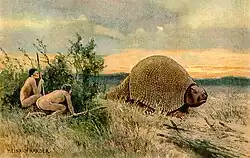
The Pleistocene stage or epoch was a long period of time. It stretched from 2.58 million years ago to 11,700 years ago.[1] It is the first epoch of the Quaternary period and the sixth in the Cainozoic. It came after the Pliocene epoch, and before the modern-day Holocene.
Ice ages
The Pleistocene was a time of ice ages: cold glacial periods with shorter, warmer, interglacials. During these ice ages, the world became much colder for a long time.
For much of the 20th century, geologists believed there were four "major" ice ages. Nowadays scientists think there were at least five.[2]
During these glaciations, much of the world we know was covered by ice: North America down to and past the Great Lakes; all of northern Russia and Europe; and England down to the Thames.
Animals
Many animals that lived during the Pleistocene have become extinct because of climate change and hunting by humans.[3]
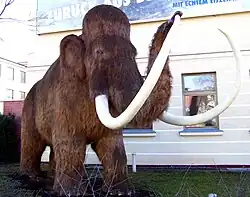
Many Pleistocene mammals were larger, cold-adapted versions of animals that live now. Mammoths were a species of elephant in the ice age. Their popular name of woolly mammoth suggests the long hair which was an adaptation to the cold.
Ancient humans
Ancient human species lived during the Pleistocene. In Europe and Asia the large-brained Neanderthal (Homo neanderthalensis) lived until about 30,000 years ago. Modern man did not descend from Neanderthals, but originated in Africa from another branch of the genus Homo.[4]
Related pages
- Ice age
- Global warming
- Human evolution
- Human timeline
- Palaeolithic
References
- ↑ International Commission on Stratigraphy (ICS). ICS geologic time scale
- ↑ "Glad You Asked: Ice Ages – What are they and what causes them?". Utah Geological Survey. 2010-09-01. Retrieved 2025-12-15.
- ↑ Martin P.S. and Klein R.G. eds 1984. Quaternary extinctions: a prehistoric revolution. Arizona, Tucson AZ.
- ↑ Klein, Richard G. 2009. The human career: human biological and cultural origins. 3rd ed, Chicago.
